
How Step-by-Step Solving Can Improve Your Math Scores (Without Extra Tuition)
Master math with guided problem-solving techniques
Discover how step-by-step problem-solving can enhance understanding and accuracy in math, leading to better scores without extra tuition.

Gaurav Parashar
@gauravparashar
Listen to this article
How Step-by-Step Solving Can Improve Your Math Scores (Without Extra Tuition)
Mathematics is often seen as a challenging subject by students across various grades, especially in the CBSE and NCERT curriculum. Many students find themselves losing marks in exams despite having practiced extensively. This blog explores how adopting a step-by-step approach to problem-solving can significantly enhance students' accuracy and understanding of mathematical concepts, ultimately leading to improved scores without the need for extra tuition.
Why Students Lose Marks Even After Practice
One of the most frustrating experiences for students is to put in hours of practice only to find that their exam scores do not reflect their efforts. This discrepancy often arises from a few common pitfalls:
Misunderstanding Concepts: Students may practice problems but fail to grasp the underlying concepts. This can lead to errors when faced with variations of problems in exams.
Rushing Through Problems: In an attempt to complete the exam quickly, students may skip essential steps or make careless mistakes.
Lack of Attention to Detail: Small arithmetic errors or misreading questions can cost valuable marks.
Overreliance on Memorization: Some students memorize formulas without understanding when and how to apply them, leading to confusion during exams.
These issues highlight the need for a more structured approach to solving mathematical problems. By focusing on a step-by-step method, students can address these pitfalls effectively.
The Importance of Solving Steps Correctly
Mathematics is not just about finding the right answer; it is about the process of reaching that answer. Each step in a mathematical problem serves a purpose and contributes to the overall solution. Here’s why solving steps correctly is crucial:
Building a Strong Foundation: Each step reinforces the concepts learned previously. For example, in algebra, understanding how to simplify expressions is essential before solving equations.
Encouraging Logical Thinking: A step-by-step approach promotes logical reasoning. Students learn to analyze each part of a problem, which enhances critical thinking skills.
Facilitating Error Detection: When students follow a structured approach, they can easily identify where they went wrong if they arrive at an incorrect answer.
Improving Retention: Engaging with each step helps students remember processes better, making it easier to recall them during exams.
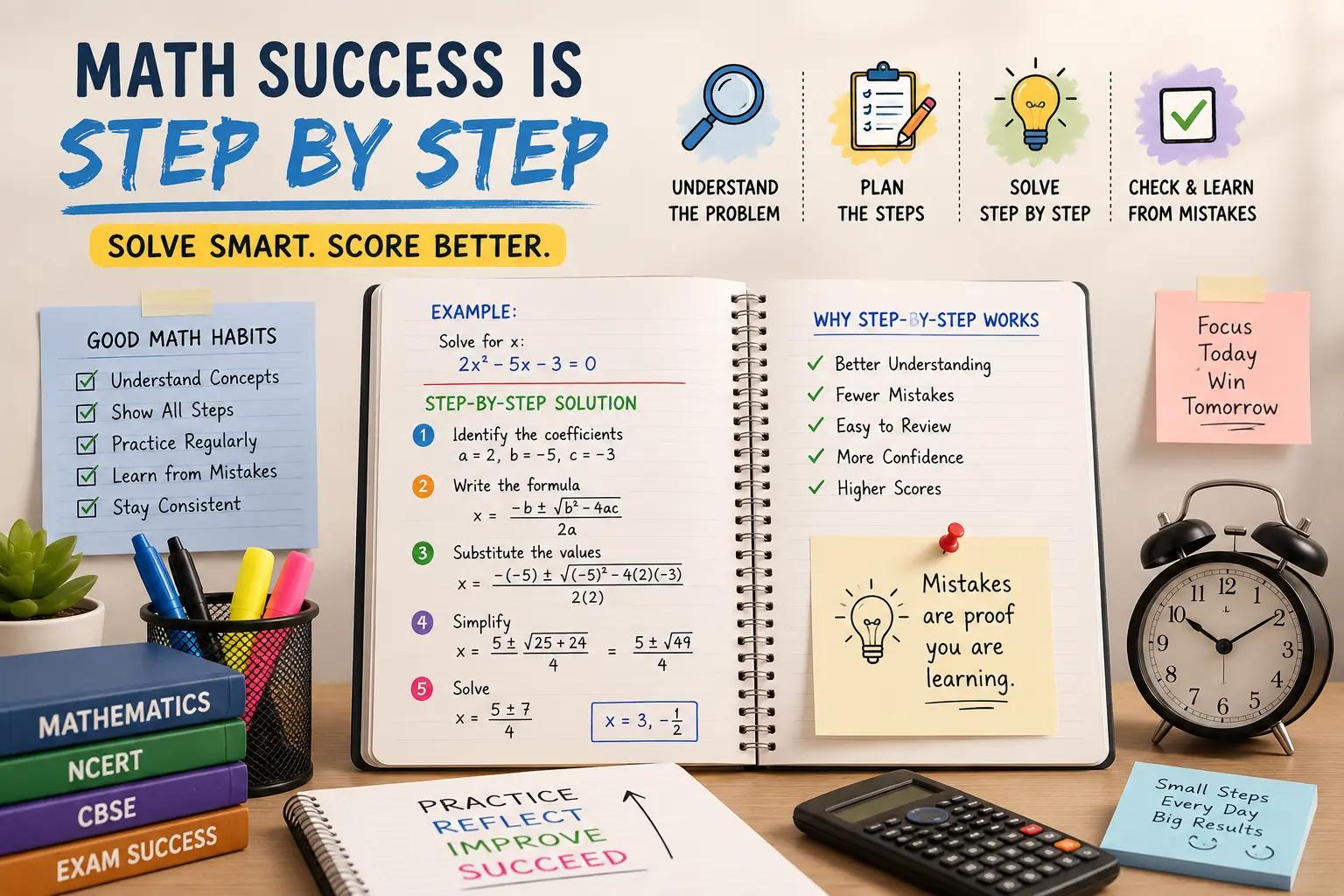
For instance, consider a typical CBSE Class 10 math problem involving the quadratic formula. Instead of jumping straight to applying the formula, students should first identify the coefficients, write down the formula, and then substitute the values step by step. This method ensures that they understand each component of the formula and how it relates to the problem at hand.
Learning from Mistakes in Each Step
Mistakes are an inevitable part of learning, especially in mathematics. However, what sets successful students apart is their ability to learn from these mistakes. Here’s how a step-by-step approach aids in this process:
Encouraging Reflection: After solving a problem, students should review each step to identify any errors. This reflection helps them understand why a mistake occurred.
Promoting a Growth Mindset: Viewing mistakes as learning opportunities fosters resilience and a positive attitude towards challenges.
Creating a Feedback Loop: By consistently analyzing their work, students can develop strategies to avoid similar mistakes in the future.
For example, if a student miscalculates while solving an equation, they should revisit each step to pinpoint where the error occurred. This practice not only corrects the current mistake but also strengthens their understanding of the concepts involved.
How Guided Solving Builds Clarity
Guided solving refers to the practice of working through problems with the support of a tutor, teacher, or educational tool. This method can significantly enhance clarity in mathematical problem-solving:
Structured Learning: Guided solving provides a framework that helps students understand the sequence of steps needed to solve a problem.
Access to Expert Insights: Students can benefit from explanations and tips from experienced educators, which can clarify complex concepts.
Encouragement of Questions: A guided approach encourages students to ask questions and seek clarification, leading to a deeper understanding.
For instance, using a platform like Edzy, students can engage with interactive problem-solving sessions that break down each step of the process. This not only aids comprehension but also makes learning more enjoyable.
Avoiding Shortcuts That Hurt Understanding
In the pursuit of quick solutions, many students resort to shortcuts that can undermine their understanding of mathematics. While shortcuts may seem appealing, they often lead to confusion and errors:
Superficial Understanding: Relying on shortcuts can result in a lack of depth in understanding, making it difficult to tackle more complex problems.
Increased Anxiety: When students encounter problems that cannot be solved using shortcuts, they may feel overwhelmed and anxious.
Limited Problem-Solving Skills: Shortcuts do not equip students with the necessary skills to approach unfamiliar problems effectively.
For example, a student might memorize a formula for finding the area of a triangle without understanding how it is derived. When faced with a problem that requires a different approach, they may struggle to adapt. Instead, focusing on the derivation and understanding the concept behind the formula will prepare them for various scenarios.
Practicing Effectively at Home
Effective practice is key to mastering mathematics. Here are some strategies for students to practice step-by-step problem-solving at home:
Use Workbooks and Practice Papers: Regularly practicing from CBSE-recommended workbooks or past exam papers can help students familiarize themselves with the exam format and types of questions.
Set a Study Schedule: Creating a consistent study schedule allows students to allocate time for each topic, ensuring comprehensive coverage of the syllabus.
Engage with Online Resources: Platforms like Edzy offer interactive exercises and guided problem-solving sessions that can enhance understanding.
Join Study Groups: Collaborating with peers can provide different perspectives on problem-solving and encourage discussion about various approaches.
For instance, a student preparing for the Class 12 board exams can set aside specific days for algebra, geometry, and calculus, ensuring they practice step-by-step methods for each topic.
Improving Exam Performance
Implementing a step-by-step approach can lead to significant improvements in exam performance. Here’s how:
Enhanced Time Management: By practicing step-by-step solving, students can develop a better sense of how much time to allocate to each part of a problem.
Increased Accuracy: A structured approach reduces the likelihood of errors, leading to more accurate answers.
Better Stress Management: Knowing that they have a reliable method to tackle problems can reduce anxiety during exams.
For example, a student who practices solving quadratic equations step by step will be more confident in applying the method during their board exams, leading to improved performance.
Building Confidence in Math
Confidence is a crucial factor in a student’s success in mathematics. A step-by-step approach can help build this confidence in several ways:
Mastery of Concepts: As students become proficient in solving problems step by step, they gain mastery over the concepts, boosting their confidence.
Positive Reinforcement: Successfully solving problems using this method provides a sense of achievement, reinforcing their belief in their abilities.
Encouragement to Tackle Challenges: With increased confidence, students are more likely to take on challenging problems and explore advanced topics.
For instance, a student who has consistently practiced solving geometry problems step by step may feel empowered to tackle more complex proofs or theorems, further enhancing their mathematical journey.
In conclusion, adopting a step-by-step approach to solving mathematical problems can significantly improve students' understanding, accuracy, and confidence. By focusing on each step, learning from mistakes, and avoiding shortcuts, students can enhance their performance in exams and develop a lifelong appreciation for mathematics. With the right strategies and resources, such as those offered by Edzy, students can achieve their academic goals without the need for extra tuition.
Suggested blogs

How to Avoid Panic When You Don’t Know an Answer in the Exam
Mastering calmness to tackle exam challenges effectively.

How to Manage Time During a 3-Hour Exam
Mastering time management for a successful exam experience.

How to Check Your Answers Properly in Exams
Mastering the art of answer checking to secure every mark in CBSE exams.

How to Improve Your Speed in Solving Questions Before Exams
Mastering speed in question-solving is crucial for CBSE students aiming for high marks.