EdzyEdzy
AI Tutor
CBSE AI TutorStep-by-step CBSE study help for Classes 6-12.
WhatsApp TutorGet AI tutor help directly on WhatsApp.
CBSE
Class 6CBSE Class 6 subjects and study material.EnglishMathematicsHindiUrdu
Class 7CBSE Class 7 subjects and study material.EnglishMathematicsHindiUrdu
Class 8CBSE Class 8 subjects and study material.EnglishMathematicsHindiUrdu
Class 9CBSE Class 9 subjects and study material.EnglishMathematicsHindiUrdu
Class 10CBSE Class 10 subjects and study material.EnglishMathematicsHindiUrdu
Class 11CBSE Class 11 subjects and study material.EnglishMathematicsHindiUrdu
Class 12CBSE Class 12 subjects and study material.EnglishMathematicsHindiUrdu
Play
DuelChallenge another student in a quick learning duel.
RumbleJoin live academic competitions and leaderboards.
BadgesTrack milestones and learning achievements.
Get AppDownload Edzy for faster access on mobile.
Schools
Inter-School ChampionshipExplore Edzy's school championship.
School InstitutionBrowse schools and institutions.
State Wise SchoolFind schools by state.
District Wise SchoolFind schools by district.
Resources
StudyStudy ToolsCalculatorPlanners
ContentBlogsNews Article
CompareEdzy vs GPTEdzy vs GeminiEdzy vs Others
Buy
SearchDownload AppLogin
EdzyEdzy

Edzy for Classes 6-12

Edzy is a personal AI tutor for CBSE and State Board students, with curriculum-aligned guidance, practice, revision, and study plans that adapt to each learner.

  • Email: always@edzy.ai
  • Phone: +91 96256 68472
  • WhatsApp: +91 96256 68472
  • Address: Sector 63, Gurgaon, Haryana

Follow Edzy

Browse by Class

  • CBSE Class 6
  • CBSE Class 7
  • CBSE Class 8
  • CBSE Class 9
  • CBSE Class 10
  • CBSE Class 11
  • CBSE Class 12
Explore the CBSE resource hub

Explore Edzy

  • Study Resources
  • Free Study Tools
  • Best Apps for Board Exams
  • Edzy vs ChatGPT
  • About Us
  • Why We Built Edzy
  • Blog
  • CBSE AI Tutor
  • Chrome Extension

Support & Legal

  • Help & FAQs
  • Accessibility
  • Privacy Policy
  • Terms & Conditions
  • Refund Policy
  • Cookie Policy
  • Site Directory

© 2026 Edzy. All rights reserved.

Curriculum-aligned learning paths for students in Classes 6-12.

CBSE
Class 9
Science
Exploration
Cell: The Building Block of Life

Question Bank

Practice Hub

Question Bank: Cell: The Building Block of Life

Structured practice
Question Practice

Practice chapter questions in a cleaner, exam-ready flow

Start with curated question sets, move into full module views when needed, and keep discovering related practice without losing your place in the chapter.

Question Bank - Cell: The Building Block of Life

View all (77)
Q1.

What is the limit of resolution of the human eye?

Single Answer MCQ
Q-00171462
View explanation
Q2.

Which tool enhances the visibility of tiny cells beyond the human eye's capability?

Single Answer MCQ
Q-00171464
View explanation
Q3.

Who was the first person to observe cells under a microscope?

Single Answer MCQ
Q-00171466
View explanation
Q4.

What is the total magnification power if both eyepiece and objective lens have a magnifying power of 10X?

Single Answer MCQ
Q-00171468
View explanation
Q5.

To estimate the size of a cell, which measurement is essential to perform first?

Single Answer MCQ
Q-00171470
View explanation
Q6.

Which of the following is NOT a feature improved in modern microscopes?

Single Answer MCQ
Q-00171472
View explanation
Q7.

Which type of microscope uses a beam of electrons for imaging?

Single Answer MCQ
Q-00171474
View explanation
Q8.

When estimating cell size, if 25 cells fit across a 5000 μm field, what is the size of one cell?

Single Answer MCQ
Q-00171476
View explanation
Q9.

What does contrast in microscopy refer to?

Single Answer MCQ
Q-00171478
View explanation
Q10.

If a light microscope is set at a 40X objective lens, what is the magnification if the eyepiece is 10X?

Single Answer MCQ
Q-00171480
View explanation
Q11.

What type of lens is primarily used in light microscopes?

Single Answer MCQ
Q-00171481
View explanation
Q12.

In practical cell size estimation, what is the unit conversion used?

Single Answer MCQ
Q-00171482
View explanation
Q13.

What significant improvement allows scientists to view cells at the nanometre scale?

Single Answer MCQ
Q-00171483
View explanation
Q14.

What basic step is essential when using a microscope for observation?

Single Answer MCQ
Q-00171484
View explanation
Q15.

What does the term 'cell theory' primarily describe?

Single Answer MCQ
Q-00171485
View explanation
Q16.

In activity involving cell size estimation, why is it important to convert mm to μm?

Single Answer MCQ
Q-00171486
View explanation
Q17.

What process do cells undergo to grow and replace dead or damaged cells?

Single Answer MCQ
Q-00171487
View explanation
Q18.

Which type of cell division is most common in human body cells?

Single Answer MCQ
Q-00171488
View explanation
Q19.

What is a primary purpose of mitosis in organisms?

Single Answer MCQ
Q-00171490
View explanation
Q20.

During which phase do chromosomes duplicate for mitosis?

Single Answer MCQ
Q-00171492
View explanation
Q21.

How many daughter cells are produced at the end of mitosis?

Single Answer MCQ
Q-00171494
View explanation
Q22.

Which stage of the cell cycle includes cell growth and DNA replication?

Single Answer MCQ
Q-00171496
View explanation
Q23.

Which of the following processes occurs during anaphase in mitosis?

Single Answer MCQ
Q-00171498
View explanation
Q24.

The continuous division of certain cells, like skin cells, is an example of what?

Single Answer MCQ
Q-00171500
View explanation
Q25.

Which of these statements about mitosis is false?

Single Answer MCQ
Q-00171502
View explanation
Q26.

In which stage does the nuclear envelope break down?

Single Answer MCQ
Q-00171504
View explanation
Q27.

What is the main difference between mitosis and meiosis?

Single Answer MCQ
Q-00171506
View explanation
Q28.

Which type of cells typically undergo meiosis?

Single Answer MCQ
Q-00171508
View explanation
Q29.

Why is DNA replication essential before mitosis?

Single Answer MCQ
Q-00171510
View explanation
Q30.

Who proposed that all plants are made of cells?

Single Answer MCQ
Q-00171516
View explanation
Q31.

What statement is NOT part of the classical Cell Theory?

Single Answer MCQ
Q-00171517
View explanation
Q32.

What process explains how new cells form from existing cells?

Single Answer MCQ
Q-00171518
View explanation
Q33.

What did Rudolf Virchow contribute to Cell Theory?

Single Answer MCQ
Q-00171519
View explanation
Q34.

Which of the following statements best defines a cell?

Single Answer MCQ
Q-00171520
View explanation
Q35.

During which process do cells naturally die in a controlled manner?

Single Answer MCQ
Q-00171521
View explanation
Q36.

What is the significance of contact inhibition in cells?

Single Answer MCQ
Q-00171522
View explanation
Q37.

Prokaryotic cells lack which of the following?

Single Answer MCQ
Q-00171523
View explanation
Q38.

Eukaryotic cells are characterized by the presence of:

Single Answer MCQ
Q-00171524
View explanation
Q39.

What occurs when a cell loses the ability to undergo controlled division?

Single Answer MCQ
Q-00171525
View explanation
Q40.

Which subunit is considered the basic unit of life?

Single Answer MCQ
Q-00171526
View explanation
Q41.

The ability of a plant cell to develop into different types of cells is called:

Single Answer MCQ
Q-00171527
View explanation
Q42.

What aspect of the cell theory unifies all biological disciplines?

Single Answer MCQ
Q-00171528
View explanation
Q43.

Which organelle is responsible for energy production in eukaryotic cells?

Single Answer MCQ
Q-00171529
View explanation
Q44.

Mitosis results in the production of:

Single Answer MCQ
Q-00171530
View explanation
Q45.

What mainly distinguishes eukaryotic cells from prokaryotic cells?

Single Answer MCQ
Q-00171531
View explanation
Q46.

What is the primary function of the cell membrane?

Single Answer MCQ
Q-00171532
View explanation
Q47.

Which of the following describes a selectively permeable membrane?

Single Answer MCQ
Q-00171533
View explanation
Q48.

The fluid-mosaic model describes the structure of which cellular component?

Single Answer MCQ
Q-00171534
View explanation
Q49.

What will happen to a plant cell placed in a hypertonic solution?

Single Answer MCQ
Q-00171535
View explanation
Q50.

Which part of the cell is responsible for synthesizing proteins?

Single Answer MCQ
Q-00171536
View explanation
Q51.

In which type of solution do plant cells remain turgid?

Single Answer MCQ
Q-00171537
View explanation
Q52.

Which of these components is found in prokaryotic cells?

Single Answer MCQ
Q-00171538
View explanation
Q53.

What is the main role of the cell wall in plant cells?

Single Answer MCQ
Q-00171539
View explanation
Q54.

Which process involves the movement of water across a selectively permeable membrane?

Single Answer MCQ
Q-00171540
View explanation
Q55.

What does the term 'tonicity' refer to in biology?

Single Answer MCQ
Q-00171541
View explanation
Q56.

What type of solution is produced when solute concentrations are equal inside and outside the cell?

Single Answer MCQ
Q-00171542
View explanation
Q57.

Which cellular structure is involved in the breakdown of waste materials?

Single Answer MCQ
Q-00171543
View explanation
Q58.

Which of the following best describes the lipid bilayer of the cell membrane?

Single Answer MCQ
Q-00171544
View explanation
Q59.

Why do plant cells require a cell wall?

Single Answer MCQ
Q-00171545
View explanation
Q60.

Which of the following correctly describes a hypotonic solution?

Single Answer MCQ
Q-00171546
View explanation
Q61.

In eukaryotic cells, which structure is important for energy production?

Single Answer MCQ
Q-00171547
View explanation
Q62.

Which of the following is NOT a basic part of most cells?

Single Answer MCQ
Q-00171557
View explanation
Q63.

What is the function of ribosomes in a cell?

Single Answer MCQ
Q-00171559
View explanation
Q64.

Which organelle is primarily responsible for energy production in the cell?

Single Answer MCQ
Q-00171561
View explanation
Q65.

What does a selectively permeable membrane allow?

Single Answer MCQ
Q-00171563
View explanation
Q66.

Which of the following is found in plant cells but not in animal cells?

Single Answer MCQ
Q-00171565
View explanation
Q67.

What is the jelly-like substance within the cell where organelles are suspended?

Single Answer MCQ
Q-00171567
View explanation
Q68.

Which of the following statements about prokaryotic cells is true?

Single Answer MCQ
Q-00171569
View explanation
Q69.

What role does the Golgi apparatus play in a cell?

Single Answer MCQ
Q-00171570
View explanation
Q70.

Which cell structure is responsible for detoxifying harmful substances?

Single Answer MCQ
Q-00171571
View explanation
Q71.

What would happen to a plant cell if its cell wall became flexible like a cell membrane?

Single Answer MCQ
Q-00171572
View explanation
Q72.

What primary component makes up the plant cell wall?

Single Answer MCQ
Q-00171573
View explanation
Q73.

What do lysosomes contain that aids in breaking down waste materials?

Single Answer MCQ
Q-00171574
View explanation
Q74.

In which type of cell would you find a nucleoid region?

Single Answer MCQ
Q-00171575
View explanation
Q75.

What distinguishes eukaryotic cells from prokaryotic cells?

Single Answer MCQ
Q-00171576
View explanation
Q76.

What is the main function of the vacuole in plant cells?

Single Answer MCQ
Q-00171577
View explanation
Q77.

Which organelle is involved in the synthesis of lipids and proteins and is often studded with ribosomes?

Single Answer MCQ
Q-00171578
View explanation
Learn Better On The App
Competitive revision

Challenge Your Friends

Compete in short duels with fast rounds, instant feedback, and zero boredom.

1v1 challenges
Fast recall training

Faster access to practice, revision, and daily study flow.

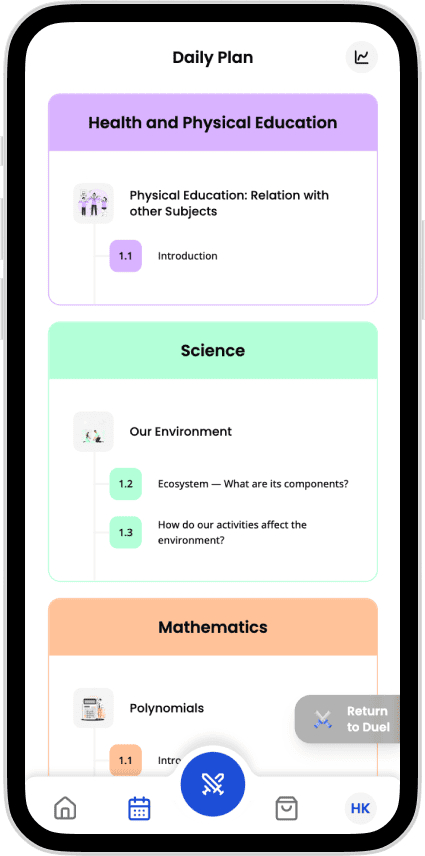
Edzy mobile app preview