
How to Revise Smartly for Exams Without Re-reading Everything
Master the art of smart revision for effective exam preparation
Discover a smarter revision framework that helps students retain concepts effectively without the need for constant re-reading. This guide covers active recall, spaced repetition, and more.

Gaurav Parashar
@gauravparashar
Listen to this article
How to Revise Smartly for Exams Without Re-reading Everything
As students approach their exams, the pressure to perform can lead to overwhelming feelings. Many students resort to re-reading their notes and textbooks, believing that this will help them retain information. However, research shows that re-reading is often ineffective for long-term retention. Instead, adopting a smarter revision strategy can enhance understanding and recall. In this blog post, we will explore a comprehensive framework for effective revision that students in Classes 6 to 12 can implement to prepare for their exams without the need to re-read everything.
Why re-reading notes doesn’t work
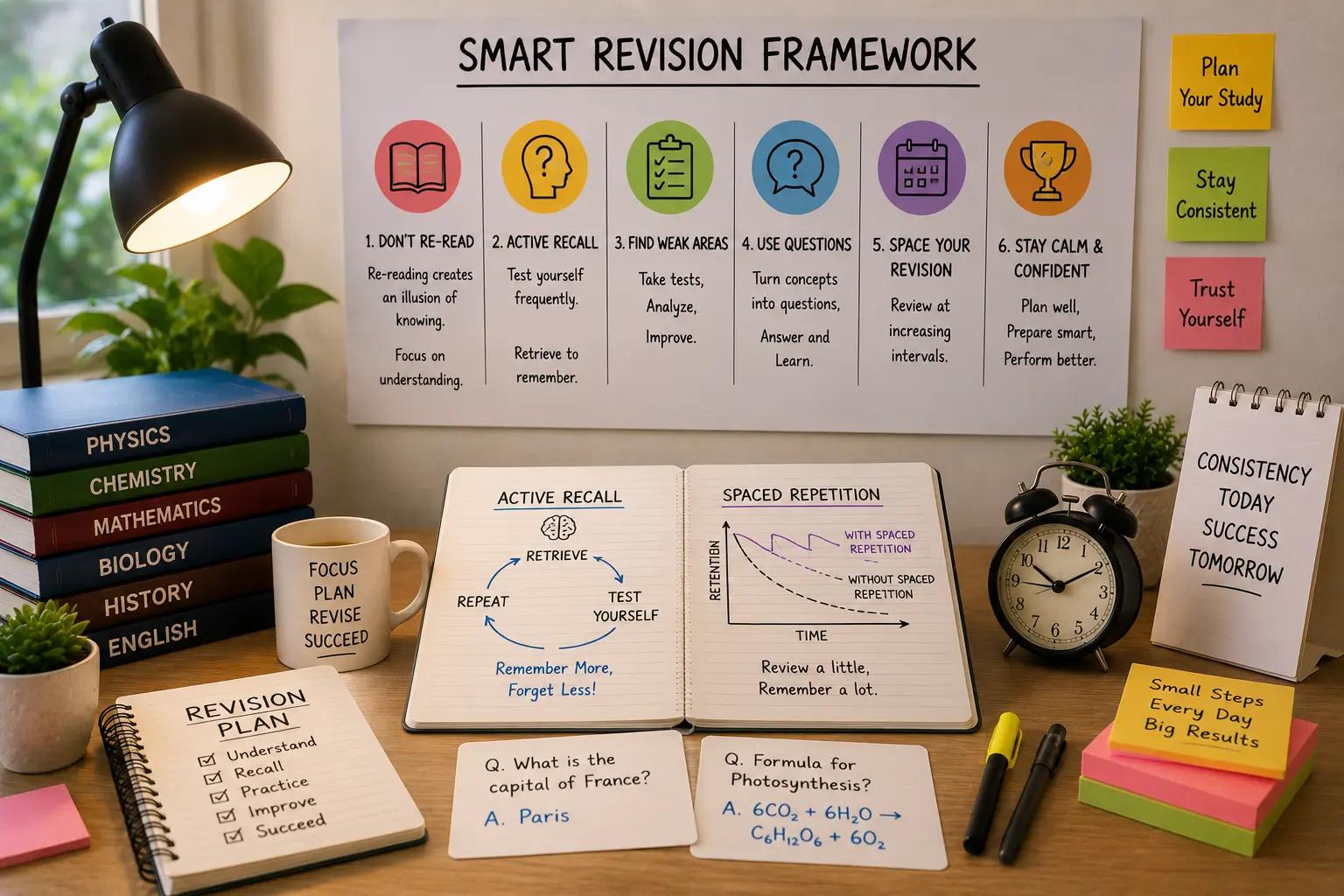
Re-reading notes may seem like a logical way to study, but it often leads to superficial learning. When students re-read their notes, they engage in passive revision, which means they are not actively processing the information. This can create an illusion of familiarity, but it does not guarantee understanding or retention.
For example, a student preparing for the Class 10 Mathematics exam might read through their notes on geometry multiple times. While they may feel confident, they might struggle to solve problems during the exam because they haven't truly internalized the concepts. Instead of re-reading, students should focus on techniques that promote active engagement with the material.
Active recall vs passive revision
Active recall is a powerful learning technique that involves retrieving information from memory. This method encourages students to test themselves on the material rather than simply reviewing it. Research has shown that active recall significantly improves retention compared to passive revision methods like re-reading.
To implement active recall, students can use flashcards, practice questions, or quizzes. For instance, a student studying for the Class 12 Biology exam might create flashcards with key terms and definitions. By regularly testing themselves, they reinforce their understanding and identify areas that need further review.
In contrast, passive revision, such as re-reading notes, does not challenge the brain to retrieve information. This can lead to a false sense of security, where students believe they know the material simply because they have seen it multiple times.
Identifying weak areas quickly
One of the keys to effective revision is identifying weak areas early in the process. This allows students to focus their efforts on topics that require more attention. To do this, students can take practice tests or quizzes that cover a range of topics. For example, a Class 9 student preparing for their Science exam can take a mock test that includes questions from physics, chemistry, and biology.
After completing the test, students should analyze their results to determine which areas they struggled with. This targeted approach ensures that revision time is spent efficiently, allowing students to strengthen their understanding of challenging concepts.
Using questions to revise concepts
Formulating questions based on the material is an effective way to reinforce learning. Students can create their own questions or use resources that provide practice questions related to their syllabus. For instance, a Class 11 student studying History might create questions about key events, dates, and figures.
By answering these questions, students engage in active recall and deepen their understanding of the subject matter. Additionally, discussing these questions with peers or family members can further enhance comprehension and retention.
How to structure short revision sessions
Short, focused revision sessions are more effective than long, drawn-out study marathons. Students should aim for sessions of 25 to 30 minutes, followed by a short break. This technique, known as the Pomodoro Technique, helps maintain concentration and prevents burnout.
During each session, students should focus on a specific topic or concept. For example, a Class 7 student preparing for their English exam might dedicate one session to revising grammar rules and another to practicing comprehension skills. By breaking down the material into manageable chunks, students can avoid feeling overwhelmed and improve retention.
The role of spaced repetition
Spaced repetition is a learning technique that involves reviewing material at increasing intervals over time. This method leverages the psychological spacing effect, which suggests that information is better retained when it is reviewed periodically rather than crammed in a single session.
Students can implement spaced repetition by scheduling their revision sessions in advance. For example, a Class 10 student preparing for their Social Science exam might review a chapter on Indian history today, then revisit it again in two days, and then again in a week. This approach reinforces learning and helps prevent forgetting.
Avoiding last-minute stress
Last-minute cramming is a common pitfall for students, often leading to increased anxiety and decreased performance. To avoid this, students should start their revision well in advance of the exam date. Creating a revision timetable can help students allocate sufficient time for each subject and topic.
For instance, a Class 12 student can create a weekly schedule that outlines which subjects to revise each day. By spreading out their study sessions, they can reduce stress and ensure that they cover all necessary material without feeling rushed.
Building confidence before exams
Confidence plays a crucial role in exam performance. Students can build confidence by practicing past exam papers and familiarizing themselves with the exam format. For example, a Class 8 student preparing for their Mathematics exam can solve previous years' question papers to understand the types of questions that are commonly asked.
Additionally, positive self-talk and visualization techniques can help students manage anxiety. Encouraging students to visualize themselves succeeding in the exam can boost their confidence and reduce stress levels.
In conclusion, revising smartly for exams involves moving away from passive methods like re-reading and embracing active recall, spaced repetition, and targeted practice. By implementing these strategies, students can enhance their understanding, retain information more effectively, and approach their exams with confidence. Remember, effective revision is not about the quantity of time spent studying but the quality of the study techniques employed.
Suggested blogs

How to Manage Time During a 3-Hour Exam
Mastering time management for a successful exam experience.

How to Check Your Answers Properly in Exams
Mastering the art of answer checking to secure every mark in CBSE exams.

How to Improve Your Speed in Solving Questions Before Exams
Mastering speed in question-solving is crucial for CBSE students aiming for high marks.

How to Use Past Year Papers the Right Way
Mastering past papers transforms passive practice into effective learning for CBSE students.