Brand Logo

Class 9

Class 9 - English
Moments (9 Chapters)|
Beehive (18 Chapters)|
Words and Expressions - I (9 Chapters)
Class 9 - Health and Physical Education
Health and Physical Education (14 Chapters)
Class 9 - Hindi
Sanchayan (4 Chapters)|
Sparsh (10 Chapters)|
Kshitij (13 Chapters)|
Kritika (4 Chapters)
Class 9 - ICT
Information and Communication Technology (8 Chapters)
Class 9 - Mathematics
Mathematics (12 Chapters)
Class 9 - Sanskrit
Shemushi Prathmo Bhag (10 Chapters)|
Vyakaranavithi (20 Chapters)|
Abhyaswaan Bhav (15 Chapters)
Class 9 - Science
Science (12 Chapters)
Class 9 - Social Science
Contemporary India (6 Chapters)|
Democratic Politics (5 Chapters)|
Economics (4 Chapters)|
India and the Contemporary World - I (5 Chapters)

Class 10

Class 10 - English
First Flight (22 Chapters)|
Foot Prints Without feet (9 Chapters)|
Words and Expressions - II (9 Chapters)
Class 10 - Health and Physical Education
Health and Physical Education (13 Chapters)
Class 10 - Hindi
Kshitij - II (13 Chapters)|
Sparsh (14 Chapters)|
Sanchayan - II (3 Chapters)|
Kritika (3 Chapters)
Class 10 - Mathematics
Mathematics (14 Chapters)
Class 10 - Sanskrit
Vyakaranavithi (14 Chapters)|
Shemushi - II (12 Chapters)|
Abhyaswaan Bhav - II (14 Chapters)
Class 10 - Science
Science (13 Chapters)
Class 10 - Social Science
Contemporary India (7 Chapters)|
Democratic Politics (5 Chapters)|
India and the Contemporary World - II (5 Chapters)|
Understanding Economic Development (5 Chapters)
Class 10 - Urdu
Nawa-e-urdu (15 Chapters)

Class 11

Class 11 - Accountancy
Accountancy - II (2 Chapters)|
Financial Accounting - I (7 Chapters)
Class 11 - Biology
Biology (19 Chapters)
Class 11 - Biotechnology
Biotechnology (12 Chapters)
Class 11 - Business Studies
Business Studies (11 Chapters)
Class 11 - Chemistry
Chemistry Part - I (6 Chapters)|
Chemistry Part - II (3 Chapters)
Class 11 - Computer Science
Computer Science (11 Chapters)
Class 11 - Creative Writing and Translation
Srijan (4 Chapters)
Class 11 - Economics
Statistics for Economics (8 Chapters)|
Indian Economic Development (8 Chapters)
Class 11 - English
Hornbill (11 Chapters)|
Snapshots (5 Chapters)|
Woven Words (27 Chapters)
Class 11 - Fine Art
An Introduction to Indian Art Part - I (8 Chapters)
Class 11 - Geography
Fundamentals of Physical Geography (14 Chapters)|
India Physical Environment (6 Chapters)|
Practical Work in Geography (6 Chapters)
Class 11 - Health and Physical Education
Health and Physical Education (11 Chapters)
Class 11 - History
Themes in World History (13 Chapters)
Class 11 - Home Science
Human Ecology and Family Sciences - I (7 Chapters)|
Human Ecology and Family Sciences - II (4 Chapters)
Class 11 - Informatics Practices
Informatics Practices (8 Chapters)
Class 11 - Knowledge Traditions Practices of India
Knowledge Traditions Practices of India (9 Chapters)
Class 11 - Mathematics
Mathematics (14 Chapters)
Class 11 - Physics
Physics Part - I (7 Chapters)|
Physics Part - II (7 Chapters)
Class 11 - Political Science
Indian Constitution at Work (10 Chapters)|
Political Theory (8 Chapters)
Class 11 - Psychology
Introduction to Psychology (8 Chapters)
Class 11 - Sangeet
Tabla evam Pakhawaj (8 Chapters)|
Hindustani Sangeet Gayan Evam Vadan (10 Chapters)
Class 11 - Sociology
Understanding Society (5 Chapters)|
Introducing Sociology (5 Chapters)

Class 12

Class 12 - Accountancy
Accountancy Part - I (4 Chapters)|
Accountancy Part - II (6 Chapters)
Class 12 - Biology
Biology (13 Chapters)
Class 12 - Biotechnology
Biotechnology (13 Chapters)
Class 12 - Business Studies
Business Studies - II (3 Chapters)|
Business Studies - I (8 Chapters)
Class 12 - Chemistry
Chemistry - II (5 Chapters)|
Chemistry - I (5 Chapters)
Class 12 - Computer Science
Computer Science (13 Chapters)
Class 12 - Economics
Introductory Microeconomics (5 Chapters)|
Introductory Macroeconomics (6 Chapters)
Class 12 - English
Flamingo (14 Chapters)|
Vistas (7 Chapters)|
Kaliedoscope (21 Chapters)
Class 12 - Fine Art
An Introduction to Indian Art Part - II (8 Chapters)
Class 12 - Geography
Practical Work in Geography - Part II (4 Chapters)|
Fundamentals of Human Geography (8 Chapters)|
India - People and Economy (9 Chapters)
Class 12 - Hindi
Aroh (15 Chapters)|
Antra (23 Chapters)|
Antral Bhag - II (3 Chapters)|
Vitan (3 Chapters)
Class 12 - History
Themes in Indian History - III (4 Chapters)|
Themes in Indian History - I (4 Chapters)|
Themes in Indian History - II (4 Chapters)
Class 12 - Home Science
Human Ecology and Family Sciences Part I (7 Chapters)|
Human Ecology and Family Sciences Part II (7 Chapters)
Class 12 - Informatics Practices
Informatics Practices (7 Chapters)
Class 12 - Mathematics
Mathematics Part - I (6 Chapters)|
Mathematics Part - II (7 Chapters)
Class 12 - Physics
Physics Part - I (8 Chapters)|
Physics Part - II (6 Chapters)
Class 12 - Political Science
Politics in India Since Independence (8 Chapters)|
Contemporary World Politics (7 Chapters)
Class 12 - Psychology
Psychology (7 Chapters)
Class 12 - Sangeet
Hindustani Sangeet Gayan Evam Vadan (9 Chapters)|
Tabla evam Pakhawaj (7 Chapters)
Class 12 - Sociology
Social Change and Development in India (8 Chapters)|
Indian Society (7 Chapters)

About Edzy - Gamified Learning Platform

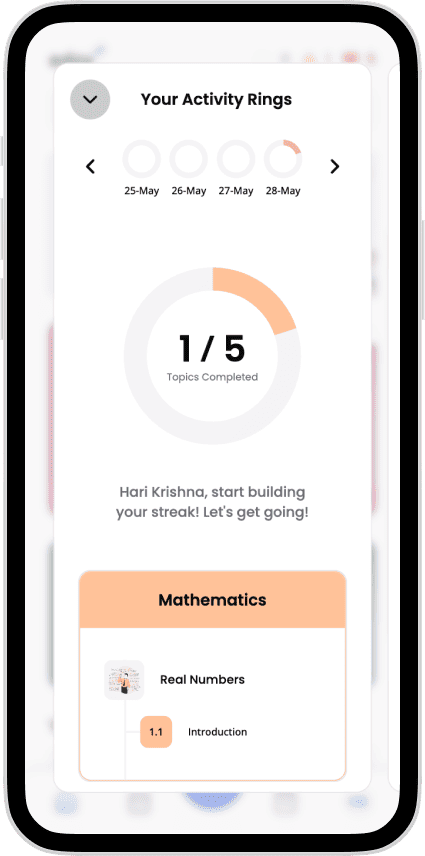
Edzy is India's premier gamified AI tutor platform for CBSE and State Board students in classes 6-12. Our platform transforms traditional studying with AI-powered study plans, interactive practice sessions, and personalized learning pathways. Students using Edzy experience unmatched learning efficiency through our immersive educational environment that combines advanced technology with curriculum-aligned content.

Why Choose Edzy for CBSE and State Board Preparation

Edzy offers an adaptive AI educational experience tailored to each student's learning style and pace. We integrate gamification with proven educational strategies to create an engaging environment that students love. Our micro-content approach breaks down complex CBSE and State Board topics into manageable lessons, building confidence through mastery-based progression and real-time feedback.

CBSE and State Board Focus Areas

Edzy specializes in transforming online education for classes 6-12 with AI-powered tutoring. We provide comprehensive NCERT-aligned content and engaging lessons across Mathematics, Science, English, Social Studies, and IT. Our system helps students master fundamental concepts and excel in board exams through AI-generated study plans, personalized learning timelines, and dynamic practice sessions.

Edzy's Unique Approach to Online Learning

Unlike traditional online coaching platforms, Edzy converts CBSE and State Board syllabus content into interactive learning adventures. Our AI tutor provides timely assistance while adapting to student progress. The platform features instant feedback, gamified practice sessions, and achievement badges to motivate continuous learning and concept mastery.

Brand Logo

Edzy | Largest Online Learning Platform for Classes 6–12

Study smarter with Edzy – India’s leading gamified AI tutor for CBSE and State Boards. Designed for Classes 6–12, Edzy offers interactive lessons, AI-powered study plans, and rewarding practice tools for every subject.

Find us on Social Media

Links

About EdzyFAQsContact UsCBSE CoursesDuelsRumblesEdzy App

Parents & Teachers

Search EdzyParent DashboardCreator PlatformEducation BlogCBSE & NCERT News

Policies

Terms and ConditionsRefund PolicyPrivacy PolicyCookie Policy

© 2026 Edzy | Largest Online Learning Platform for Classes 6–12. All rights reserved.

Edzy is an AI tutor for CBSE and State Board students, offering interactive lessons and personalized learning for Classes 6–12.

SitemapNews SitemapBlog SitemapSchool SitemapAccessibility
CBSE
Class 11
Mathematics
Mathematics
Probability

Question Bank

Question Bank: Probability

Question Bank - Probability

View all (73)
Q1.

What is the probability of an impossible event?

Single Answer MCQ
Q-00052382
Q2.

If P(A) = 0.4, what is P(not A)?

Single Answer MCQ
Q-00052383
Q3.

Which of the following statements about mutually exclusive events is true?

Single Answer MCQ
Q-00052384
Q4.

If two events A and B are independent, what can be said about P(A and B)?

Single Answer MCQ
Q-00052385
Q5.

In a sample space with 10 equally likely outcomes, if event A consists of 4 outcomes, what is P(A)?

Single Answer MCQ
Q-00052386
Q6.

What is the probability of the union of two mutually exclusive events A and B?

Single Answer MCQ
Q-00052387
Q7.

If P(A) = 0.2 and P(B) = 0.3, what is P(A or B) if A and B are independent?

Single Answer MCQ
Q-00052388
Q8.

Consider a deck of cards. What is the probability of drawing a heart or a diamond?

Single Answer MCQ
Q-00052389
Q9.

If an event A has a probability of 0.6, what can be said about the event A' (not A)?

Single Answer MCQ
Q-00052391
Q10.

Given P(A) = 0.1 and P(B) = 0.2 with P(A ∩ B) = 0.02, what is P(A ∪ B)?

Single Answer MCQ
Q-00052393
Q11.

In an experiment, what does the sample space represent?

Single Answer MCQ
Q-00052395
Q12.

What is the probability of drawing a red card from a standard deck of cards?

Single Answer MCQ
Q-00052397
Q13.

What does it mean if two events A and B are independent?

Single Answer MCQ
Q-00052399
Q14.

If the probability of rolling a sum of 7 on two dice is 1/6, what can be said about rolling a sum of 4?

Single Answer MCQ
Q-00052401
Q15.

If event A occurs with a probability of 0.7, what is the minimum probability of event B for P(A ∩ B) to be non-zero?

Single Answer MCQ
Q-00052403
Q16.

What represents the complement of event A?

Single Answer MCQ
Q-00052423
Q17.

If event A occurs with outcomes {1, 2, 3} and event B with outcomes {3, 4, 5}, what is A ∩ B?

Single Answer MCQ
Q-00052424
Q18.

What does A ∪ B signify?

Single Answer MCQ
Q-00052425
Q19.

In which case are two events A and B called mutually exclusive?

Single Answer MCQ
Q-00052426
Q20.

For the events A = {HHT, HTH, TTH} and B = {HHT, THT}, what is A - B?

Single Answer MCQ
Q-00052427
Q21.

Which of the following represents at least one head appearing when tossing a coin thrice?

Single Answer MCQ
Q-00052428
Q22.

If A = {2, 3, 5} and B = {1, 3, 5}, what is A ∩ B?

Single Answer MCQ
Q-00052429
Q23.

From the event A = {HHT, HTH, THH}, what is the complementary event A' in a sample space S = {HHH, HHT, HTH, THH, HTT, THT, TTH, TTT}?

Single Answer MCQ
Q-00052430
Q24.

When assessing two events, A and B, where A occurs on rolling a 6 and B on summing two throws being 11 or more, what is A ∩ B?

Single Answer MCQ
Q-00052431
Q25.

A and B are events defined in a dice experiment. When is the event A or B empty?

Single Answer MCQ
Q-00052432
Q26.

If event A has outcomes {x, y} and event B has outcomes {y, z}, what is A ∩ B?

Single Answer MCQ
Q-00052433
Q27.

In a sample space S containing {1, 2, 3, 4, 5, 6}, if A is the event 'even numbers', what is A'?

Single Answer MCQ
Q-00052434
Q28.

Two events are called independent if?

Single Answer MCQ
Q-00052435
Q29.

If event A occurs with probability 0.5 and event B, which is independent of A, occurs with probability 0.3, what is P(A ∩ B)?

Single Answer MCQ
Q-00052436
Q30.

Which of the following events are considered mutually exclusive?

Single Answer MCQ
Q-00052437
Q31.

If you draw one card from a standard deck, are the events 'drawing a heart' and 'drawing a club' mutually exclusive?

Single Answer MCQ
Q-00052438
Q32.

An experiment consists of rolling a die. Event A is that the die shows an odd number, and Event B is that it shows a number less than 4. Are A and B mutually exclusive?

Single Answer MCQ
Q-00052439
Q33.

In a survey, Event A represents 'individuals who prefer tea' while Event B represents 'individuals who prefer coffee'. Are these events mutually exclusive?

Single Answer MCQ
Q-00052440
Q34.

Which situation illustrates mutually exclusive events?

Single Answer MCQ
Q-00052441
Q35.

If two events have no outcomes in common, what can we conclude about them?

Single Answer MCQ
Q-00052442
Q36.

When flipping two coins, what are the events 'both coins show heads' and 'at least one coin shows tails' considered?

Single Answer MCQ
Q-00052443
Q37.

In a single toss of a fair coin, if Event A is 'the coin lands heads' and Event B is 'the coin lands tails', what relationship do A and B have?

Single Answer MCQ
Q-00052444
Q38.

Select the pair of events that can never occur simultaneously.

Single Answer MCQ
Q-00052445
Q39.

If Events C and D are mutually exclusive, what can we say about the probability of their intersection?

Single Answer MCQ
Q-00052446
Q40.

If two events A and B are mutually exclusive, what is P(A ∩ B)?

Single Answer MCQ
Q-00052447
Q41.

Which of the following pairs of events are NOT mutually exclusive?

Single Answer MCQ
Q-00052448
Q42.

When you roll a die, which two events are guaranteed to be mutually exclusive?

Single Answer MCQ
Q-00052449
Q43.

If a single die is thrown, the events 'rolling a number less than 4' and 'rolling a number greater than 4' are:

Single Answer MCQ
Q-00052450
Q44.

In a game where you can either draw a red card or a black card, what is the relationship between these two outcomes?

Single Answer MCQ
Q-00052451
Q45.

Which of the following events is NOT exhaustive for a die roll?

Single Answer MCQ
Q-00052452
Q46.

Which events formed by a die roll are mutually exclusive?

Single Answer MCQ
Q-00052453
Q47.

If events A, B, and C are defined based on rolling a die as follows: A = {1, 2}, B = {2, 3}, C = {3, 4}, which statement is true?

Single Answer MCQ
Q-00052454
Q48.

Identify an exhaustive set from the following events involving tossing a coin three times.

Single Answer MCQ
Q-00052455
Q49.

Which set of events from rolling two dice is exhaustive?

Single Answer MCQ
Q-00052456
Q50.

If events X, Y, and Z are defined such that X = {1, 3}, Y = {2, 4}, and Z = {5, 6}, what can be concluded?

Single Answer MCQ
Q-00052457
Q51.

Consider two events A and B related to the outcome of a card draw from a deck. If A is drawing a red card and B is drawing a black card, which statement is true?

Single Answer MCQ
Q-00052458
Q52.

Which pair of events regarding the number rolled on a die is mutually exclusive?

Single Answer MCQ
Q-00052459
Q53.

Which of the following combinations of events involving a single coin toss are mutually exclusive and exhaustive?

Single Answer MCQ
Q-00052460
Q54.

Given events A = {1}, B = {2}, C = {3}, what conclusion can be drawn from these events related to rolling a die?

Single Answer MCQ
Q-00052461
Q55.

If event A represents the occurrence of rolling an odd number and event B rolling an even number, which is true?

Single Answer MCQ
Q-00052462
Q56.

In an experiment of throwing a die, if the events are defined as A: {1, 2} and B: {3, 4}, which of the following is true?

Single Answer MCQ
Q-00052463
Q57.

When two events E1 and E2 are defined from rolling a die such that E1 = {1, 2, 3} and E2 = {3, 4, 5}, what can be said about E1 and E2?

Single Answer MCQ
Q-00052464
Q58.

Identifying a proper exhaustive set from the events related to three coin tosses tells us what?

Single Answer MCQ
Q-00052465
Q59.

Which of the following represents the sample space of rolling a single die?

Single Answer MCQ
Q-00052481
Q60.

According to the axiomatic approach, what is the probability of the null set?

Single Answer MCQ
Q-00052482
Q61.

If two events A and B are mutually exclusive, what does this mean about their probabilities?

Single Answer MCQ
Q-00052483
Q62.

What is the total probability of the sample space S?

Single Answer MCQ
Q-00052484
Q63.

In a fairness of coin toss, if P(H) = 0.5, what is P(T)?

Single Answer MCQ
Q-00052485
Q64.

If event E has a probability of 0.3, what can we deduce about P(E')?

Single Answer MCQ
Q-00052486
Q65.

Which of the following is true for two events A and B if they are exhaustive?

Single Answer MCQ
Q-00052487
Q66.

If A and B are independent events, what is true about P(A ∩ B)?

Single Answer MCQ
Q-00052488
Q67.

Which of the following statements about the axiomatic approach is correct?

Single Answer MCQ
Q-00052489
Q68.

Which of the following events occurs when rolling two dice and getting a sum of 9?

Single Answer MCQ
Q-00052490
Q69.

If an event E has P(E) = 0.75, what is the expected error in its occurrence?

Single Answer MCQ
Q-00052491
Q70.

What does P(A ∪ B) equal when A and B are mutually inclusive?

Single Answer MCQ
Q-00052492
Q71.

If an event has a probability greater than 1, it is considered what?

Single Answer MCQ
Q-00052493
Q72.

In an experiment where a fair die is rolled, which of the following is an elementary event?

Single Answer MCQ
Q-00052494
Q73.

If events A and B are complementary, what is true about their probabilities?

Single Answer MCQ
Q-00052495

📚 Learn Without Limits

Access NCERT content for free. No hidden charges—just pure learning.

Edzy mobile app