Edzy
AI TutorResourcesToolsCompareBuy
SearchDownload AppLogin
Edzy

Edzy for Classes 6-12

Edzy is a personal AI tutor for CBSE and State Board students, with curriculum-aligned guidance, practice, revision, and study plans that adapt to each learner.

  • Email: always@edzy.ai
  • Phone: +91 96256 68472
  • WhatsApp: +91 96256 68472
  • Address: Sector 63, Gurgaon, Haryana

Follow Edzy

Browse by Class

  • CBSE Class 6
  • CBSE Class 7
  • CBSE Class 8
  • CBSE Class 9
  • CBSE Class 10
  • CBSE Class 11
  • CBSE Class 12
Explore the CBSE resource hub

Explore Edzy

  • Study Resources
  • Free Study Tools
  • Best Apps for Board Exams
  • Edzy vs ChatGPT
  • About Us
  • Why We Built Edzy
  • Blog
  • CBSE AI Tutor

Support & Legal

  • Help & FAQs
  • Accessibility
  • Privacy Policy
  • Terms & Conditions
  • Refund Policy
  • Cookie Policy
  • Site Directory

© 2026 Edzy. All rights reserved.

Curriculum-aligned learning paths for students in Classes 6-12.

CBSE
Class 11
Mathematics
Mathematics
Probability
Question Bank

Question Bank - Probability

Practice Hub

Question Bank: Probability

This chapter introduces the foundational concepts of probability, emphasizing the significance of events and sample spaces in understanding chance.

Structured practice

Question Bank - Probability

Q1.

What is the probability of an impossible event?

Single Answer MCQ
Q-00052382
View explanation
Q2.

If P(A) = 0.4, what is P(not A)?

Single Answer MCQ
Q-00052383
View explanation
Q3.

Which of the following statements about mutually exclusive events is true?

Single Answer MCQ
Q-00052384
View explanation
Q4.

If two events A and B are independent, what can be said about P(A and B)?

Single Answer MCQ
Q-00052385
View explanation
Q5.

In a sample space with 10 equally likely outcomes, if event A consists of 4 outcomes, what is P(A)?

Single Answer MCQ
Q-00052386
View explanation
Q6.

What is the probability of the union of two mutually exclusive events A and B?

Single Answer MCQ
Q-00052387
View explanation
Q7.

If P(A) = 0.2 and P(B) = 0.3, what is P(A or B) if A and B are independent?

Single Answer MCQ
Q-00052388
View explanation
Q8.

Consider a deck of cards. What is the probability of drawing a heart or a diamond?

Single Answer MCQ
Q-00052389
View explanation
Q9.

If an event A has a probability of 0.6, what can be said about the event A' (not A)?

Single Answer MCQ
Q-00052391
View explanation
Q10.

Given P(A) = 0.1 and P(B) = 0.2 with P(A ∩ B) = 0.02, what is P(A ∪ B)?

Single Answer MCQ
Q-00052393
View explanation
Q11.

In an experiment, what does the sample space represent?

Single Answer MCQ
Q-00052395
View explanation
Q12.

What is the probability of drawing a red card from a standard deck of cards?

Single Answer MCQ
Q-00052397
View explanation
Q13.

What does it mean if two events A and B are independent?

Single Answer MCQ
Q-00052399
View explanation
Q14.

If the probability of rolling a sum of 7 on two dice is 1/6, what can be said about rolling a sum of 4?

Single Answer MCQ
Q-00052401
View explanation
Q15.

If event A occurs with a probability of 0.7, what is the minimum probability of event B for P(A ∩ B) to be non-zero?

Single Answer MCQ
Q-00052403
View explanation
Q16.

What represents the complement of event A?

Single Answer MCQ
Q-00052423
View explanation
Q17.

If event A occurs with outcomes {1, 2, 3} and event B with outcomes {3, 4, 5}, what is A ∩ B?

Single Answer MCQ
Q-00052424
View explanation
Q18.

What does A ∪ B signify?

Single Answer MCQ
Q-00052425
View explanation
Q19.

In which case are two events A and B called mutually exclusive?

Single Answer MCQ
Q-00052426
View explanation
Q20.

For the events A = {HHT, HTH, TTH} and B = {HHT, THT}, what is A - B?

Single Answer MCQ
Q-00052427
View explanation
Q21.

Which of the following represents at least one head appearing when tossing a coin thrice?

Single Answer MCQ
Q-00052428
View explanation
Q22.

If A = {2, 3, 5} and B = {1, 3, 5}, what is A ∩ B?

Single Answer MCQ
Q-00052429
View explanation
Q23.

From the event A = {HHT, HTH, THH}, what is the complementary event A' in a sample space S = {HHH, HHT, HTH, THH, HTT, THT, TTH, TTT}?

Single Answer MCQ
Q-00052430
View explanation
Q24.

When assessing two events, A and B, where A occurs on rolling a 6 and B on summing two throws being 11 or more, what is A ∩ B?

Single Answer MCQ
Q-00052431
View explanation
Q25.

A and B are events defined in a dice experiment. When is the event A or B empty?

Single Answer MCQ
Q-00052432
View explanation
Q26.

If event A has outcomes {x, y} and event B has outcomes {y, z}, what is A ∩ B?

Single Answer MCQ
Q-00052433
View explanation
Q27.

In a sample space S containing {1, 2, 3, 4, 5, 6}, if A is the event 'even numbers', what is A'?

Single Answer MCQ
Q-00052434
View explanation
Q28.

Two events are called independent if?

Single Answer MCQ
Q-00052435
View explanation
Q29.

If event A occurs with probability 0.5 and event B, which is independent of A, occurs with probability 0.3, what is P(A ∩ B)?

Single Answer MCQ
Q-00052436
View explanation
Q30.

Which of the following events are considered mutually exclusive?

Single Answer MCQ
Q-00052437
View explanation
Q31.

If you draw one card from a standard deck, are the events 'drawing a heart' and 'drawing a club' mutually exclusive?

Single Answer MCQ
Q-00052438
View explanation
Q32.

An experiment consists of rolling a die. Event A is that the die shows an odd number, and Event B is that it shows a number less than 4. Are A and B mutually exclusive?

Single Answer MCQ
Q-00052439
View explanation
Q33.

In a survey, Event A represents 'individuals who prefer tea' while Event B represents 'individuals who prefer coffee'. Are these events mutually exclusive?

Single Answer MCQ
Q-00052440
View explanation
Q34.

Which situation illustrates mutually exclusive events?

Single Answer MCQ
Q-00052441
View explanation
Q35.

If two events have no outcomes in common, what can we conclude about them?

Single Answer MCQ
Q-00052442
View explanation
Q36.

When flipping two coins, what are the events 'both coins show heads' and 'at least one coin shows tails' considered?

Single Answer MCQ
Q-00052443
View explanation
Q37.

In a single toss of a fair coin, if Event A is 'the coin lands heads' and Event B is 'the coin lands tails', what relationship do A and B have?

Single Answer MCQ
Q-00052444
View explanation
Q38.

Select the pair of events that can never occur simultaneously.

Single Answer MCQ
Q-00052445
View explanation
Q39.

If Events C and D are mutually exclusive, what can we say about the probability of their intersection?

Single Answer MCQ
Q-00052446
View explanation
Q40.

If two events A and B are mutually exclusive, what is P(A ∩ B)?

Single Answer MCQ
Q-00052447
View explanation
Q41.

Which of the following pairs of events are NOT mutually exclusive?

Single Answer MCQ
Q-00052448
View explanation
Q42.

When you roll a die, which two events are guaranteed to be mutually exclusive?

Single Answer MCQ
Q-00052449
View explanation
Q43.

If a single die is thrown, the events 'rolling a number less than 4' and 'rolling a number greater than 4' are:

Single Answer MCQ
Q-00052450
View explanation
Q44.

In a game where you can either draw a red card or a black card, what is the relationship between these two outcomes?

Single Answer MCQ
Q-00052451
View explanation
Q45.

Which of the following events is NOT exhaustive for a die roll?

Single Answer MCQ
Q-00052452
View explanation
Q46.

Which events formed by a die roll are mutually exclusive?

Single Answer MCQ
Q-00052453
View explanation
Q47.

If events A, B, and C are defined based on rolling a die as follows: A = {1, 2}, B = {2, 3}, C = {3, 4}, which statement is true?

Single Answer MCQ
Q-00052454
View explanation
Q48.

Identify an exhaustive set from the following events involving tossing a coin three times.

Single Answer MCQ
Q-00052455
View explanation
Q49.

Which set of events from rolling two dice is exhaustive?

Single Answer MCQ
Q-00052456
View explanation
Q50.

If events X, Y, and Z are defined such that X = {1, 3}, Y = {2, 4}, and Z = {5, 6}, what can be concluded?

Single Answer MCQ
Q-00052457
View explanation
Q51.

Consider two events A and B related to the outcome of a card draw from a deck. If A is drawing a red card and B is drawing a black card, which statement is true?

Single Answer MCQ
Q-00052458
View explanation
Q52.

Which pair of events regarding the number rolled on a die is mutually exclusive?

Single Answer MCQ
Q-00052459
View explanation
Q53.

Which of the following combinations of events involving a single coin toss are mutually exclusive and exhaustive?

Single Answer MCQ
Q-00052460
View explanation
Q54.

Given events A = {1}, B = {2}, C = {3}, what conclusion can be drawn from these events related to rolling a die?

Single Answer MCQ
Q-00052461
View explanation
Q55.

If event A represents the occurrence of rolling an odd number and event B rolling an even number, which is true?

Single Answer MCQ
Q-00052462
View explanation
Q56.

In an experiment of throwing a die, if the events are defined as A: {1, 2} and B: {3, 4}, which of the following is true?

Single Answer MCQ
Q-00052463
View explanation
Q57.

When two events E1 and E2 are defined from rolling a die such that E1 = {1, 2, 3} and E2 = {3, 4, 5}, what can be said about E1 and E2?

Single Answer MCQ
Q-00052464
View explanation
Q58.

Identifying a proper exhaustive set from the events related to three coin tosses tells us what?

Single Answer MCQ
Q-00052465
View explanation
Q59.

Which of the following represents the sample space of rolling a single die?

Single Answer MCQ
Q-00052481
View explanation
Q60.

According to the axiomatic approach, what is the probability of the null set?

Single Answer MCQ
Q-00052482
View explanation
Q61.

If two events A and B are mutually exclusive, what does this mean about their probabilities?

Single Answer MCQ
Q-00052483
View explanation
Q62.

What is the total probability of the sample space S?

Single Answer MCQ
Q-00052484
View explanation
Q63.

In a fairness of coin toss, if P(H) = 0.5, what is P(T)?

Single Answer MCQ
Q-00052485
View explanation
Q64.

If event E has a probability of 0.3, what can we deduce about P(E')?

Single Answer MCQ
Q-00052486
View explanation
Q65.

Which of the following is true for two events A and B if they are exhaustive?

Single Answer MCQ
Q-00052487
View explanation
Q66.

If A and B are independent events, what is true about P(A ∩ B)?

Single Answer MCQ
Q-00052488
View explanation
Q67.

Which of the following statements about the axiomatic approach is correct?

Single Answer MCQ
Q-00052489
View explanation
Q68.

Which of the following events occurs when rolling two dice and getting a sum of 9?

Single Answer MCQ
Q-00052490
View explanation
Q69.

If an event E has P(E) = 0.75, what is the expected error in its occurrence?

Single Answer MCQ
Q-00052491
View explanation
Q70.

What does P(A ∪ B) equal when A and B are mutually inclusive?

Single Answer MCQ
Q-00052492
View explanation
Q71.

If an event has a probability greater than 1, it is considered what?

Single Answer MCQ
Q-00052493
View explanation
Q72.

In an experiment where a fair die is rolled, which of the following is an elementary event?

Single Answer MCQ
Q-00052494
View explanation
Q73.

If events A and B are complementary, what is true about their probabilities?

Single Answer MCQ
Q-00052495
View explanation
Learn Better On The App
Free learning flow

Learn Without Limits

Access NCERT content for free with a cleaner, faster way to revise every day.

Chapter summaries
Revision tools

Faster access to practice, revision, and daily study flow.

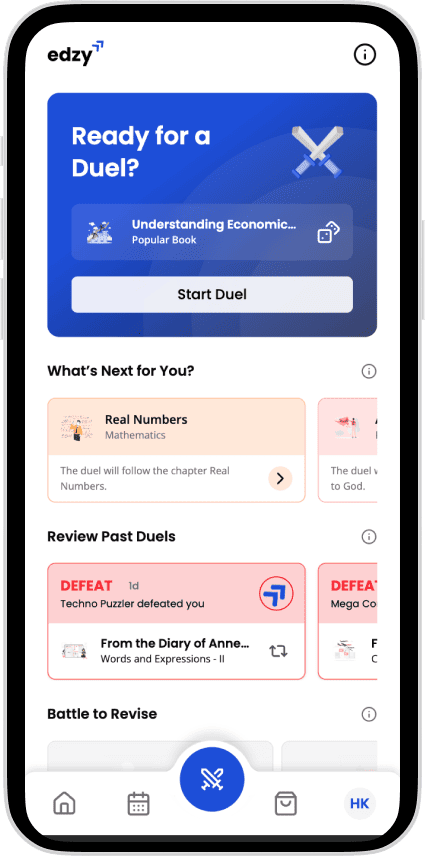
Edzy mobile app preview