
CBSE Launches E-Waste Awareness Campaign and Collection Drive in Schools
Schools across India to participate in a nationwide initiative promoting responsible e-waste disposal.
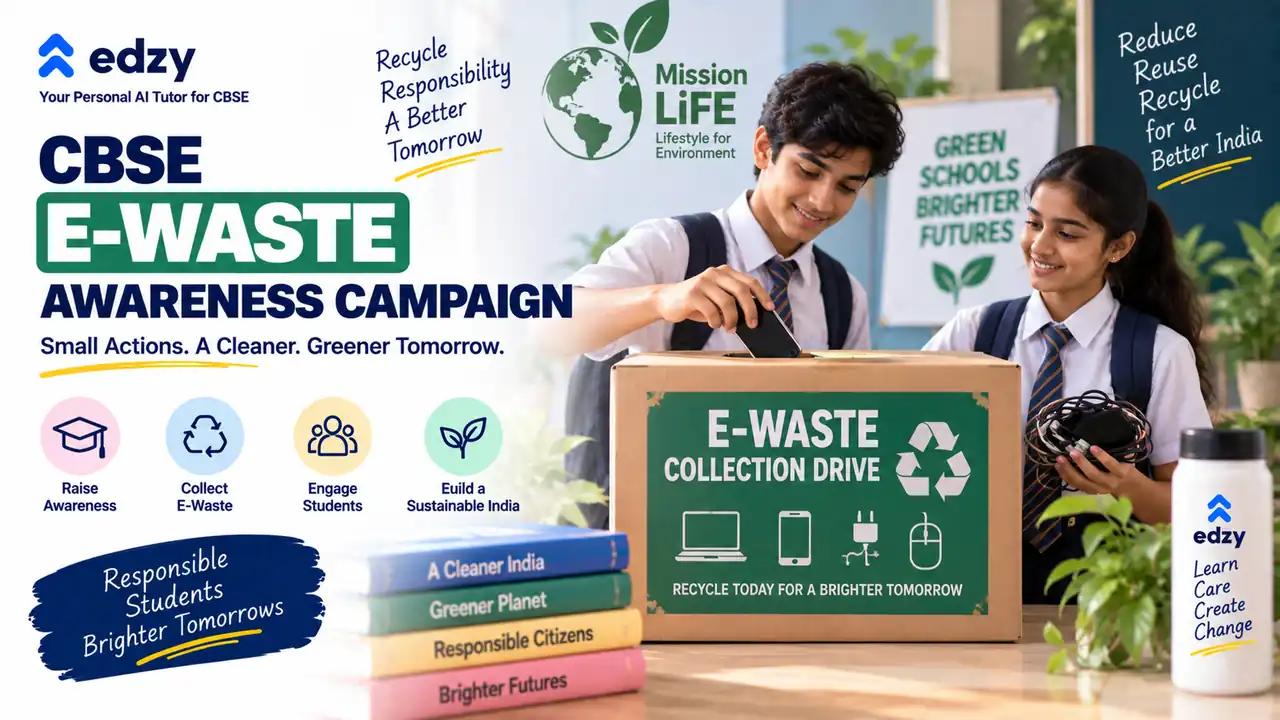
The CBSE has announced an E-Waste Awareness Campaign and Collection Drive, encouraging schools to engage in responsible e-waste disposal. This initiative aims to educate students about the dangers of e-waste and promote sustainable practices. Schools are urged to set up collection points and participate actively in this important environmental initiative.
Listen to this article
CBSE Launches E-Waste Awareness Campaign and Collection Drive in Schools
Understanding the E-Waste Awareness Campaign
The Central Board of Secondary Education (CBSE) has initiated a nationwide E-Waste Awareness Campaign and Collection Drive aimed at schools across India. This campaign is part of the broader Mission LiFE initiative, which focuses on promoting sustainable practices among students and communities. The campaign is a collaborative effort between the Department of School Education & Literacy (DoSEL) and the Ministry of Environment, Forest and Climate Change (MoEFCC), emphasizing the importance of responsible e-waste disposal. Readers can compare this update with national sports day 2026 celebrations a call for related CBSE context.
India generates millions of tonnes of e-waste annually, and improper handling of this waste can lead to severe environmental and health hazards. The campaign aims to educate students about these dangers while promoting the principles of a circular economy. Schools are encouraged to establish dedicated e-waste collection corners and engage students in various activities to raise awareness about e-waste management. Readers can compare this update with cbse organizes capacity building programmes for teachers for related CBSE context.
For more insights on related educational initiatives, schools can refer to the National Sports Day 2026 celebrations, which also promote community engagement. Readers can compare this update with cbse young india culinary championship 2026 27 for related CBSE context.
Phased Implementation of the Campaign
The campaign will be implemented in two phases. The first phase, running from September 15 to September 30, focuses on preparatory actions. Schools are required to set up e-waste collection corners equipped with secure containers for obsolete electronics such as cables, old phones, and calculators. This phase also includes mapping nodal authorities to connect school clusters with authorized recyclers or Producer Responsibility Organizations (PROs). Readers can compare this update with cbse launches 3030 eklavya online series for for related CBSE context.
Additionally, schools are encouraged to conduct webinars and workshops to educate students and teachers about the dangers of e-waste and the importance of responsible disposal. These sessions will cover topics related to the circular economy and how students can contribute to sustainable practices. Readers can compare this update with cbse issues advisory on misleading information on for related CBSE context.
As part of the campaign, schools can also review the capacity-building programs provided by CBSE to enhance teacher engagement in environmental education.
Engaging Students in E-Waste Collection
The second phase of the campaign, from October 1 to October 31, will focus on the implementation and collection of e-waste. Schools will organize co-curricular activities such as inter-house poster-making, e-waste art installations, and essay writing competitions to engage students creatively. Students will be encouraged to audit their homes for end-of-life electronics and deposit them at school collection points with parental consent.
Furthermore, the campaign emphasizes the importance of safe collection and disposal of e-waste. Schools must ensure that students do not dismantle or handle hazardous items such as damaged lithium-ion batteries or broken cathode-ray tubes. The collected e-waste will be picked up by CPCB-certified recyclers, ensuring that the disposal process adheres to safety regulations.
For more on how schools can enhance their educational offerings, the Young India Culinary Championship is another initiative that encourages student participation in diverse activities.
Tracking and Reporting Participation
To ensure effective monitoring of the campaign, school Eco Club coordinators will log metrics such as the number of student participants, workshops held, and kilograms of e-waste collected onto the Eco Clubs for Mission LiFE portal. This real-time tracking will help assess the impact of the campaign and encourage schools to share their best practices on social media platforms using the hashtag #SpecialCampaign6.
Schools are also requested to upload details of their participation and activities on the Mission LiFE portal. This initiative not only promotes environmental awareness but also aligns with the National Education Policy (NEP) 2020, which advocates for integrating environmental education across subject areas.
For schools looking to enhance their environmental initiatives, the Eklavya online series offers resources for integrating computational thinking and AI into the curriculum.
What This Campaign Means for Students and Schools
What are the key objectives of the E-Waste Awareness Campaign? The E-Waste Awareness Campaign aims to educate students about the dangers of e-waste, promote responsible disposal practices, and engage schools in sustainable environmental initiatives. By participating in this campaign, students learn the importance of recycling and the impact of e-waste on health and the environment.
This initiative is crucial for fostering a sense of responsibility among students regarding environmental issues. As they engage in activities related to e-waste management, they develop skills that align with the principles of sustainable development. The campaign also encourages collaboration between schools, parents, and local authorities, creating a community-wide effort to address e-waste challenges.
In conclusion, the E-Waste Awareness Campaign and Collection Drive is a significant step towards promoting environmental sustainability in schools. By participating actively, students and educators can contribute to a healthier planet and a more informed society.
For further updates on educational initiatives, schools should keep an eye on the latest news, including the advisory on misleading information from CBSE.
Related News
CBSE LOC Submission Deadline Approaches: Only 7 Days Left
CBSE Science Challenge 2026-27: A Platform for Scientific Inquiry
Fit India Freedom Run 2026: A Nationwide Campaign for Health and Fitness

CBSE Class 10 Board Exam 2026-2027: Submission of Examination Forms for Private Candidates