
How to Actually Understand Math Instead of Memorizing Formulas (Class 7–9 Guide)
A practical guide for middle school students to move from memorization to true understanding in Mathematics.
This blog provides a comprehensive guide for students and parents on how to foster true understanding of mathematics concepts rather than relying on rote memorization of formulas.

Gaurav Parashar
@gauravparashar
Listen to this article
How to Actually Understand Math Instead of Memorizing Formulas (Class 7–9 Guide)
Mathematics is often viewed as a daunting subject by students, especially in middle school when the concepts become more abstract. Many students resort to memorizing formulas as a shortcut to solve problems, but this approach can lead to significant gaps in understanding. In this guide, we will explore effective strategies for students in classes 7 to 9 to develop a deeper comprehension of mathematical concepts, moving beyond rote memorization to true understanding.
Why Memorizing Formulas Doesn’t Work Long-Term
Memorizing formulas may provide a temporary solution for solving math problems, but it often fails to foster a genuine understanding of the underlying concepts. When students memorize formulas without grasping their meaning, they may struggle to apply them in different contexts or when faced with complex problems. For instance, a student might memorize the formula for the area of a triangle, but if they encounter a problem that requires them to derive that formula, they may be at a loss.
Moreover, memorization can lead to anxiety during exams. Students often fear forgetting a formula, which can hinder their performance. Instead of relying on memory, students should focus on understanding the 'why' behind each formula. This understanding will not only help them recall the formula when needed but also enable them to apply it correctly in various situations.
How Conceptual Gaps Start in Middle School
Middle school is a critical period for mathematical development. Many students begin to encounter more abstract concepts, such as algebra and geometry, which require a solid foundation in earlier arithmetic skills. If students have gaps in their understanding from previous grades, these gaps can widen as they progress. For example, a student who struggles with fractions may find it challenging to grasp algebraic expressions that involve fractions.
Additionally, the pressure to perform well in exams can lead students to prioritize grades over understanding. This mindset can create a cycle of memorization and superficial learning, where students focus on passing tests rather than truly comprehending the material. Parents and educators must recognize these gaps early and encourage a focus on understanding rather than just grades.
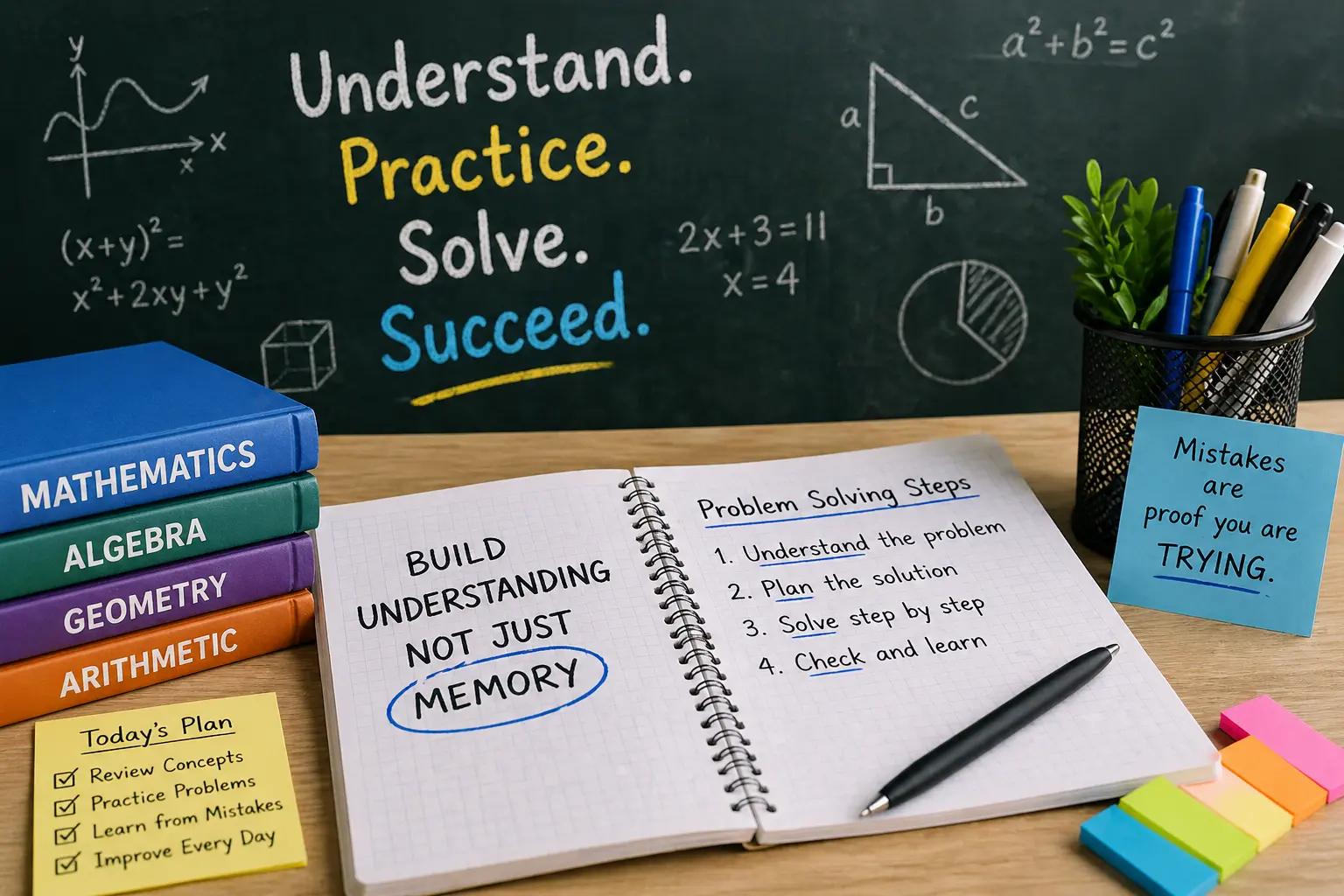
Breaking Down Problems Step by Step
One effective way to foster understanding in mathematics is to break down problems into smaller, manageable steps. This approach not only simplifies complex problems but also helps students see the connections between different concepts. For instance, when solving a word problem, students can start by identifying the key information and what is being asked. From there, they can outline the steps needed to arrive at a solution.
Consider the following example:
A rectangle has a length of 10 cm and a width of 5 cm. What is the area?
Instead of jumping straight to the formula for area (Area = length × width), students should first identify the dimensions given and what the area represents. By breaking it down, they can understand that they need to multiply the two dimensions to find the total space within the rectangle.
The Role of Guided Solving in Learning Math
Guided solving is a teaching method where educators lead students through the problem-solving process. This approach allows students to observe how to tackle problems step-by-step, providing them with a framework for their own problem-solving efforts. During guided solving, teachers can ask probing questions that encourage students to think critically about the problem at hand.
For example, a teacher might present a problem involving the Pythagorean theorem and ask students to explain each step as they work through it. This not only reinforces their understanding but also builds their confidence in applying the theorem independently in the future.
Practicing with Step-Wise Feedback
Practice is essential for mastering mathematical concepts, but it should be accompanied by constructive feedback. Students should engage in exercises that require them to apply concepts in various contexts. After completing a problem, they should review their work step-by-step, identifying any mistakes and understanding why they occurred.
For instance, if a student incorrectly calculates the area of a triangle, they should revisit each step of their calculation to pinpoint where they went wrong. This process of self-reflection is crucial for reinforcing learning and preventing the same mistakes in the future.
Using Mistakes as a Learning Tool
Mistakes are often viewed negatively in the learning process, but they can be powerful learning tools. Encouraging students to embrace their mistakes can foster a growth mindset, where they see challenges as opportunities for improvement. When students make errors, they should analyze what went wrong and how they can correct it.
For example, if a student misapplies a formula in a geometry problem, they should take the time to understand the correct application of that formula. This not only solidifies their understanding but also helps them develop resilience in the face of challenges.
How to Build Confidence in Problem-Solving
Confidence plays a significant role in a student's ability to tackle mathematical problems. To build confidence, students should start with problems that are within their skill level and gradually progress to more challenging ones. Celebrating small successes can also boost their self-esteem and encourage them to take on more difficult tasks.
Additionally, students should be encouraged to explain their thought processes to peers or family members. Teaching others is a powerful way to reinforce one's understanding and build confidence. For instance, a student who has mastered solving linear equations can help a classmate, which further solidifies their own knowledge.
Daily Habits for Stronger Math Skills
Developing strong math skills requires consistent practice and the establishment of daily habits. Students should set aside dedicated time each day to work on math problems, review concepts, and reflect on their learning. This routine can help reinforce their understanding and make math a regular part of their academic life.
In addition to daily practice, students can benefit from utilizing online resources and tools, such as Edzy, which offers gamified learning experiences tailored to CBSE and NCERT curricula. These platforms provide interactive exercises that make learning math enjoyable and engaging.
Furthermore, students should seek help when needed, whether from teachers, peers, or online resources. Asking questions and seeking clarification can prevent misunderstandings from becoming larger gaps in knowledge.
Conclusion
Transitioning from memorization to true understanding in mathematics is a journey that requires patience, practice, and the right strategies. By focusing on conceptual understanding, breaking down problems, and embracing mistakes, students can develop a solid foundation in math that will serve them well throughout their academic careers. Parents play a crucial role in this process by supporting their children and encouraging a positive attitude towards learning. With the right approach, students can not only excel in mathematics but also develop a lifelong appreciation for the subject.
Suggested blogs

Why You Shouldn’t Skip Steps in Maths (Even If You Know the Answer)
Understanding the importance of step-by-step problem-solving in CBSE Mathematics.

How to Improve Accuracy in Maths Without Extra Practice Hours
Why mastering accuracy is the key to unlocking your true potential in Maths.

How to Revise Formulas in Maths Without Forgetting Them
Mastering math formulas through understanding and practice — a guide for CBSE students.

How to Identify Your Weak Areas in Studies (And Fix Them Fast)
Transforming academic weaknesses into strengths through targeted strategies.