
What Personalised Learning Actually Means for a CBSE Student (And Why It's Not What Most People Think)
Most students hear "personalised learning" and think pace. The real advantage is precision here's what that looks like for CBSE preparation.
Personalised learning isn't just about going at your own speed it's about getting the right explanation, for the right gap, at the right moment. This blog introduces the Learning Fit Problem: why thirty students receiving the same lesson on the same day creates silent gaps that compound across chapters. It breaks down the three layers of personalisation that actually matter for CBSE students content alignment, gap identification, and pace and what to look for in an AI learning tool that delivers all three.
Listen to this article
What Personalised Learning Actually Means for a CBSE Student (And Why It's Not What Most People Think)
"Personalised learning" has become one of those phrases that sounds meaningful until you try to picture what it actually looks like on a Tuesday evening when your child is stuck on Chapter 5 and the exam is in three weeks.
Most people imagine it means learning at your own pace some students going faster, some slower, all arriving at the same destination. That's part of it. But the deeper version of personalised learning isn't about speed. It's about fit.
The Learning Fit Problem
Every CBSE classroom teaches the same chapter, on the same day, at the same pace, to thirty students who all arrived with different foundations. Some students understood Chapter 3 fully before Chapter 4 began. Some didn't but the class moved on anyway.
That gap doesn't disappear. It travels forward with the student, making each subsequent chapter slightly harder than it should be, in ways that are difficult to trace back to their source. By the time exams arrive, the student knows they're struggling but not exactly where the problem started.
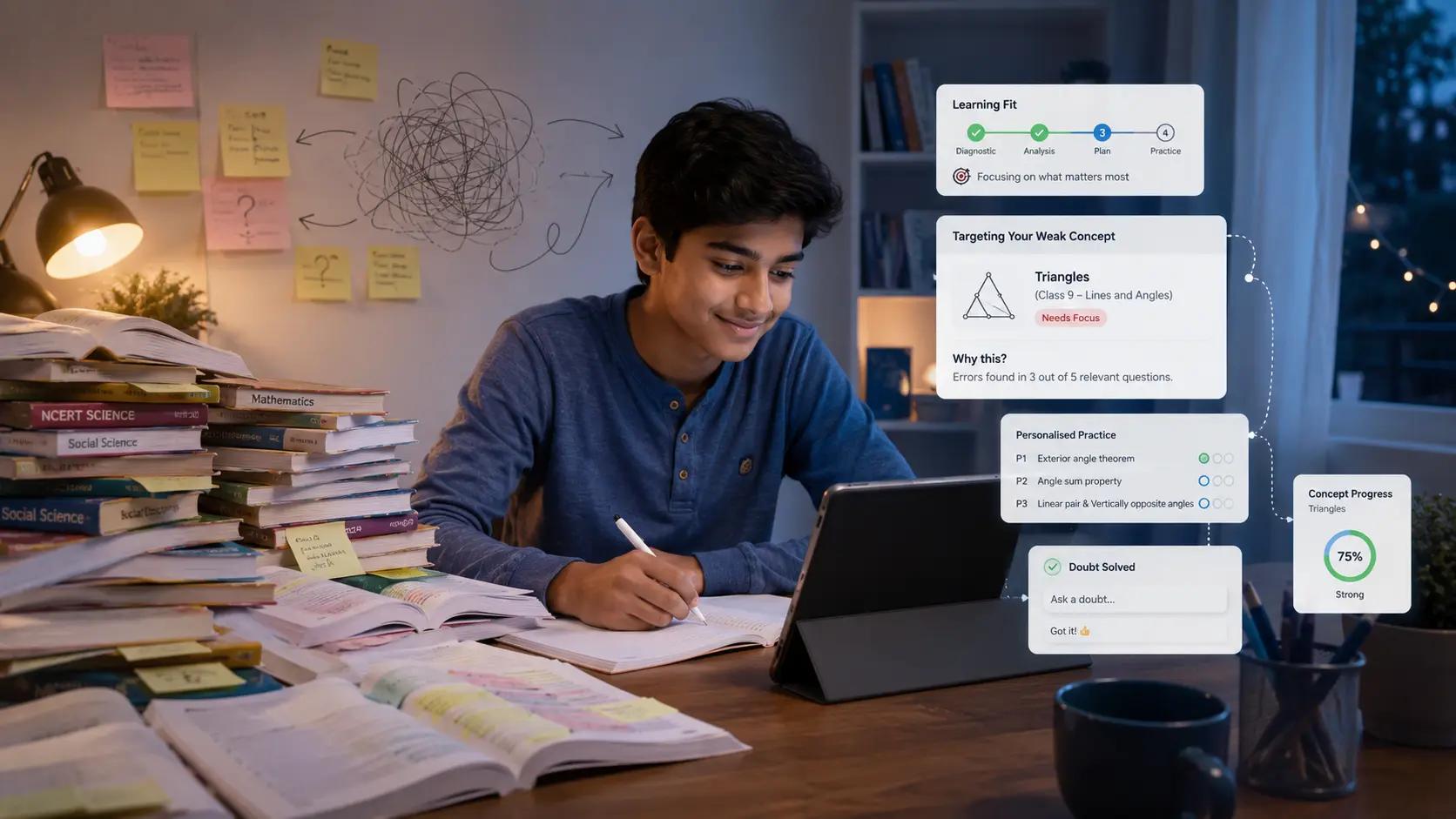
This is the Learning Fit Problem: a student receiving instruction designed for the average, when their actual needs are specific to them. A student who's solid on photosynthesis but confused on mineral absorption doesn't need to revise the whole chapter. They need the exact concept that didn't land, explained in a way that fits how they think about it, followed immediately by a question that confirms they've got it.
That specificity is what personalised learning actually means and it's what AI makes possible at scale.
What Personalisation Looks Like in Practice for CBSE Students
In a traditional study routine, practice is chapter-wide. You finish Chapter 6, you attempt the exercise questions at the back. If you get question 4 wrong, you re-read the chapter. If you get question 7 wrong, you re-read the chapter again. The feedback loop is broad and slow.
Personalised AI-driven learning narrows that loop dramatically. Here's what the difference looks like for a Class 9 or Class 10 student:
Without personalisation: Study Chapter → Attempt all questions → Get some wrong → Re-read entire chapter → Repeat
With personalised AI support: Study Chapter → Attempt questions → AI identifies the specific concept behind each error → Student revisits only that concept → Attempts a targeted question on that concept → Confirms closure → Moves forward
The second path takes the same amount of time sometimes less and produces dramatically more precise revision. The student isn't covering ground they've already covered. Every minute is spent on what actually needs work.
This is exactly what the shift toward AI tutors in education is delivering and why the conversation around how AI tutors are transforming personalised learning for students has moved from theory to classroom reality in a very short time.
The Three Layers of Personalisation That Actually Matter
Not all personalisation is equal. For a CBSE student preparing for board exams, there are three specific layers that determine whether personalised support actually improves marks or just feels more convenient.
Layer 1 — Content personalisation Is the practice content mapped to your exact chapter, your exact grade level, and your exact curriculum? Generic AI tools give generically correct answers. A CBSE student needs NCERT-aligned explanations in the language their board paper will use. Content that doesn't match the curriculum adds confusion, not clarity.
Layer 2 — Gap personalisation Does the system identify your specific gap not just the chapter you're working on, but the precise concept within that chapter where your understanding breaks down? This is the difference between "you need to revise Chapter 7" and "you need to revisit the difference between speed and velocity in Chapter 7 before attempting momentum questions."
Layer 3 — Pace personalisation Can you revisit an explanation three times, ask a follow-up question, ask a simpler version of the same question without judgment, without the class moving on? The ability to stay with a concept until it genuinely clicks, rather than moving forward because the syllabus demands it, is the layer most traditional study resources don't offer.
Edzy is built around all three layers for CBSE students specifically curriculum-aligned content, concept-level gap identification through chapter-wise practice, and AI doubt-solving that lets students stay with a concept as long as they need. The combination is what makes personalised support feel genuinely personal rather than just digitally delivered.
Why Personalisation Matters More in CBSE Than in Other Curricula
The CBSE board examination pattern has shifted significantly over the past several years. The introduction of competency-based questions, case-based integrated problems, and assertion-reason formats means the exam is no longer testing whether students remembered a chapter it's testing whether they genuinely understood the concepts well enough to apply them in unfamiliar contexts.
A student who revised by covering chapters can answer direct recall questions reasonably well. The same student will struggle with a case-based question that presents a real-world scenario and requires them to identify which concept applies and why.
Personalised learning builds the kind of understanding that survives that test. When a student has revisited a concept multiple times, in multiple contexts, with immediate feedback each time they don't just remember it. They understand it well enough to reach for it in an unfamiliar problem.
That's the shift personalised AI-driven learning is making possible for CBSE students and it's why a student with access to genuinely personalised revision has a structural advantage over one revising the same way every student in their class is revising.
What Parents Should Look for in an AI Learning Tool
If you're evaluating AI support for your CBSE child, the question isn't whether the tool uses AI. Most do. The question is whether the AI is doing anything genuinely personalised or just delivering content faster.
Three things to check:
Does it identify specific gaps or just flag wrong answers? Flagging a wrong answer tells a student they got it wrong. Identifying the concept behind the error tells them what to study. The second is personalisation. The first is just marking.
Is the content curriculum-specific? An AI tool that explains photosynthesis correctly but in language that doesn't match the NCERT chapter creates a disconnect that makes revision harder, not easier. Curriculum alignment is non-negotiable for CBSE preparation.
Does it allow follow-up questions? A static explanation however clear doesn't personalise. The ability to ask "but why does that step happen?" and receive a relevant answer is what separates an AI tutor from an AI textbook.
Edzy's AI doubt-solving is built around these three criteria students ask in their own words, follow up as many times as needed, and every explanation stays scoped to the NCERT chapter and grade level they're working in.
The Student Who Benefits Most from Personalised Learning
It isn't the student who's already ahead. It's the student who is genuinely trying, putting in hours every week, but not seeing the marks reflect the effort because the effort is going into covering ground rather than closing gaps.
Personalised learning doesn't make studying easier. It makes studying more accurate. The hours stay the same. What changes is the precision every session targeting what actually needs work, rather than what comes next in the textbook.
For a CBSE student in Class 9, 10, or 12, that precision compounds across the academic year into a foundation that doesn't just survive the board exam it performs in it.
Suggested blogs
How to Actually Use AI for CBSE Board Exam Preparation (Without Wasting Time on It)
Most students use AI the wrong way during revision. Here's the method that actually builds retention before board exams.
How AI-Based Practice Helps CBSE Class 10 Students Transition to Class 11
Navigating the academic leap from Class 10 to Class 11 with AI support
How AI Can Help CBSE Class 10 Students Revise Smarter During Holidays
Discover how AI tools can make holiday study effective yet enjoyable for CBSE Class 10 students.

Ethical Use of AI Tools During CBSE Class 10 Exam Preparation
Navigating AI responsibly for effective exam preparation