
Why Your Study Sessions Feel Productive But Your Marks Don't Reflect It
The retention gap is why effort and results don't always match here's what's actually happening and how to fix it.
Most CBSE students measure a study session by how much they covered. But covering content and retaining content are two completely different things. This blog introduces the Retention Gap the distance between feeling like you've studied and being able to recall it under exam conditions and a practical Three-Day Rule that restructures when retrieval happens to build lasting memory without adding extra study time.

Listen to this article
Why Your Study Sessions Feel Productive But Your Marks Don't Reflect It
You spent two hours on the chapter. You read every page. You felt like you understood it.
Then the test came and you went blank on questions you were sure you knew.
This isn't an intelligence problem. It isn't even a focus problem. It's a retention gap the distance between feeling like you've studied something and actually being able to recall it when it counts. And it's one of the most common reasons CBSE students put in genuine effort and still don't see the marks they deserve.
What the Retention Gap Actually Is
Most students measure the success of a study session by how much they covered. Finished the chapter session successful. Read all the notes session successful.
But covering content and retaining content are two completely different things. You can read a chapter end to end and retain almost none of it, because reading without active processing is passive exposure and passive exposure doesn't build durable memory.
The Retention Gap is the space between those two things. It's not visible while you're studying. It only shows up three days later when you try to recall something and realise it's gone.
Why This Happens: The Memory Problem Nobody Explains
Here's the part most students never get told.
Memory doesn't work like a recording. It works more like a muscle it gets stronger when you use it, and it fades when you don't. Reading something once creates a weak initial trace. Without retrieval without actively pulling the information back out of your memory that trace fades quickly, often within 24 to 48 hours of first reading it.
This is the science behind why children forget what they studied even after sitting at their desk for an hour. It's not that the studying didn't happen. It's that the studying wasn't designed to build retention it was designed to cover content. There's a detailed breakdown of exactly how this works, and what parents and students can do about it, in this piece on why children forget what they studied and how AI helps close the learning gap worth reading if you want to understand the full picture behind the Forgetting Curve and what actually defeats it.
The short version: the only studying that builds lasting memory is studying that involves retrieval putting the book down and pulling information back out, rather than reading it again.
The Two Types of Retention Failure
Not all retention gaps are the same. Knowing which one you're dealing with changes how you fix it.
Type 1 — You understood it but didn't reinforce it. You genuinely understood the concept when you first read it. But you didn't revisit it within 24–48 hours, so the memory trace faded before it had a chance to strengthen. This is the most common type, and the fix is straightforward: spaced retrieval. Attempt a question on the concept the next day, not the next week.
Type 2 — You thought you understood it but there was a gap underneath. This one is harder to spot. The concept felt clear while reading, but there was actually a point of confusion that passed too quickly to register. Three days later, when you try to recall it, the gap surfaces not as "I forgot this" but as "I was never quite sure about this to begin with."
Type 2 is what Edzy's AI doubt-solving is specifically designed to catch. When you attempt a practice question on a concept and can't answer it, Edzy identifies whether the issue is retrieval (you knew it but can't recall it right now) or understanding (there's still a gap in how the concept works). The distinction matters because the two types need different responses and mixing them up wastes revision time.
How to Close the Retention Gap: The Three-Day Rule
The most practical change you can make to your study routine costs no extra time it just restructures when things happen.
Day 1: Study the chapter or concept. At the end, write three things you learned from memory not copied from notes, written from recall. This single act doubles the initial memory trace compared to reading alone.
Day 2: Without opening the textbook, attempt two questions on what you studied. Get them wrong? That's fine — the retrieval attempt itself strengthens memory even when you can't fully answer. Then check your answer, identify exactly what you missed, and read only that section.
Day 3: One question, from memory. If you can answer it, the concept is encoded. If you can't, repeat Day 2.
This is the Three-Day Rule three short retrieval sessions spread across 72 hours that take less total time than re-reading a chapter once, and build dramatically stronger retention.
Where AI Fits Into This
AI doesn't solve the Retention Gap on its own. But it makes the Three-Day Rule much easier to follow consistently.
The practical problem with self-testing is that most students don't have a ready supply of questions at the right level, in the right format, for the exact concept they just studied. Generating your own questions takes time. Waiting for school tests means the 24-hour window has long passed.
Edzy solves this by surfacing chapter-wise practice questions mapped to NCERT learning outcomes so after studying any CBSE chapter, you can immediately attempt concept-level questions rather than waiting for the next test or spending revision time building your own. The questions are scoped to your grade level and curriculum, which means you're practising in the exact format and language your board paper will use.
More importantly, when a practice question surfaces a gap when you attempt it and can't answer it Edzy's doubt-solving lets you resolve that gap immediately, in plain language, with a curriculum-anchored explanation. The retrieval attempt + immediate doubt resolution + re-attempt cycle is the closest thing to a complete retention loop that a self-studying CBSE student can run without a tutor.
The Subjects Where the Retention Gap Hits Hardest
The Retention Gap affects every subject, but it's most damaging in subjects where concepts build on each other.
Mathematics is the clearest example. A gap in one chapter doesn't stay in that chapter it becomes a recurring obstacle in every chapter that uses the same underlying concept. Students often describe this as "I'm just bad at Maths," when what they actually have is a specific unresolved gap from two months ago that keeps resurfacing.
Science in Class 9 and 10 follows the same pattern. Chemical reactions, electricity, life processes each topic in the CBSE Science syllabus assumes earlier concepts are solid. A retention gap in Chapter 1 compounds through Chapters 6, 7, and 8 without the student realising where the problem started.
Social Science is less obviously sequential, but terminology and frameworks from early chapters the structure of government, the concept of federalism, the causes of historical events reappear as context in later chapters. Students who never properly retained the earlier concepts find later chapters confusing in ways that are hard to diagnose.
In all three cases, the fix is the same: catch the gap early, close it immediately, and test the closure before moving forward.
One Practical Test for Right Now
Before your next study session, try this:
Pick any chapter you "finished" in the last two weeks. Without opening the textbook, write a five-point summary of what the chapter covered. Then open the textbook and check.
The points you missed the ones that surprised you are your Retention Gap for that chapter. They're also exactly what you should be practising tomorrow, not the points you already remembered.
That gap between what you thought you retained and what you actually retained is the real measure of where your revision needs to go next. Everything else is already done.
Suggested blogs

Why You Shouldn’t Skip Steps in Maths (Even If You Know the Answer)
Understanding the importance of step-by-step problem-solving in CBSE Mathematics.

How to Improve Accuracy in Maths Without Extra Practice Hours
Why mastering accuracy is the key to unlocking your true potential in Maths.
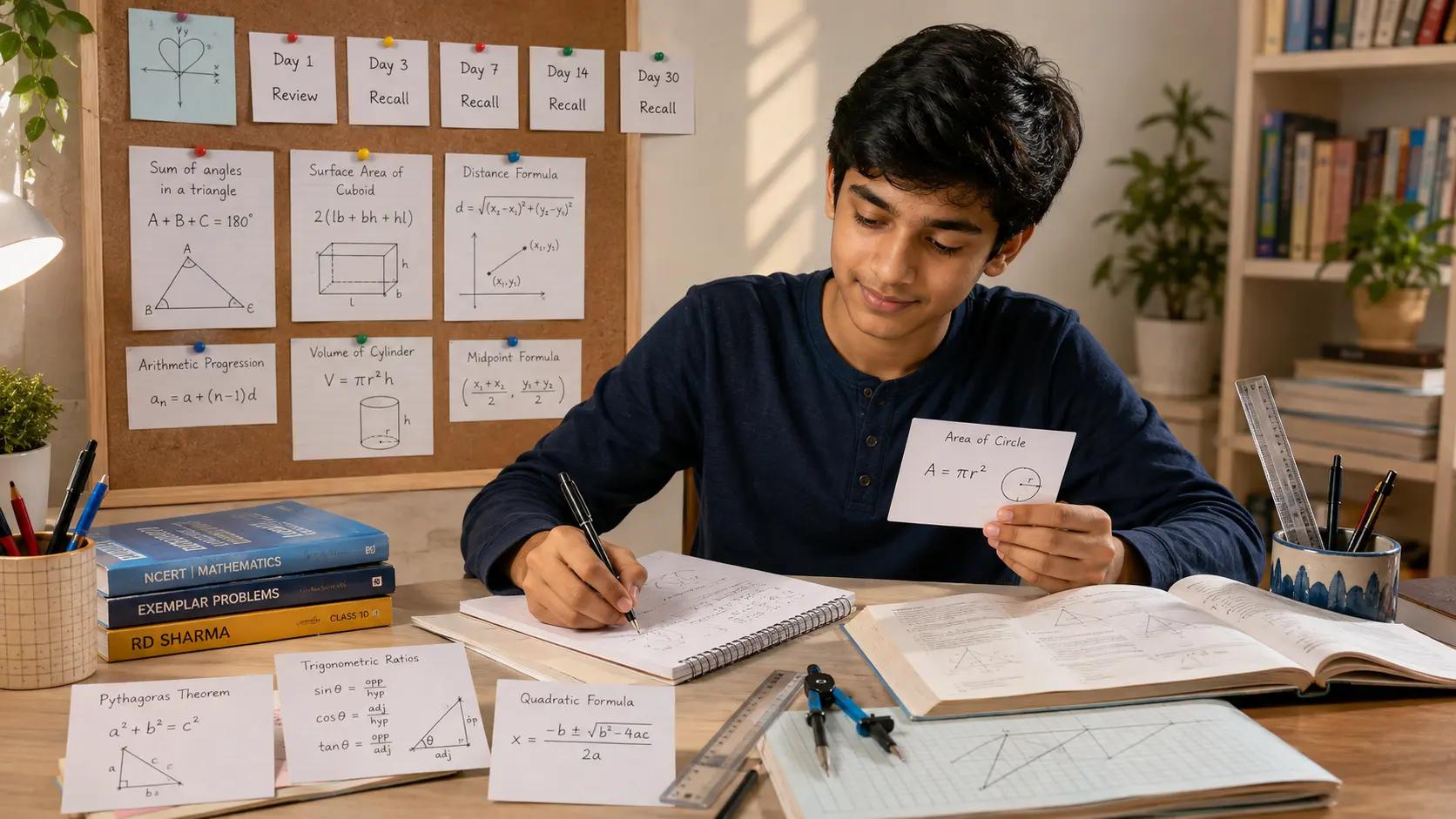
How to Revise Formulas in Maths Without Forgetting Them
Mastering math formulas through understanding and practice — a guide for CBSE students.

How to Identify Your Weak Areas in Studies (And Fix Them Fast)
Transforming academic weaknesses into strengths through targeted strategies.