EdzyEdzy
AI Tutor
CBSE AI TutorStep-by-step CBSE study help for Classes 6-12.
WhatsApp TutorGet AI tutor help directly on WhatsApp.
CBSE
Class 6CBSE Class 6 subjects and study material.EnglishMathematicsHindiUrdu
Class 7CBSE Class 7 subjects and study material.EnglishMathematicsHindiUrdu
Class 8CBSE Class 8 subjects and study material.EnglishMathematicsHindiUrdu
Class 9CBSE Class 9 subjects and study material.EnglishMathematicsHindiUrdu
Class 10CBSE Class 10 subjects and study material.EnglishMathematicsHindiUrdu
Class 11CBSE Class 11 subjects and study material.EnglishMathematicsHindiUrdu
Class 12CBSE Class 12 subjects and study material.EnglishMathematicsHindiUrdu
Play
DuelChallenge another student in a quick learning duel.
RumbleJoin live academic competitions and leaderboards.
BadgesTrack milestones and learning achievements.
Get AppDownload Edzy for faster access on mobile.
Schools
Inter-School ChampionshipExplore Edzy's school championship.
School InstitutionBrowse schools and institutions.
State Wise SchoolFind schools by state.
District Wise SchoolFind schools by district.
Resources
StudyStudy ToolsCalculatorPlanners
ContentBlogsNews Article
CompareEdzy vs GPTEdzy vs GeminiEdzy vs Others
Buy
SearchDownload AppLogin
EdzyEdzy

Edzy for Classes 6-12

Edzy is a personal AI tutor for CBSE and State Board students, with curriculum-aligned guidance, practice, revision, and study plans that adapt to each learner.

  • Email: always@edzy.ai
  • Phone: +91 96256 68472
  • WhatsApp: +91 96256 68472
  • Address: Sector 63, Gurgaon, Haryana

Follow Edzy

Browse by Class

  • CBSE Class 6
  • CBSE Class 7
  • CBSE Class 8
  • CBSE Class 9
  • CBSE Class 10
  • CBSE Class 11
  • CBSE Class 12
Explore the CBSE resource hub

Explore Edzy

  • Study Resources
  • Free Study Tools
  • Best Apps for Board Exams
  • Edzy vs ChatGPT
  • About Us
  • Why We Built Edzy
  • Blog
  • CBSE AI Tutor
  • Chrome Extension

Support & Legal

  • Help & FAQs
  • Accessibility
  • Privacy Policy
  • Terms & Conditions
  • Refund Policy
  • Cookie Policy
  • Site Directory

© 2026 Edzy. All rights reserved.

Curriculum-aligned learning paths for students in Classes 6-12.

CBSE
Class 9
Science
Exploration
Journey Inside the Atom

Revision Guide

Practice Hub

Revision Guide: Journey Inside the Atom

Structured practice

Journey Inside the Atom - Quick Look Revision Guide

Your 1-page summary of the most exam-relevant takeaways from Exploration.

This compact guide covers 20 must-know concepts from Journey Inside the Atom aligned with Class 9 preparation for Science. Ideal for last-minute revision or daily review.

Revision Guide

Revision guide

Complete study summary

Essential formulas, key terms, and important concepts for quick reference and revision.

Key Points

1

Atoms are the building blocks of matter.

Every physical substance around us is made of atoms, which are the smallest entities of matter.

2

Acharya Kanada proposed 'parmanus'.

Ancient Indian thinker Kanada suggested that matter is made of indivisible particles called parmanus, the origin of atomic theory.

3

Dalton's atomic theory basics.

John Dalton proposed that all matter is composed of indivisible atoms, setting the foundation for modern atomic theory.

4

Thomson’s plum pudding model.

J.J. Thomson suggested that atoms contain negatively charged electrons within a positively charged sphere—a model later disproven.

5

Rutherford's gold foil experiment.

Disproved Thomson's model by showing that atoms consist of a small nucleus with electrons orbiting around it.

6

Planetary model of Rutherford.

Rutherford proposed that the atom is mostly empty space, with a dense nucleus at the center, where protons reside.

7

Bohr’s model and energy levels.

Niels Bohr introduced fixed electron orbits or energy levels, explaining atomic stability through quantization of energy.

8

Subatomic particles: protons, electrons, neutrons.

Atoms consist of positively charged protons, negatively charged electrons, and neutral neutrons that contribute to atomic mass.

9

Mass number vs Atomic number.

The mass number is the sum of protons and neutrons in the nucleus, while the atomic number is the number of protons.

10

Isotopes defined.

Isotopes are atoms of the same element with the same atomic number but different mass numbers due to varying neutrons.

11

Valency and combining capacity.

Valency is the number of electrons an atom can gain, lose, or share to achieve a stable electronic configuration.

12

Electronic configuration rules.

Electrons fill atomic shells from lowest to highest energy, obeying the 2n² rule for maximum electrons in each shell.

13

Neutrons stabilize the nucleus.

Neutrons prevent proton repulsion in the nucleus by adding mass without charge, maintaining atomic stability.

14

Average atomic mass calculation.

The weighted average atomic mass considers the relative abundance of an element's isotopes in nature.

15

Isobars explained.

Isobars are different elements with the same mass number but different atomic numbers, showcasing diverse atomic structures.

16

Limitations of Bohr's model.

Bohr’s model cannot fully explain the complex behavior of electrons, which exist in probabilistic states rather than fixed paths.

17

Nuclear force role.

The strong nuclear force binds protons and neutrons together in the nucleus, counteracting electrical repulsion between protons.

18

Chadwick's neutron discovery.

James Chadwick confirmed the existence of neutrons in 1932, which explained the mass discrepancies in atomic theory.

19

Impact of atomic theory.

The evolution of atomic theory significantly advanced chemistry and physics, influencing technology, medicine, and energy solutions.

20

Importance of electron clouds.

In modern physics, electrons are described as existing in a cloud-like region around the nucleus, indicating probable locations.


Learn Better On The App
Built for collaborative learning

Study With Friends

Join classmates, challenge them in duels, and make practice more engaging.

Quick duels
Shared momentum

Faster access to practice, revision, and daily study flow.

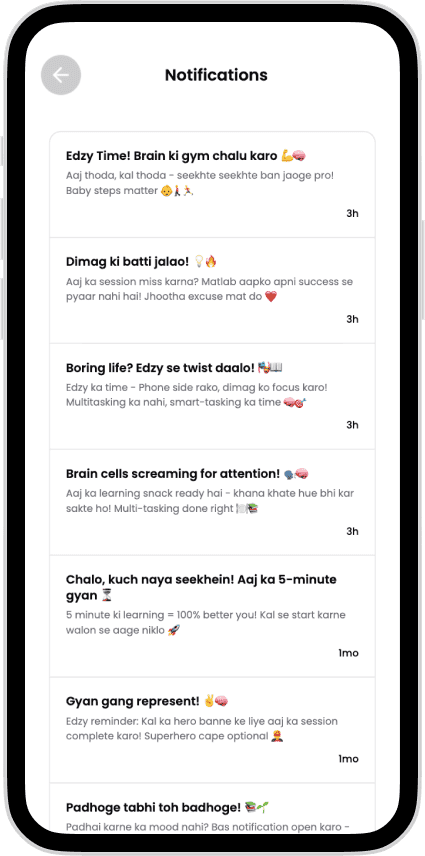
Edzy mobile app preview

Chapters related to "Journey Inside the Atom"

Tissues in Action

Start chapter

Describing Motion Around Us

Start chapter

Exploring Mixtures and their Separation

Start chapter

How Forces Affect Motion

Start chapter

Work, Energy, and Simple Machines

Start chapter

Atomic Foundations of Matter

Start chapter

Sound Waves: Characteristics and Applications

Start chapter

Reproduction: How Life Continues

Start chapter

Patterns in Life: Diversity and Classification

Start chapter

Earth as a System: Energy, Matter, and Life

Start chapter

Worksheet Levels Explained

This drawer provides information about the different levels of worksheets available in the app.

Journey Inside the Atom Summary, Important Questions & Solutions | All Subjects

Question Bank

Worksheet

Revision Guide