
How to Study One Chapter Properly (Instead of Skimming Everything)
Master the art of deep learning for academic success
Explore a structured approach to studying one chapter thoroughly, enhancing comprehension and retention for CBSE/NCERT students.


Gaurav Parashar
@gauravparashar
Listen to this article
How to Study One Chapter Properly (Instead of Skimming Everything)
Most students don't have a reading problem. They have a processing problem.
They sit with the textbook open, move through every page, and still close it feeling like they understood nothing — or worse, feeling like they understood everything, only to go blank on the same content three days later during revision.
The difference between skimming a chapter and actually learning it isn't how long you spend on it. It's what you do with it while you're reading. Here's a structured approach that works for CBSE and NCERT chapters specifically — one that replaces the rush with a method that actually sticks.
Why Rushing Through Chapters Backfires
The pressure to cover a packed CBSE syllabus pushes most students into a completion mindset — the goal becomes finishing the chapter, not understanding it. A few common reasons this happens:
A tight academic schedule with multiple subjects competing for time
Fear of falling behind classmates who seem to be moving faster
No clear method for what "understanding a chapter" actually means
The problem with the completion mindset is that it creates an illusion of progress. The chapter is done — but three weeks later, nothing is retrievable. Quality of engagement with one chapter consistently outperforms the quantity of chapters covered.
Step 1: Preview Before You Read
Before reading a single paragraph, spend five minutes skimming the chapter structure. Look at the headings, subheadings, diagrams, and any bold or highlighted terms. This gives your brain a framework — a rough map of where the chapter is going — before the details arrive.
This matters because the brain retains information better when it can attach new details to an existing structure. Without the preview, each new idea arrives in isolation. With it, every paragraph has a place to land.
For a chapter on photosynthesis, for example, you'd notice before reading that the chapter covers the process, the inputs and outputs, and the role of chlorophyll. Now when you encounter each of those in the text, you're filling in a map rather than reading from a blank page.
Step 2: Read Actively, Not Passively
Passive reading is moving your eyes across text while your mind does something else. Active reading is engaging with the text as a dialogue — constantly asking what the author is trying to explain and whether you can picture it.
Practically, this means:
Underlining the single most important sentence in each paragraph — not every sentence, just one
Writing a two-word summary in the margin after each section
Pausing at every diagram and trying to explain it out loud before reading the caption
The goal isn't annotation for its own sake. It's creating moments of genuine processing rather than passive exposure.
Step 3: Break the Chapter Into Parts and Set a Goal for Each
Large chapters feel overwhelming as a single block. The solution is to treat each heading or subheading as a separate study unit — read it, process it, and confirm you've understood it before moving to the next.
For each section, set a simple goal: be able to explain this section in two sentences without looking at the text. If you can, move forward. If you can't, re-read that section only — not the whole chapter.
This keeps you honest. Most students re-read entire chapters when confused, which dilutes focus. The problem is almost always in one specific section, and that's the only section that needs attention.
Step 4: Ask Questions While You Read
This is the step most study guides mention and most students skip — because it feels slower. It isn't. It's the step that makes everything else faster.
For every major concept in the chapter, ask three things:
What is this actually saying? Can I put it in my own words?
Why does this work this way? What's the logic underneath?
How does this connect to something I already know?
The How question is particularly powerful. It forces you to link the new concept to your existing knowledge — and linked knowledge is dramatically more retrievable than isolated facts.
If you find yourself stuck on the Why — unable to answer why a concept works the way it does — that's a doubt, and it needs to be resolved before you move on. Unresolved doubts don't stay contained: in CBSE subjects, concepts build on each other, and a gap in one chapter quietly undermines the next. This is the core argument in a piece on how CBSE students accumulate Doubt Debt across chapters — worth reading if you want to understand why doubts compound and what to do about them chapter by chapter.
Step 5: Practice Immediately After Each Section
Don't wait until the end of the chapter to test yourself. After completing each section, attempt one or two questions on it before moving forward.
Most NCERT textbooks include questions at the end of each chapter — use them. But use them section by section, not all at once at the end. If a question stumps you, that tells you exactly where to re-read. If you can answer it confidently, move on.
Other effective immediate practice options:
Create a flashcard for the key term introduced in that section
Solve one practice problem if the section is mathematical
Explain the section's core idea to a study partner or out loud to yourself
Teaching what you've just learned even if you're explaining it to no one is one of the most reliable ways to identify what you genuinely understood versus what you only feel like you understood.
Step 6: Revise Within 24 Hours
Retention drops sharply in the first 24 hours after learning something new. Revisiting the chapter the following day — even for just 15 minutes significantly slows that drop.
This doesn't mean re-reading the chapter. It means:
Re-reading only your margin notes and underlines
Attempting two or three questions without looking at the text first
Identifying anything you can't recall clearly and re-reading only that section
Done consistently across every chapter, this 15-minute follow-up compounds into a significant advantage by the time exams arrive — because the content has been encoded twice, not once.
Step 7: Test Until You Can Teach It
The final check before marking a chapter as genuinely understood: can you explain the core concept to someone else without referring to the textbook?
This is the Feynman Technique applied to chapter study. If you can explain it clearly, in plain language, the concept is yours. If you reach for the book, there's still a gap — and you've just identified exactly where it is.
Try these methods:
Write a half-page summary of the chapter in your own words
Attempt your own quiz — three questions you'd ask if you were setting the test
Exchange that quiz with a classmate and test each other
The goal of all of this isn't to finish chapters faster. It's to finish fewer chapters with the confidence that each one is actually learned — which, before board exams, is worth far more than a long list of chapters "covered."
Mastery of one chapter is worth more than surface familiarity with ten. The students who do well in CBSE board exams aren't usually the ones who covered the most they're the ones who left the fewest gaps.
Suggested blogs
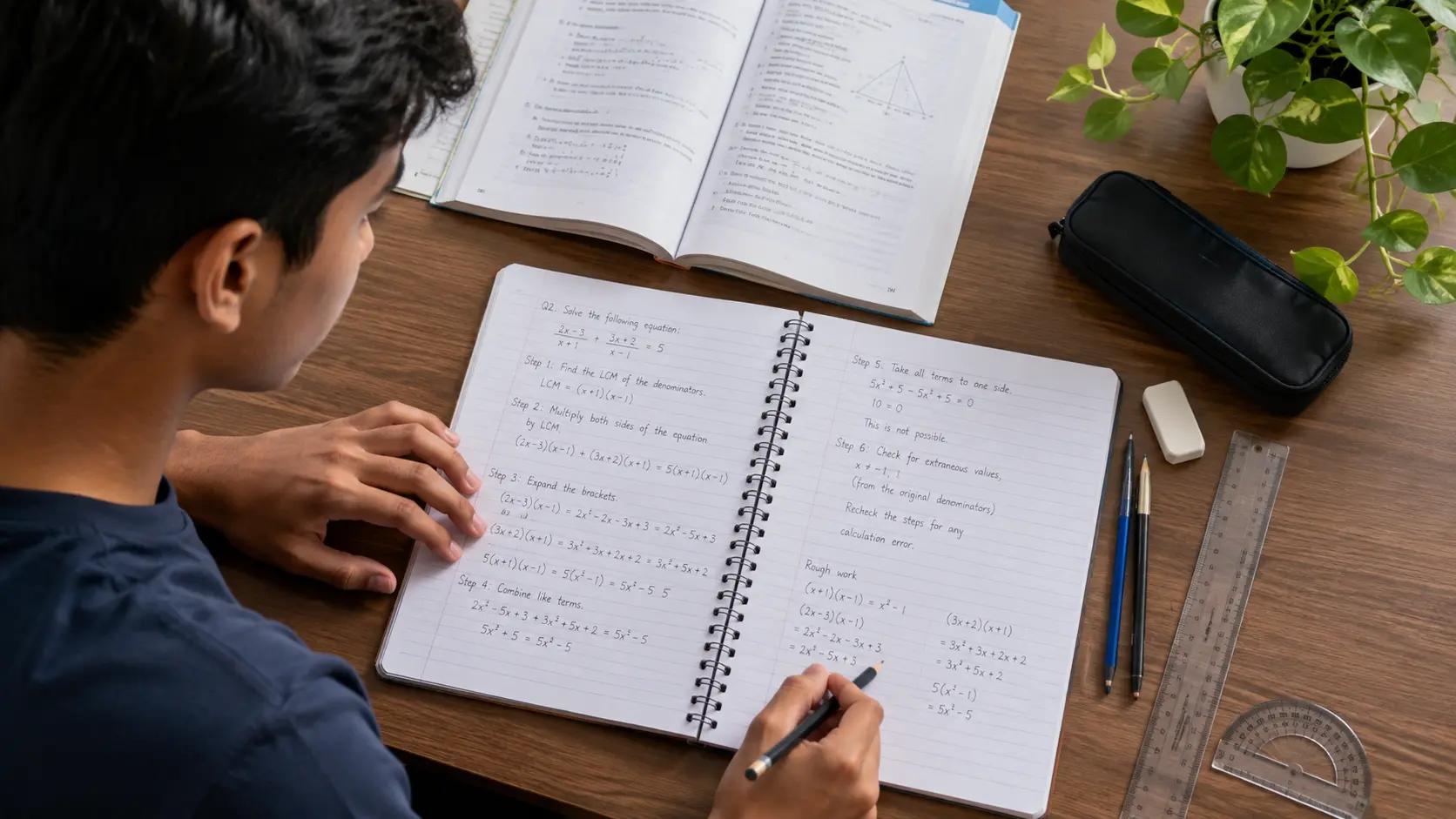
Why You Shouldn’t Skip Steps in Maths (Even If You Know the Answer)
Understanding the importance of step-by-step problem-solving in CBSE Mathematics.

How to Improve Accuracy in Maths Without Extra Practice Hours
Why mastering accuracy is the key to unlocking your true potential in Maths.

How to Revise Formulas in Maths Without Forgetting Them
Mastering math formulas through understanding and practice — a guide for CBSE students.

How to Identify Your Weak Areas in Studies (And Fix Them Fast)
Transforming academic weaknesses into strengths through targeted strategies.