
Class 6 Maths: How to Understand Fractions Using Everyday Examples
Understanding fractions through real-life scenarios makes learning engaging and effective for CBSE students.
Many Class 6 students struggle with fractions, leading to confusion in mathematics. This blog introduces the concept of 'Fractional Thinking', a method that uses everyday examples to simplify fractions. Readers will learn practical ways to grasp fractions, common mistakes to avoid, and how to practice independently.

Hari krishna
@harikrishna2
Listen to this article
Class 6 Maths: How to Understand Fractions Using Everyday Examples
Understanding the Importance of Fractions in Class 6 Maths
Fractions are a fundamental concept in mathematics, especially for Class 6 students studying under the CBSE curriculum. They represent parts of a whole and are crucial for understanding more complex mathematical ideas later on. In the NCERT Class 6 Mathematics syllabus, fractions are introduced in Chapter 2, where students learn to identify, compare, and perform operations with fractions. This foundational knowledge is essential not just for exams but also for everyday problem-solving. For strategies on how to maximize study time, students can explore various techniques that enhance their learning experience.
Before diving into fractions, students should be comfortable with basic concepts such as whole numbers and the idea of division. Understanding how to divide a whole into equal parts is vital for grasping fractions. For instance, if a student knows that dividing a pizza into 4 equal slices means each slice is a quarter of the pizza, they are already on their way to understanding fractions. Additionally, learning how to avoid last-minute cramming can help reinforce these foundational concepts. To further enhance their understanding, students can also read about improving their study routine.
Core Concepts Behind Understanding Fractions Using Everyday Examples
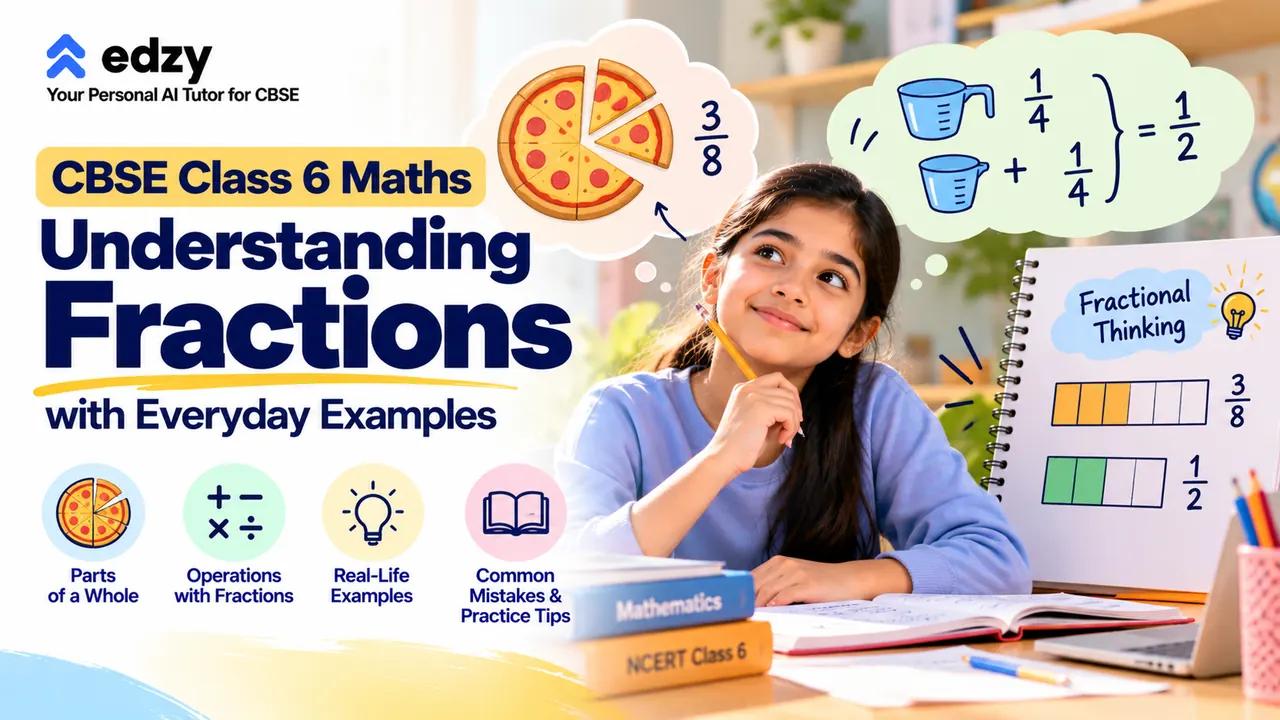
To effectively understand fractions, students can relate them to everyday situations. For example, consider a chocolate bar divided into 8 equal pieces. If a student eats 3 pieces, they have consumed 3/8 of the chocolate bar. This real-world example helps students visualize fractions as parts of a whole, making the concept more relatable and easier to grasp. Another practical example is measuring ingredients while cooking. If a recipe calls for 1/2 cup of sugar and a student only has a 1/4 cup measuring cup, they need to understand that they will need two 1/4 cups to make 1/2 cup. This scenario not only reinforces the concept of fractions but also teaches students how to apply their knowledge in practical situations. For more tips on using mistakes as learning tools, students can refer to additional resources.
Introducing the Named Concept: Fractional Thinking
The concept of Fractional Thinking involves viewing fractions as parts of a whole in various real-life contexts. This approach encourages students to think critically about how fractions apply to their daily lives, enhancing their understanding and retention of the concept. For instance, when sharing a cake among friends, students can visualize how many pieces each person gets and what fraction of the cake remains. By applying Fractional Thinking, students can better grasp the significance of fractions beyond the classroom.
Using Fractional Thinking, students can also explore scenarios like sharing toys or dividing time for activities. For example, if a child has 12 toys and shares them equally with 3 friends, each friend receives 4 toys, which can be expressed as 4/12 of the total toys. This method not only makes learning engaging but also helps students remember the concept of fractions through relatable experiences.
Worked Example: Solving Fraction Problems with Real-Life Scenarios
Let's take a closer look at a worked example using Fractional Thinking. Imagine a Class 6 student is helping their parent bake cookies. The recipe requires 3/4 cup of flour, but they only have a 1/4 cup measuring cup. To find out how many 1/4 cups are needed, the student can set up a simple division: 3/4 divided by 1/4. This can be visualized as how many times 1/4 fits into 3/4.
To solve this, students can think of it as follows: if they have 3 pieces of 1/4, they can combine them to make 3/4. Thus, the answer is 3. This example not only teaches students how to perform operations with fractions but also reinforces the idea of fractions as parts of a whole in a practical context.
Common Misconceptions and Corrections in Understanding Fractions
One common misconception among Class 6 students is treating fractions as whole numbers. For instance, a student might think that 1/2 is less than 1/3 because they see the numerator (1) is smaller than the numerator of 1/3. However, when they visualize it using Fractional Thinking, they can see that 1/2 represents a larger portion of a whole than 1/3. This misunderstanding can lead to errors in comparisons and operations involving fractions.
Another frequent mistake is failing to find a common denominator when adding or subtracting fractions. For example, if a student tries to add 1/4 and 1/2 without converting 1/2 to 2/4, they will arrive at an incorrect answer. Teaching students to always look for a common denominator can help them avoid this pitfall. They can practice this concept by using real-life examples, such as combining different amounts of ingredients in cooking.
Independent Practice and Self-Check: Building Confidence in Fractions
To reinforce their understanding of fractions, students should engage in independent practice using Fractional Thinking. They can create their own examples based on daily activities, such as sharing snacks or dividing screen time among friends. For instance, if a student has 10 candies and wants to share them with 2 friends, they can calculate how many candies each person gets by dividing 10 by 3, which equals 3 with a remainder of 1, or 3 1/3 candies each.
Additionally, students can check their understanding by solving problems from their NCERT textbooks or practicing with past exam papers. For example, they can refer to Chapter 2 of their Class 6 Mathematics book and complete exercises that involve adding, subtracting, and comparing fractions. This practice not only solidifies their knowledge but also prepares them for the types of questions they will encounter in their CBSE board exams.
For further strategies on how to improve study habits, students can refer to our blog on improving exam speed. This resource provides insights into managing time effectively during tests, which is crucial for subjects like Mathematics where fractions often appear in various formats.
Conclusion: Mastering Fractions Through Real-Life Applications
Understanding fractions is essential for Class 6 students as they build a foundation for future mathematical concepts. By employing Fractional Thinking and relating fractions to everyday situations, students can enhance their comprehension and retention of this critical topic. As they practice and apply these concepts, they will become more confident in their ability to solve fraction-related problems, ultimately leading to better performance in their CBSE examinations. Every mark a CBSE student loses to a careless error is a mark they already earned — the only task left is making sure it shows up on the paper.
Suggested blogs

Class 6 Science: How to Separate Mixtures With Simple Home Experiments
Mastering the art of separating mixtures through engaging home experiments.

How to Strengthen Weak CBSE Class 10 Concepts After Board Exams
Revisit and reinforce your foundational concepts for future success

Best Way to Revise CBSE Class 10 Maths Formulas During Exam Gaps
Efficient strategies for mastering CBSE Class 10 Maths formulas

How to Revise CBSE Class 10 English Writing Sections in One Week
Master the writing sections of CBSE Class 10 English in just one week.