
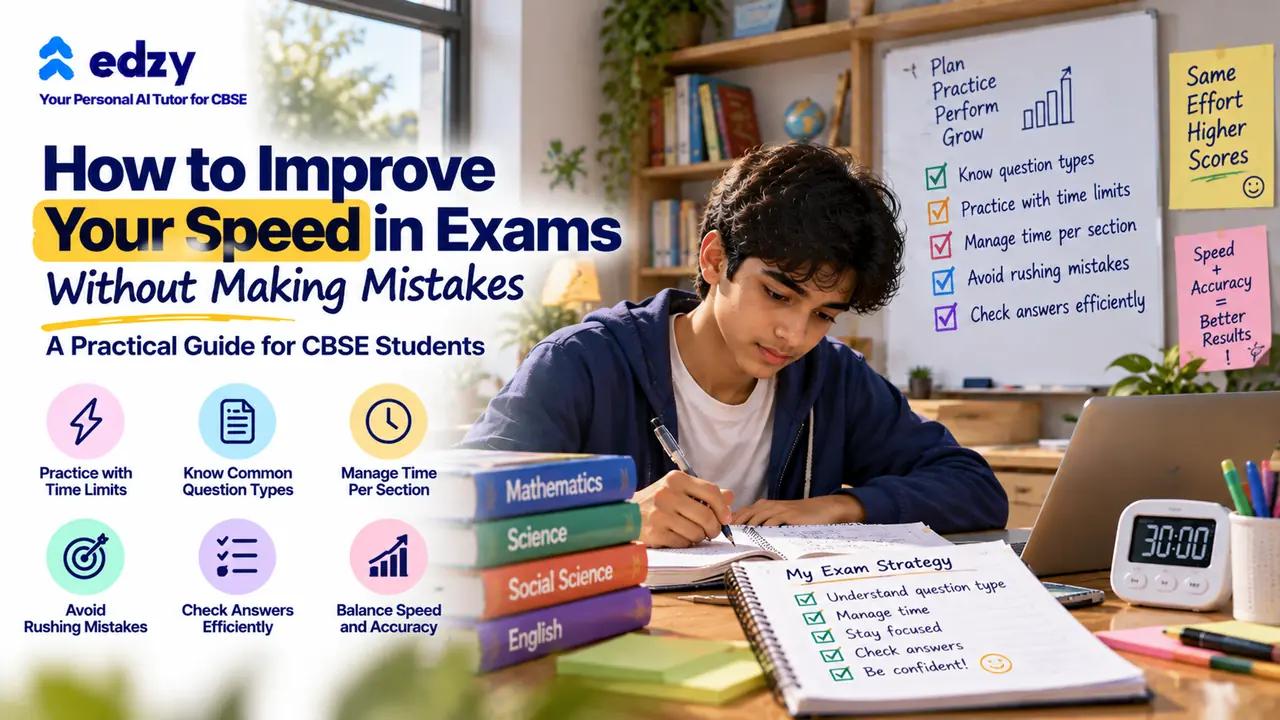
How to Improve Speed in Exams Without Making More Mistakes
Mastering the art of speed and accuracy for CBSE exams.
Many CBSE students struggle with balancing speed and accuracy during exams, leading to careless mistakes. This blog introduces the concept of the Speed-Accuracy Balance Framework, which helps students enhance their performance. Readers will learn effective strategies to improve their exam speed without compromising on accuracy, practical tips for managing time, and how to practice effectively under pressure.

Gaurav Parashar
@gauravparashar
Listen to this article
How to Improve Speed in Exams Without Making More Mistakes
Why Speed Matters in Exams
In the high-pressure environment of CBSE examinations, speed is crucial. Students often face a time crunch, especially in subjects like Mathematics and Science, where complex problems require quick thinking and efficient problem-solving skills. For instance, a Class 10 student tackling a lengthy case-based question in Mathematics must navigate through multiple steps quickly to avoid running out of time. The ability to answer questions swiftly can significantly impact overall performance, making it essential for students to develop strategies that enhance their speed while maintaining accuracy. To learn more about effective strategies, check out how to improve your speed in solving questions before exams.
Common Mistakes When Rushing
When students rush through their exams, they often fall prey to common pitfalls that lead to careless errors. For example, a Class 12 student answering questions on Federalism might misinterpret a statement due to hasty reading, resulting in incorrect answers. Additionally, skipping steps in calculations, particularly in subjects like Physics, can lead to wrong conclusions. Recognizing these mistakes is the first step toward improving speed without sacrificing accuracy. Students must learn to identify their tendencies to rush and implement strategies to mitigate these errors. For more on avoiding mistakes, consider reading how to avoid last-minute cramming before exams.
Improving Familiarity with Questions
One effective way to enhance speed is by becoming familiar with the types of questions commonly asked in CBSE exams. For instance, a Class 9 student preparing for the Science exam should focus on understanding the formats of questions related to Photosynthesis or Laws of Motion. By reviewing past year papers and sample questions, students can develop a sense of what to expect, which can significantly reduce the time spent on each question. Familiarity breeds confidence, allowing students to approach questions more quickly and accurately. To dive deeper into this topic, check out how to use past year papers the right way.
Practicing Under Time Limits
Simulating exam conditions during practice sessions is vital for improving speed. Students should set strict time limits when working on practice papers or sample questions. For example, a Class 10 student preparing for the board exams could allocate 30 minutes to complete a set of 10 questions on Quadratic Equations. This practice not only helps in managing time effectively but also builds the stamina needed for the actual exam. Over time, students will find that they can answer questions more quickly while maintaining a high level of accuracy.
Managing Time Per Section
Effective time management is crucial during exams. Students should allocate specific time slots for each section based on the number of questions and their difficulty level. For instance, in a Class 12 Physics exam, if there are 20 questions and a total of 3 hours, a student might decide to spend 1 hour on the first 10 questions, allowing 2 minutes per question. This strategy ensures that students do not spend too much time on any single question, which can lead to panic and mistakes. By practicing this approach, students can develop a rhythm that allows them to maintain speed throughout the exam.
Checking Answers Efficiently
One of the most effective strategies for maintaining accuracy while improving speed is to develop a systematic approach to checking answers. Students should allocate a few minutes at the end of each section to review their answers. For example, a Class 10 student might quickly scan their responses to case-based questions in Social Science, ensuring that they have not skipped any parts of the question. This practice not only helps catch careless mistakes but also reinforces the correct answers in the student’s mind, enhancing retention.
Balancing Speed and Accuracy
The key to success in exams lies in balancing speed and accuracy. Students must learn to gauge their pace and adjust it according to the difficulty of the questions. For instance, a Class 11 student tackling assertion-reason questions in Chemistry should recognize when to slow down and analyze the statements carefully to avoid misinterpretation. The Speed-Accuracy Balance Framework can be a useful tool in this regard, allowing students to develop a personalized strategy that works best for them. By practicing this balance, students can improve their overall performance and confidence in exams.
Improving Overall Performance
Ultimately, the goal of improving speed in exams is to enhance overall performance. Students should focus on building a strong foundation in their subjects, as this knowledge will allow them to answer questions more quickly and accurately. For example, a Class 12 student preparing for the board exams in Mathematics should ensure they understand all the core concepts, such as integration and differentiation, to tackle complex problems efficiently. Regular practice, combined with the strategies outlined in this blog, will lead to improved results and reduced exam stress.
Why do CBSE students struggle to maintain speed without making mistakes? Many students find it challenging to balance speed and accuracy due to the pressure of time constraints during exams. This often leads to careless errors, as they rush through questions without fully understanding them. By implementing effective strategies and practicing under timed conditions, students can improve their speed while minimizing mistakes.
In summary, mastering the art of speed in exams is essential for CBSE students. By understanding the common mistakes made when rushing, improving familiarity with question formats, and practicing under time constraints, students can enhance their performance significantly. The Speed-Accuracy Balance Framework serves as a valuable tool in achieving this balance, allowing students to approach their exams with confidence. For further insights on effective exam strategies, consider reading how to check your answers properly in exams and how to revise one day before the exam without panic.
Suggested blogs

How to Revise One Day Before the Exam (Without Panic)
Mastering last-minute revision for CBSE exams without stress.
Class 12 Physics: How to Revise Entire Syllabus Before Boards
Mastering the Class 12 Physics syllabus for board exams through efficient revision strategies.
Class 10 Maths: How to Revise Entire Syllabus Before Boards
Mastering the Class 10 Maths syllabus for board exams requires a strategic approach to revision.
Class 10 Maths: How to Practice Sample Papers Effectively
Mastering sample papers is the key to acing your Class 10 Maths board exams.