
Class 6 Science: How to Separate Mixtures With Simple Home Experiments
Mastering the art of separating mixtures through engaging home experiments.
Students often struggle with understanding how to separate mixtures effectively. This blog introduces the concept of separation techniques through simple home experiments. Readers will learn practical methods, common misconceptions, and a structured approach to mastering this essential science topic.

Hari krishna
@harikrishna2
Listen to this article
Class 6 Science: How to Separate Mixtures With Simple Home Experiments
Learning Objectives and Prerequisites
In Class 6 Science, students delve into the topic of mixtures and their separation. The primary learning objective is to understand the different methods of separating substances in mixtures. Before diving into these techniques, students should have a foundational understanding of what mixtures are, including homogeneous and heterogeneous mixtures, as outlined in the NCERT Class 6 Science textbook. Familiarity with basic laboratory equipment and safety protocols is also beneficial, as students will be conducting simple experiments at home.
Core Concepts Behind How to Separate Mixtures
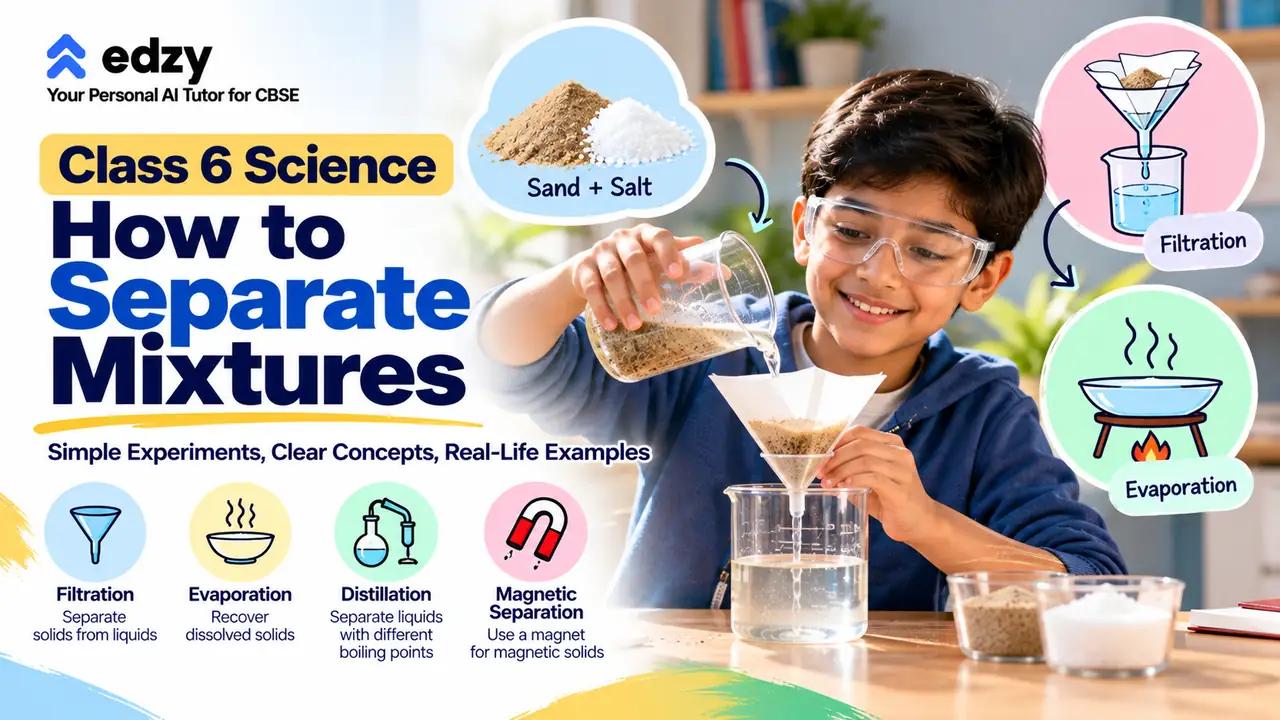
Separation of substances is a fundamental concept in science that allows us to isolate components of mixtures based on their physical properties. The methods of separation include filtration, evaporation, distillation, and magnetic separation. Each method is suitable for specific types of mixtures. For instance, filtration is used to separate solid particles from liquids, while evaporation is effective for separating dissolved solids from liquids. Understanding these concepts is crucial for students as they prepare for their CBSE examinations, particularly in the context of practical applications in real-life scenarios. Students can also benefit from using the last 48 hours before an exam effectively to reinforce their learning.
Worked Example: Separating Sand and Salt
A classic example of separating mixtures at home involves sand and salt. To perform this experiment, students will need a mixture of sand and salt, water, a beaker, and a filter paper. First, dissolve the salt in water, creating a saltwater solution. Next, pour the mixture through the filter paper placed in a funnel. The sand will remain on the filter paper, while the saltwater will pass through. Finally, to retrieve the salt, heat the saltwater solution until the water evaporates, leaving the salt behind. This experiment not only demonstrates the principles of filtration and evaporation but also reinforces the concept of mixtures and their separation. Students can enhance their understanding of time management during such experiments by referring to our article on managing time during a 3-hour exam.
Common Misconceptions and Corrections
One common misconception among students is that all mixtures can be separated using the same method. For instance, many believe that filtration can be used for all types of mixtures, which is not true. Filtration is only effective for heterogeneous mixtures where solid particles are suspended in a liquid. Another misconception is that evaporation can separate all dissolved substances, which is incorrect as some substances may decompose upon heating. Clarifying these misconceptions is essential for students to develop a robust understanding of separation techniques. To further their knowledge, students should consider using mistakes as their biggest study advantage to solidify their grasp of these concepts.
Independent Practice and Self-Check
To reinforce their understanding of separation techniques, students should engage in independent practice by conducting their own experiments. They can try separating different mixtures found at home, such as oil and water or sand and pebbles. After conducting these experiments, students should reflect on the methods used and the outcomes achieved. A self-check can involve answering questions such as: What method did you use? Why was it effective? What challenges did you face? This reflective practice will enhance their learning experience and prepare them for their upcoming assessments. Additionally, students can improve their speed in solving questions by checking out our blog on improving speed in exams without making more mistakes. For those interested in mastering their study habits, exploring how to study smarter, not longer can also be beneficial.
Why Do CBSE Students Struggle with Separation Techniques?
Why do CBSE students struggle with separation techniques? Many CBSE students find it challenging to grasp the concept of separating mixtures due to a lack of practical experience and understanding of the underlying principles. Without hands-on experiments, students may struggle to visualize how different methods work in real-life scenarios. Engaging in simple home experiments can bridge this gap, allowing students to see the practical applications of their theoretical knowledge.
The Mixture Mastery Framework
Introducing the Mixture Mastery Framework, a structured approach to understanding and mastering the separation of mixtures. This framework emphasizes three key components: identification of the mixture type, selection of the appropriate separation method, and execution of the experiment. By following this framework, students can systematically approach any mixture separation task, ensuring they choose the right technique and understand the science behind it. This method not only aids in academic performance but also fosters a deeper appreciation for scientific inquiry.
Applying the Mixture Mastery Framework
To apply the Mixture Mastery Framework, students should first identify the type of mixture they are working with. For example, if they have a mixture of sand and salt, they recognize it as a heterogeneous mixture. Next, they select the appropriate separation method, which in this case would be a combination of filtration and evaporation. Finally, they execute the experiment, documenting their process and results. This structured approach not only simplifies the separation process but also prepares students for more complex scientific challenges in higher classes.
Real-Life Applications of Separation Techniques
Understanding separation techniques has practical implications beyond the classroom. For instance, in industries, separation methods are crucial for purifying substances and recycling materials. Students can relate these concepts to real-world scenarios, such as how water is purified in treatment plants or how oil is separated from water in environmental clean-up efforts. By connecting classroom learning to real-life applications, students can appreciate the relevance of their studies and enhance their motivation to learn.
Conclusion: Embracing the Science of Separation
Mastering the separation of mixtures through simple home experiments empowers students to take charge of their learning. By applying the Mixture Mastery Framework, they can approach separation tasks with confidence and clarity. Engaging in hands-on experiments not only solidifies their understanding of scientific concepts but also nurtures a lifelong curiosity about the world around them. Every student has the potential to excel in science, and understanding how to separate mixtures is just the beginning of their scientific journey.
Suggested blogs
Class 6 Maths: How to Understand Fractions Using Everyday Examples
Understanding fractions through real-life scenarios makes learning engaging and effective for CBSE students.

How to Strengthen Weak CBSE Class 10 Concepts After Board Exams
Revisit and reinforce your foundational concepts for future success
Best Way to Revise CBSE Class 10 Maths Formulas During Exam Gaps
Efficient strategies for mastering CBSE Class 10 Maths formulas
How to Revise CBSE Class 10 English Writing Sections in One Week
Master the writing sections of CBSE Class 10 English in just one week.