
Class 12 Physics: How to Revise Entire Syllabus Before Boards
Mastering the Class 12 Physics syllabus for board exams through efficient revision strategies.
Facing the daunting task of revising the entire Class 12 Physics syllabus? This blog introduces the Revision Framework, a structured approach to streamline your study process. Readers will learn how to break down the syllabus, prioritize chapters, and effectively use active recall techniques to enhance retention. By the end, students will feel equipped to tackle their board exams with confidence.

Gaurav Parashar
@gauravparashar
Listen to this article
Class 12 Physics: How to Revise Entire Syllabus Before Boards
Why Revision Feels Overwhelming for CBSE Students
As Class 12 board exams approach, many students feel an immense pressure to cover the entire Physics syllabus. This pressure often leads to anxiety and a sense of being overwhelmed. The syllabus is vast, covering topics like Electromagnetic Waves, Optics, and Nuclei, each requiring deep understanding and practice. The fear of not being able to retain information or perform well can make revision feel like an insurmountable task. To combat this, students can explore quick revision techniques that can ease their stress.
However, with a structured approach, students can transform their revision process from chaotic to manageable. This blog will introduce the Revision Framework, a systematic method to help students effectively revise the Class 12 Physics syllabus before their board exams.
Breaking the Syllabus into Manageable Sections
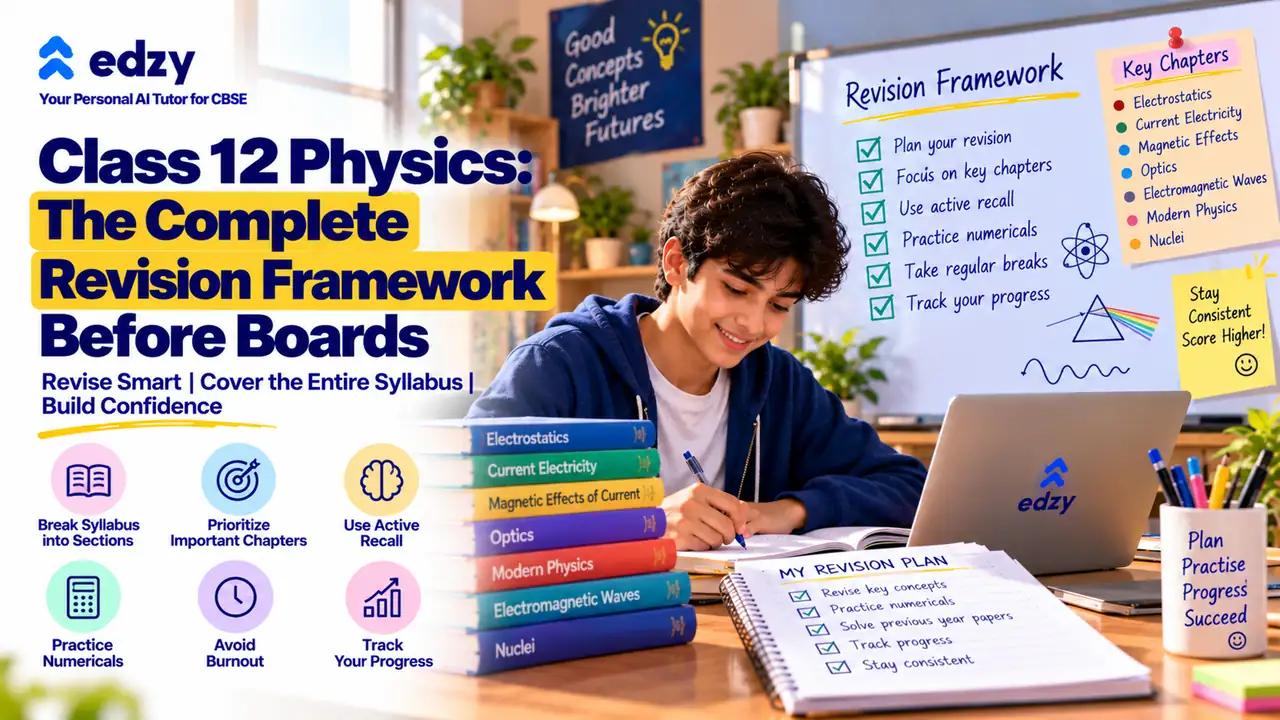
The first step in effective revision is to break down the syllabus into smaller, manageable sections. The Class 12 Physics syllabus can be divided into key units such as Electrostatics, Current Electricity, Magnetic Effects of Current, and Optics. By categorizing the syllabus, students can focus on one section at a time, reducing the feeling of being overwhelmed. Students can also benefit from effective answer-checking strategies to enhance their preparation.
For instance, a student preparing for the board exam can allocate specific days to each unit. They might dedicate two days to Electrostatics, followed by three days for Current Electricity. This approach not only makes the revision process more structured but also allows for deeper understanding of each topic.
Prioritizing Important Chapters for Board Exams
Not all chapters carry the same weight in terms of marks. Understanding which chapters are crucial can help students prioritize their revision effectively. For example, chapters like Optics and Electromagnetic Induction are often heavily featured in board exams and require thorough preparation. Students should review previous years' question papers to identify frequently asked questions. By focusing on high-yield topics, such as Wave Optics and Alternating Current, students can maximize their chances of scoring well. This targeted approach ensures that students are not just revising but revising smartly, similar to the methods outlined in effective study routines.
Using Active Recall for Effective Retention
Active recall is a powerful technique that enhances memory retention. Instead of passively reading through notes, students should actively test themselves on the material. For example, after studying Laws of Motion, a student can close their book and write down everything they remember about the chapter.
This method can be applied to all chapters. Students can create flashcards for key concepts and formulas, such as the Newton's Laws or the principle of conservation of energy. Regularly quizzing themselves on these flashcards will reinforce their understanding and help them recall information during exams.
Practicing Numericals to Build Confidence
Physics is not just about theory; it heavily involves numerical problems. Students must practice numerical questions from chapters like Kinematics and Thermodynamics to build their confidence. A solid grasp of numerical problems can significantly boost a student's performance in board exams.
For instance, a Class 12 student should solve at least 20 numerical problems from each chapter, focusing on different types of questions, including those that require application of formulas and those that are conceptual. This practice will not only prepare them for the exam but also help them understand the practical applications of the concepts they have learned, similar to the strategies discussed in effective study techniques.
Avoiding Burnout During Revision
While it’s important to study hard, it’s equally crucial to take breaks to avoid burnout. Students should incorporate short breaks into their study schedule. For example, after a 45-minute study session, taking a 10-minute break can help refresh the mind.
Moreover, engaging in physical activities like sports or yoga can also help alleviate stress. A Class 12 student preparing for the board exams might find that a quick game of badminton or a short meditation session can rejuvenate their focus and energy levels, making their study sessions more productive.
Tracking Progress for Continuous Improvement
Tracking progress is essential for effective revision. Students should maintain a revision diary where they can note down what topics they have covered and what areas need more focus. This diary can serve as a motivational tool, showing students how much they have accomplished.
For example, a student can mark off chapters as they complete them, such as Waves or Optics. This visual representation of progress can boost their confidence and keep them motivated to continue their revision journey.
Entering Boards Confidently with the Revision Framework
The Revision Framework is designed to help students approach their revision systematically. By breaking the syllabus into sections, prioritizing important chapters, using active recall, practicing numericals, avoiding burnout, and tracking progress, students can enter their board exams with confidence.
As the board exams approach, remember that every mark a CBSE student loses to a careless error is a mark they already earned — the only task left is making sure it shows up on the paper. Embrace the Revision Framework and transform your study experience.
Why do CBSE students feel overwhelmed by revision?CBSE students often feel overwhelmed by revision due to the vast syllabus and the pressure to perform well in board exams. The fear of not retaining information or missing important concepts can lead to anxiety. However, by implementing structured revision strategies, such as the Revision Framework, students can manage their study time effectively and build confidence in their knowledge. Additionally, they can learn to avoid last-minute cramming which often adds to their stress.
Suggested blogs

How to Improve Speed in Exams Without Making More Mistakes
Mastering the art of speed and accuracy for CBSE exams.

How to Revise One Day Before the Exam (Without Panic)
Mastering last-minute revision for CBSE exams without stress.
Class 10 Maths: How to Revise Entire Syllabus Before Boards
Mastering the Class 10 Maths syllabus for board exams requires a strategic approach to revision.

Class 10 Maths: How to Practice Sample Papers Effectively
Mastering sample papers is the key to acing your Class 10 Maths board exams.