
Class 9 Maths: How to Understand Polynomials With Worked Examples
Mastering polynomials is crucial for Class 9 students to excel in mathematics and beyond.
Many Class 9 students struggle with polynomials, leading to confusion and poor performance. This blog introduces the Polynomial Mastery Framework, a structured approach to understanding polynomials. Readers will learn core concepts, see worked examples, and identify common mistakes to avoid.

Hari krishna
@harikrishna2
Listen to this article
Class 9 Maths: How to Understand Polynomials With Worked Examples
Understanding Polynomials for Class 9 Students
Polynomials are a fundamental concept in Class 9 Mathematics, forming the basis for many advanced topics in algebra. Students often find themselves grappling with the intricacies of polynomials, which can lead to confusion and a lack of confidence. This blog aims to clarify these concepts using the Polynomial Mastery Framework, which breaks down the understanding of polynomials into manageable parts. Through clear explanations and worked examples, students will gain a solid grasp of polynomials, paving the way for success in their studies.
Learning Objectives and Prerequisites
Before diving into polynomials, it is essential for students to have a firm understanding of basic algebraic concepts. Familiarity with terms such as variables, constants, and coefficients is crucial. Students should also be comfortable with operations involving integers and fractions, as these skills will be applied when working with polynomials. The primary objective of this blog is to help students understand what polynomials are, how to perform operations on them, and how to apply these operations in solving problems. For additional insights, students can refer to our guide on improving speed in solving questions.
Core Concepts Behind Polynomials
A polynomial is a mathematical expression that consists of variables raised to whole number powers, along with coefficients. For example, the expression 3x2 + 5x - 2 is a polynomial where 3, 5, and -2 are coefficients, and x is the variable. Polynomials can be classified based on their degree, which is determined by the highest power of the variable. For instance, the polynomial mentioned has a degree of 2, making it a quadratic polynomial.
Understanding the structure of polynomials is essential for performing operations such as addition, subtraction, multiplication, and division. For example, when adding two polynomials like 2x + 3 and 4x - 5, students combine like terms to get 6x - 2. This process of combining like terms is a common task in polynomial operations and is crucial for simplifying expressions. To enhance their skills, students can explore our article on quick revision techniques.
Worked Example: Adding and Subtracting Polynomials
Let’s consider a practical example to illustrate how to add and subtract polynomials. Suppose we have the following two polynomials:
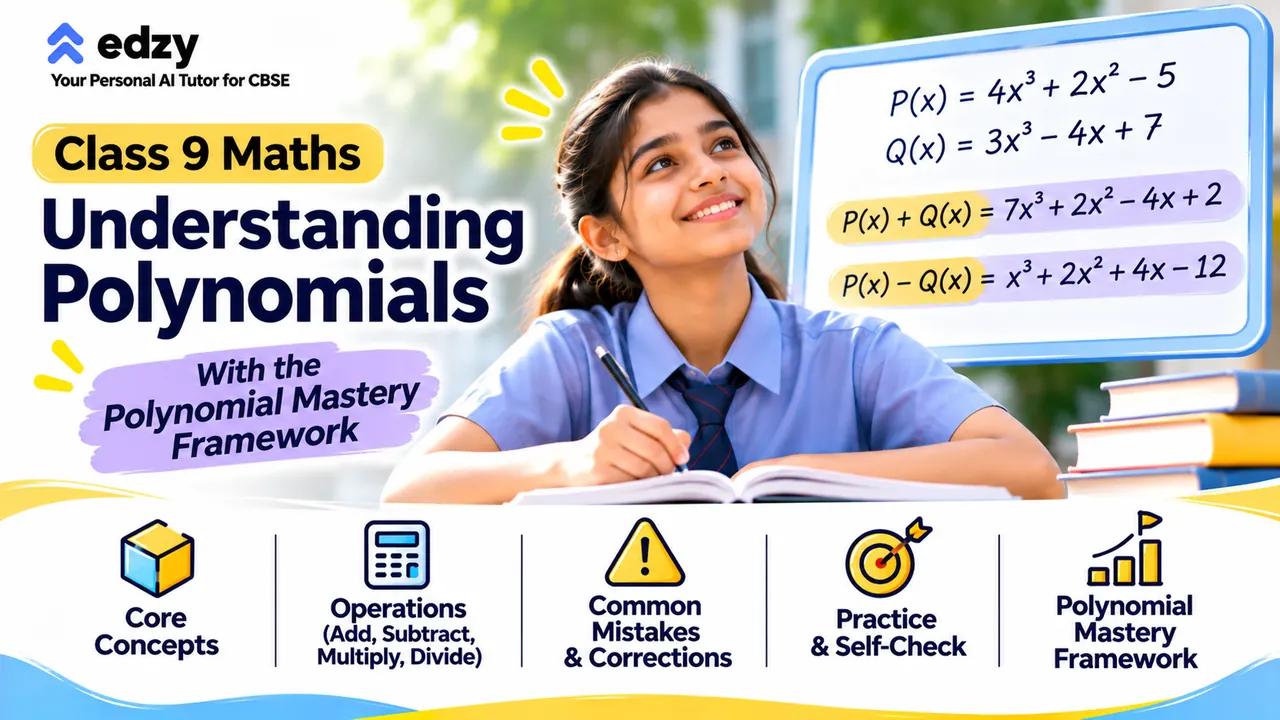
P(x) = 4x3 + 2x2 - 5 and Q(x) = 3x3 - 4x + 7.
To add these polynomials, we write:
P(x) + Q(x) = (4x3 + 2x2 - 5) + (3x3 - 4x + 7).
Now, combine like terms:
(4x3 + 3x3) + (2x2) + (-4x) + (-5 + 7) = 7x3 + 2x2 - 4x + 2.
Next, let’s subtract Q(x) from P(x):
P(x) - Q(x) = (4x3 + 2x2 - 5) - (3x3 - 4x + 7).
Distributing the negative sign gives:
4x3 + 2x2 - 5 - 3x3 + 4x - 7.
Combining like terms results in:
(4x3 - 3x3) + (2x2) + (4x) + (-5 - 7) = x3 + 2x2 + 4x - 12.
This example demonstrates the importance of organizing terms and carefully combining like terms, which is a skill that will be beneficial in future chapters such as Quadratic Equations.
Common Misconceptions and Corrections
One common misconception among students is treating polynomials like simple numbers. For instance, when students see 2x + 3, they may mistakenly think they can simply add 2 and 3 without considering the variable. It is crucial to emphasize that polynomials consist of variables and coefficients that must be treated according to algebraic rules.
Another frequent error occurs during multiplication. Students may forget to apply the distributive property correctly. For example, when multiplying (x + 2)(x + 3), students should remember to multiply each term in the first polynomial by each term in the second, leading to:
x2 + 3x + 2x + 6 = x2 + 5x + 6.
To avoid these mistakes, students should practice regularly and seek clarification whenever they encounter difficulties. Engaging with resources such as the blog on avoiding last-minute cramming can also provide valuable strategies for mastering polynomial operations.
Independent Practice and Self-Check
To solidify understanding, students should engage in independent practice. A good exercise is to create their own polynomials and perform various operations on them. For example, students can take 2x2 + 3x - 4 and x2 - 5x + 6 and practice adding, subtracting, and multiplying these polynomials.
After completing their exercises, students should check their answers against solutions provided in their textbooks or online resources. This self-checking method helps identify areas that need further review. Additionally, students can refer to the blog on using the last 48 hours before an exam effectively to learn from errors made during practice.
Why Do CBSE Students Struggle with Polynomials?
Why do CBSE students struggle with polynomials? Many CBSE students find polynomials challenging due to a lack of foundational understanding and the complexity of operations involved. This struggle often stems from misconceptions about how to manipulate variables and coefficients, leading to errors in calculations. By addressing these misconceptions and practicing regularly, students can build confidence and proficiency in working with polynomials.
The Polynomial Mastery Framework
The Polynomial Mastery Framework is a structured approach designed to help students understand polynomials effectively. This framework emphasizes three key components: understanding the definition and structure of polynomials, mastering operations on polynomials, and applying these operations in problem-solving scenarios. By following this framework, students can systematically build their knowledge and skills in handling polynomials.
For instance, when students learn about polynomial operations, they can apply the Polynomial Mastery Framework to practice addition and subtraction first, then move on to multiplication and division. This step-by-step approach ensures that students do not feel overwhelmed and can build their confidence gradually.
Additionally, students can utilize resources such as the blog on revising the entire syllabus to reinforce their understanding of polynomials through real exam scenarios.
Conclusion
Mastering polynomials is essential for success in Class 9 Mathematics and beyond. By understanding the core concepts, practicing diligently, and utilizing the Polynomial Mastery Framework, students can overcome challenges and excel in their studies. Every mark a CBSE student loses to a careless error is a mark they already earned — the only task left is making sure it shows up on the paper.
Suggested blogs
Class 11 Physics: How to Draw Free-Body Diagrams Correctly
Mastering Free-Body Diagrams: A Key Skill for CBSE Physics Success.

Class 10 Science: How to Understand Magnetic Effects of Electric Current
Mastering the magnetic effects of electric current is crucial for Class 10 students — here’s how to do it effectively.
Class 10 Maths: How to Choose Between Substitution and Elimination
Mastering the art of solving linear equations with confidence and clarity.

Class 9 Science: How to Read Distance-Time and Velocity-Time Graphs
Understanding motion graphs is essential for mastering concepts in Class 9 Science and excelling in CBSE exams.