
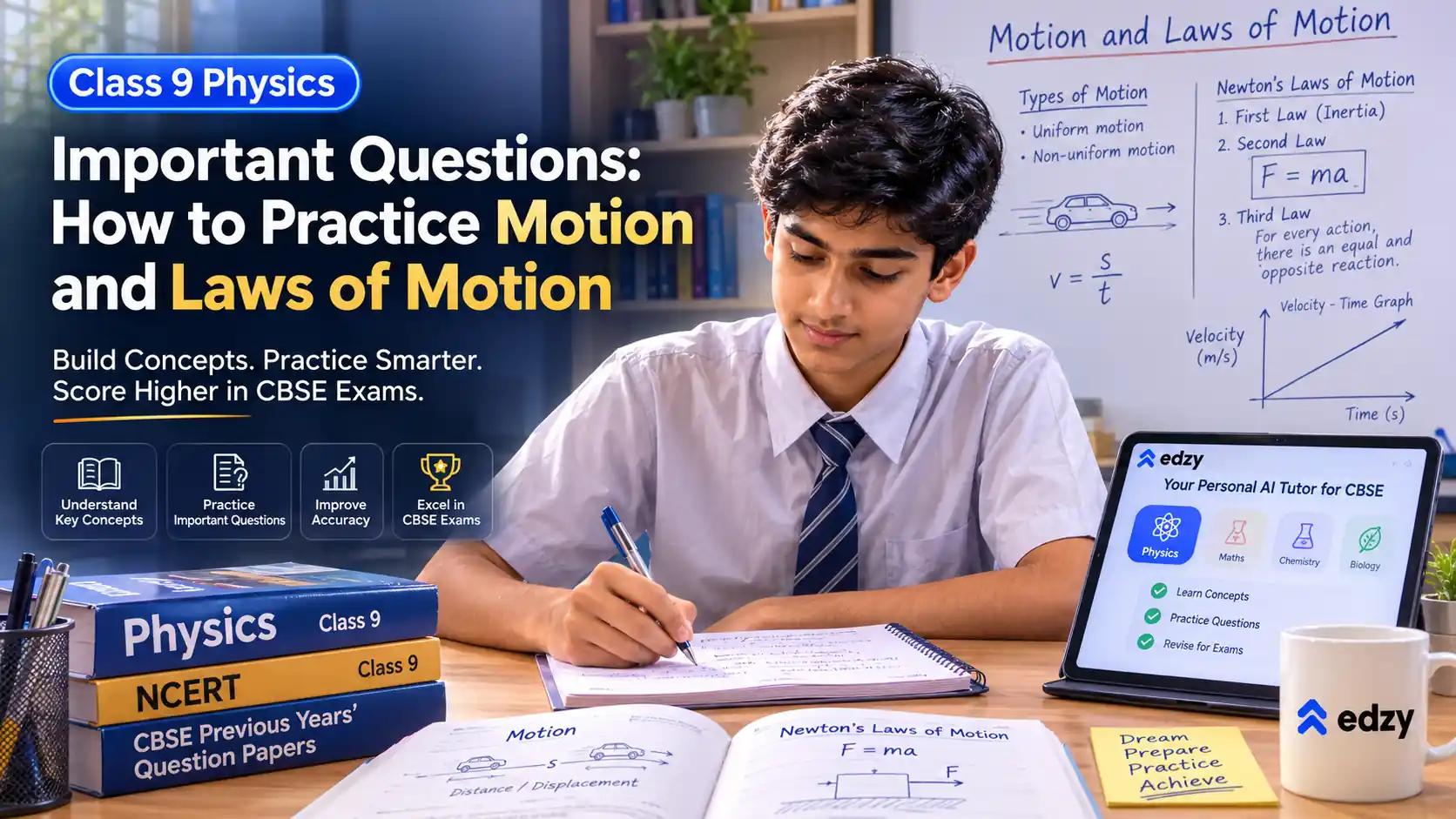
Class 9 Physics Important Questions: How to Practice Motion and Laws of Motion
Mastering Class 9 Physics concepts to excel in Motion and Laws of Motion.
Struggling with Physics concepts in Class 9? This blog emphasizes the importance of understanding Motion and Laws of Motion, providing strategies to practice effectively. Readers will learn how to break down numericals, avoid common mistakes, and utilize diagrams for better comprehension.

Gaurav Parashar
@gauravparashar
Class 9 Physics Important Questions: How to Practice Motion and Laws of Motion
Physics can often seem daunting for Class 9 students, especially when it comes to understanding concepts like Motion and Laws of Motion. These chapters are crucial not only for building a strong foundation in Physics but also for scoring well in your CBSE exams. This blog will guide you through effective strategies to practice important questions from these chapters, ensuring you grasp the concepts thoroughly and perform confidently in your exams.
Why Motion and Laws of Motion Are Important for Class 9 Students
The chapters on Motion and Laws of Motion in Class 9 Physics are pivotal as they introduce students to fundamental concepts that are essential for higher studies in Physics. Understanding these concepts lays the groundwork for topics in Class 10 and beyond, such as force, momentum, and energy. Moreover, these chapters are frequently tested in the CBSE board exams, making them critical for students aiming for high scores. For instance, questions related to Newton's laws often appear in various formats, including case-based and assertion-reason questions, which require a solid understanding of the underlying principles. Students can enhance their preparation by exploring effective unit test strategies.
Understanding Concepts Before Solving Problems
Before diving into solving problems, it is essential to have a clear understanding of the concepts of Motion and Laws of Motion. For example, students should be familiar with the definitions of speed, velocity, and acceleration, as well as the distinction between them. A Class 9 student should be able to explain the difference between uniform and non-uniform motion, which is crucial when tackling numericals. To reinforce these concepts, students can refer to NCERT textbooks, which provide clear explanations and examples. Engaging with these concepts through practical experiments, such as measuring the speed of a moving object, can also enhance understanding. Additionally, utilizing resources like accuracy improvement techniques can be beneficial.
Breaking Down Numericals Step by Step
When faced with numerical problems in Physics, especially in the chapters on Motion and Laws of Motion, students should adopt a step-by-step approach. For instance, consider a problem that requires calculating the distance traveled by a car moving at a constant speed. First, identify the given data: speed, time, and the formula to use, which in this case is distance = speed × time. By substituting the values into the formula, students can arrive at the solution systematically. This method not only helps in solving the problem accurately but also builds confidence in handling complex questions. Practicing a variety of question types, as suggested in smart revision techniques, can also enhance understanding.
Common Mistakes in Motion Problems
One of the most common pitfalls for students when solving motion problems is misinterpreting the question. For example, a student might confuse speed with velocity, leading to incorrect calculations. Another frequent mistake is neglecting to convert units appropriately, such as using kilometers per hour instead of meters per second. To avoid these errors, students should practice reading questions carefully and double-checking their calculations. Engaging with past year CBSE board exam papers can help students identify these common mistakes and learn how to avoid them in their own work.
Practicing Different Question Types
To excel in the chapters on Motion and Laws of Motion, students should practice a variety of question types. This includes numerical problems, conceptual questions, and application-based scenarios. For instance, a typical CBSE question might ask students to apply Newton's second law to a real-world situation, such as calculating the force required to move an object of a certain mass. By diversifying their practice, students can develop a comprehensive understanding of the subject matter. Additionally, resources like sample papers and previous years' question papers can provide valuable insights into the types of questions that frequently appear in exams.
Using Diagrams and Graphs for Better Understanding
Visual aids like diagrams and graphs can significantly enhance a student's understanding of motion concepts. For example, drawing a velocity-time graph can help students visualize how an object's velocity changes over time. This is particularly useful when discussing concepts like acceleration and deceleration. Students should practice sketching graphs based on given data, as this skill is often tested in CBSE exams. Moreover, incorporating diagrams in their answers can help students communicate their understanding more effectively, especially in descriptive questions.
Revising Effectively Before Tests
Effective revision is crucial for retaining the concepts learned in Physics. Students should create a revision schedule that allocates time for each chapter, focusing on key concepts, formulas, and problem-solving techniques. For instance, a student preparing for a test on Motion should revisit the definitions, key formulas, and practice numericals related to that chapter. Utilizing tools like flashcards for formulas and summary notes can aid in quick revision. Additionally, engaging in group study sessions can provide opportunities for discussion and clarification of doubts, enhancing overall understanding.
Improving Accuracy and Confidence in Physics
Building accuracy and confidence in Physics requires consistent practice and self-assessment. Students should regularly attempt mock tests under timed conditions to simulate the exam environment. This practice not only helps in managing time effectively during the actual exam but also boosts confidence. Furthermore, reviewing mistakes made in these tests is essential for improvement. For example, a student might find that they consistently struggle with questions involving Newton's laws; identifying this pattern allows them to focus their revision on that area. Resources like effective revision techniques can also provide strategies for enhancing retention and understanding.
Why Do CBSE Students Struggle with Physics Concepts?
Why do CBSE students struggle with Physics concepts? Many CBSE students find Physics challenging due to the abstract nature of its concepts and the mathematical skills required to solve problems. Without a solid grasp of foundational principles, students often feel overwhelmed by complex numericals and theoretical questions. To overcome this, it is crucial for students to engage deeply with the material, practice regularly, and seek help when needed. Utilizing resources like NCERT textbooks and online platforms can provide additional support and clarity.
Named Concept: The Conceptual Clarity Framework
The Conceptual Clarity Framework is a structured approach designed to help students master Physics concepts effectively. This framework emphasizes understanding the fundamental principles before attempting to solve problems. By breaking down complex topics into manageable parts, students can build a solid foundation that enhances their problem-solving abilities. For instance, when studying Laws of Motion, students should first focus on understanding Newton's laws individually before applying them to real-world scenarios. This framework not only aids in comprehension but also fosters confidence in tackling various question types.
Applying the Conceptual Clarity Framework in Practice
To apply the Conceptual Clarity Framework effectively, students should start by identifying key concepts in the chapters on Motion and Laws of Motion. For example, when learning about inertia, students should explore its definition, real-life examples, and its implications in various scenarios. Engaging in discussions with peers or teachers can further solidify understanding. Additionally, practicing questions that require the application of these concepts will reinforce learning and improve retention. Utilizing resources like learning from mistakes can also enhance this process.
Final Thoughts on Mastering Class 9 Physics
Mastering the chapters on Motion and Laws of Motion is essential for Class 9 students aiming to excel in Physics. By adopting a structured approach to practice, understanding concepts deeply, and utilizing the Conceptual Clarity Framework, students can significantly improve their performance. Regular practice, effective revision strategies, and learning from mistakes will not only enhance accuracy but also build confidence. Every mark a CBSE student loses to a careless error is a mark they already earned — the only task left is making sure it shows up on the paper.
Suggested blogs

How to Avoid Panic When You Don’t Know an Answer in the Exam
Mastering calmness to tackle exam challenges effectively.

How to Manage Time During a 3-Hour Exam
Mastering time management for a successful exam experience.

How to Check Your Answers Properly in Exams
Mastering the art of answer checking to secure every mark in CBSE exams.

How to Improve Your Speed in Solving Questions Before Exams
Mastering speed in question-solving is crucial for CBSE students aiming for high marks.