
How to Plan Your Final Month Before Board Exams (Without Panic)
A structured approach to mastering your final month before board exams, ensuring clarity and confidence.
Feeling overwhelmed as board exams approach? The final month is crucial for CBSE students, and planning effectively can alleviate panic. This blog outlines a day-by-day strategy to maximize your preparation, focusing on what to prioritize and how to balance revision with practice. Learn how to tackle weak chapters and enter the exam room with confidence.


Gaurav Parashar
@gauravparashar
Listen to this article
How to Plan Your Final Month Before Board Exams (Without Panic)
How to Plan Your Final Month Before Board Exams (Without Panic)
As the board exams approach, students often find themselves in a whirlwind of anxiety and uncertainty. The last month before the exams can feel overwhelming, leaving many students unsure of how to effectively utilize their time. This blog aims to provide a realistic, day-by-day approach to planning the final month before boards for maximum clarity and confidence.
Why the Last Month Feels Overwhelming
The pressure of impending board exams can lead to a sense of panic among students. With the vast syllabus of subjects like CBSE Mathematics, Science, and Social Science, students often feel they have too much to cover in too little time. For instance, a Class 10 student preparing for the Mathematics board exam may feel overwhelmed by chapters like Quadratic Equations and Statistics, especially when they realize they have not yet mastered the concepts. This anxiety can lead to procrastination, which further compounds the problem.
Moreover, the fear of failure and the desire to perform well can create a mental block, making it difficult to focus on studying. Students may find themselves oscillating between studying multiple subjects and feeling guilty for not dedicating enough time to each. This chaotic approach often results in ineffective study sessions and increased stress levels. To combat this, students can refer to our guide on avoiding last-minute cramming for effective strategies.
What to Focus on vs What to Ignore
In the final month, it is crucial to prioritize effectively. Focus on core subjects such as Mathematics and Science, which carry significant weight in the board exams. For example, a Class 12 student should concentrate on key chapters like Photosynthesis in Biology and Electrostatics in Physics, as these topics frequently appear in board papers. Additionally, students can enhance their understanding by reviewing how to use mistakes to improve their marks.
Conversely, avoid getting bogged down by less critical topics or those that have historically been less emphasized in exams. For instance, if a student has consistently performed well in Federalism in Social Science, they might choose to allocate less time to that chapter and focus more on challenging areas. This strategic approach allows students to maximize their study time and reduce feelings of overwhelm.
Creating a Simple Daily Structure
A well-structured daily plan can significantly ease the pressure of exam preparation. Start by breaking down the remaining days into manageable study blocks. For instance, a student can allocate specific days for different subjects, ensuring that each subject receives adequate attention. A Class 10 student might dedicate Mondays and Wednesdays to Mathematics, focusing on chapters like Linear Equations and Quadratic Equations, while Tuesdays and Thursdays could be reserved for Science.
Incorporate short breaks into the study schedule to maintain focus and prevent burnout. For example, after a 90-minute study session, a 15-minute break can help refresh the mind. This simple structure not only enhances productivity but also creates a sense of routine, which can be comforting during stressful times.
Balancing Revision and Practice
Revision is essential, but it must be balanced with practice to ensure comprehensive preparation. Students should allocate time for both reviewing concepts and solving sample papers. For instance, a Class 12 student preparing for the board exams in Mathematics should spend mornings revising formulas and concepts from chapters like Calculus and Probability, while afternoons can be dedicated to solving past year papers and sample questions. This method can be enhanced by learning how to check answers properly in exams.
Engaging with different types of questions, such as case-based questions and assertion-reason questions, helps students become familiar with the exam format. This practice not only reinforces learning but also builds confidence in tackling various question types during the actual exams.
Handling Weak Chapters Smartly
Every student has weak areas that require extra attention. Identifying these chapters early on is crucial. For instance, if a Class 10 student struggles with Electricity in Science, they should allocate more time to this chapter in their study plan. Instead of avoiding it, they can break it down into smaller topics, such as Ohm's Law and Series and Parallel Circuits, and tackle each one systematically.
Additionally, seeking help from teachers or peers can provide clarity on difficult concepts. Engaging in group study sessions can also be beneficial, as discussing topics like Motion and Forces in Physics can enhance understanding through collaborative learning.
Avoiding Burnout in the Final Stretch
As the exam date approaches, the risk of burnout increases. It is essential to maintain a healthy balance between study and relaxation. Students should incorporate physical activities, such as yoga or short walks, into their daily routine to relieve stress. For instance, a Class 11 student preparing for the board exams can take a 30-minute break for a brisk walk after a study session to rejuvenate their mind.
Moreover, ensuring adequate sleep is vital. Sleep deprivation can lead to decreased concentration and memory retention. A well-rested mind is more effective at recalling information, especially during high-pressure situations like board exams.
Tracking Daily Progress
Keeping track of daily progress can provide a sense of accomplishment and motivate students to stay on course. Students can maintain a study journal where they note down what they have covered each day. For example, a Class 12 student might write, "Reviewed Thermodynamics and solved 10 case-based questions from last year's paper." This practice not only helps in self-assessment but also highlights areas that may need further attention.
Additionally, setting small, achievable goals for each study session can enhance focus. Completing a set number of questions from a chapter or revising a specific topic can serve as a motivational boost, reinforcing the idea that progress is being made.
Entering Exams with Confidence
As the exam day approaches, confidence becomes a critical factor in performance. Students should engage in positive self-talk and visualize success. For instance, a Class 10 student preparing for the Mathematics exam can practice affirmations like, "I am well-prepared, and I will do my best." This mental preparation can significantly impact performance.
Moreover, familiarizing oneself with the exam format can alleviate anxiety. Understanding the structure of the question paper, including the types of questions and marking scheme, can help students feel more prepared. For example, knowing that the Class 12 Physics exam includes both theoretical and numerical questions allows students to strategize their time effectively during the exam.
Finally, remember that every mark a CBSE student loses to a careless error is a mark they already earned — the only task left is making sure it shows up on the paper.
Why do CBSE students feel overwhelmed as exams approach? The pressure of impending board exams can lead to anxiety and uncertainty, making it difficult for students to focus on studying effectively. A structured plan that prioritizes key subjects and balances revision with practice can alleviate this stress and enhance confidence.
By following this structured approach, students can navigate the final month before board exams with clarity and confidence. Implementing a daily study plan, focusing on weak areas, and maintaining a healthy balance between study and relaxation will ensure that students are well-prepared to face their exams. Remember, the goal is not just to cover the syllabus but to truly understand and retain the concepts, paving the way for success in the board exams.
For more insights on effective study strategies, check out our blog on improving speed in exams and learn how to tackle exam pressure with confidence. Additionally, consider exploring how to study faster before exams to enhance your preparation.
Suggested blogs

How to Use the Last 48 Hours Before an Exam Effectively
Transforming exam anxiety into a structured plan for success.

How to Improve Speed in Exams Without Making More Mistakes
Mastering the art of speed and accuracy for CBSE exams.

How to Revise One Day Before the Exam (Without Panic)
Mastering last-minute revision for CBSE exams without stress.
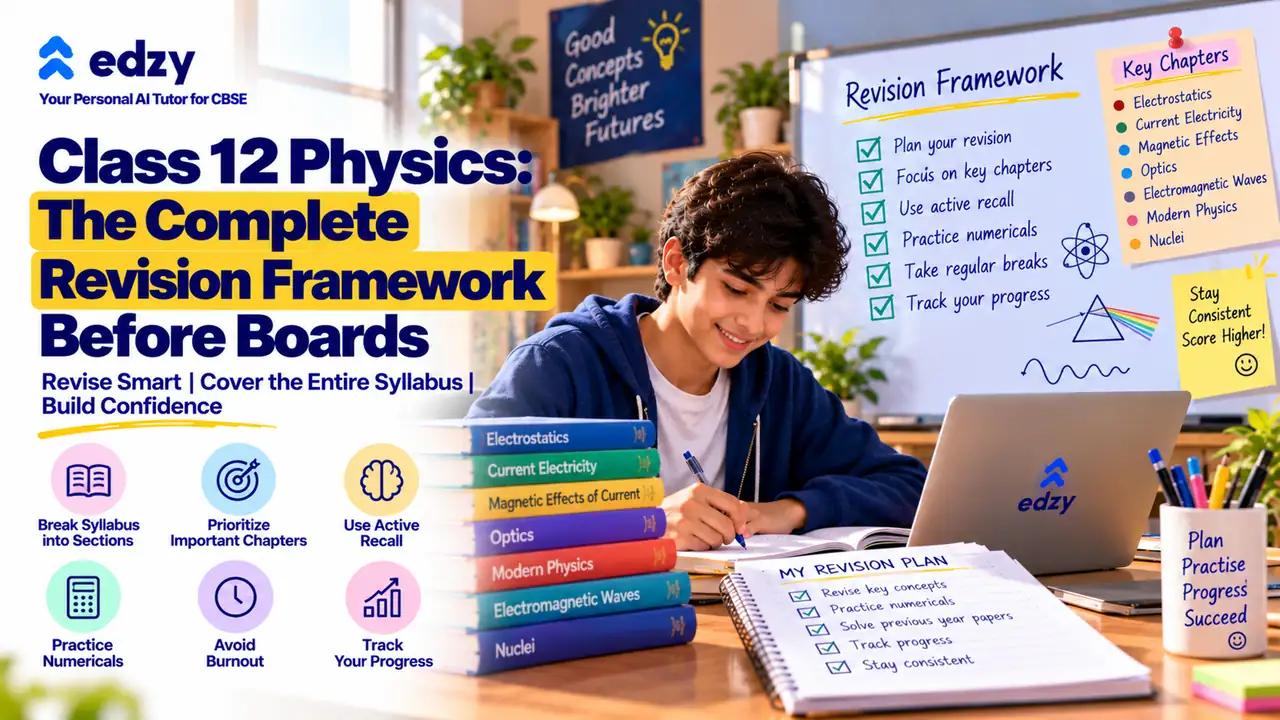
Class 12 Physics: How to Revise Entire Syllabus Before Boards
Mastering the Class 12 Physics syllabus for board exams through efficient revision strategies.