
Note-Taking Systems That Actually Work for CBSE Students
Master effective note-taking techniques for better exam preparation.
Explore proven note-taking methods tailored for CBSE and NCERT students to enhance retention and improve exam performance.
Listen to this article
Note-Taking Systems That Actually Work for CBSE Students
Good notes are half the battle won in exams. For students preparing for CBSE and NCERT exams, effective note-taking can significantly enhance retention and understanding of the material. In this blog, we will explore various note-taking techniques, how to summarize NCERT chapters quickly, tips for different learning styles, and much more.
Why Effective Notes Improve Retention
Taking notes is not just about writing down what the teacher says; it’s about processing and organizing information in a way that makes it easier to understand and remember. Studies have shown that students who take effective notes perform better in exams. This is because the act of writing helps to reinforce learning, allowing students to engage with the material actively.
When students take notes, they are forced to listen, comprehend, and summarize information, which enhances their cognitive abilities. Effective notes serve as a valuable study tool, making revision more efficient. By organizing information logically, students can quickly locate key concepts when preparing for exams.
Cornell Note-Taking Method
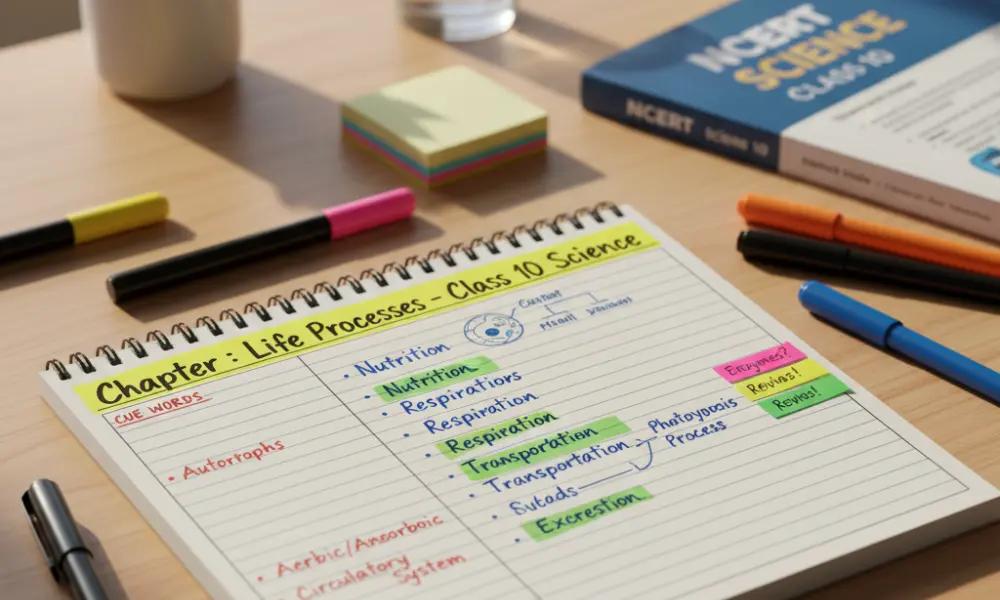
The Cornell method is a systematic way of organizing notes that encourages students to engage with the material actively. This method divides the page into three sections: cues, notes, and summary.
Cues: This section is on the left side of the page and is used for keywords or questions that relate to the notes.
Notes: The main section is where students write down the lecture notes or information from textbooks.
Summary: At the bottom of the page, students summarize the notes in their own words.
Using the Cornell method, students can easily review their notes by covering the notes section and recalling the information based on the cues. This technique is particularly effective for subjects like Science and Mathematics, where understanding concepts is crucial.
Outline Method
The outline method is another effective way to take notes, especially for students who prefer a structured approach. This method involves organizing information hierarchically, using bullet points and indentations to show relationships between concepts.
For example, when studying a chapter on the Indian Freedom Struggle, a student might outline the key events, leaders, and movements in a structured format:
Indian Freedom Struggle
First War of Independence (1857)
Indian National Congress Formation (1885)
Non-Cooperation Movement (1920)
This method helps students to see the bigger picture and understand how different concepts are interconnected, making it easier to recall information during exams.
Mind Mapping
Mind mapping is a visual note-taking technique that can be particularly beneficial for visual learners. It involves creating a diagram that represents concepts and their relationships. Students start with a central idea and branch out to related topics, using colors, images, and symbols to enhance memory retention.
For instance, when studying a chapter on ecosystems, a student might create a mind map that includes:
Types of Ecosystems
Food Chains
Human Impact on Ecosystems
Mind maps allow students to visualize information, making it easier to understand complex topics and recall them during exams.
How to Summarize NCERT Chapters Quickly
Summarizing NCERT chapters is an essential skill for students. Here are some steps to help students summarize effectively:
Read the Chapter Thoroughly: Before summarizing, students should read the entire chapter to understand the main ideas.
Identify Key Points: Highlight or underline important concepts, definitions, and examples.
Write a Summary: In their own words, students should write a brief summary of the chapter, focusing on the main ideas and supporting details.
Review and Revise: After writing the summary, students should review it to ensure clarity and accuracy.
By following these steps, students can create concise summaries that serve as effective study aids.
Tips for Visual and Auditory Learners
Different students have different learning styles. Here are some tailored tips for visual and auditory learners:
For Visual Learners
Use colors and highlighters to differentiate between topics.
Incorporate diagrams and charts into notes.
Create flashcards for quick revision of key concepts.
For Auditory Learners
Record lectures and listen to them during revision.
Discuss topics with peers to reinforce learning.
Use mnemonic devices to remember information.
By understanding their learning style, students can adopt note-taking strategies that work best for them.
Digital Note-Taking Tools vs Traditional Notebooks
With the rise of technology, students now have the option to take notes digitally or traditionally. Each method has its advantages and disadvantages.
Digital Note-Taking Tools
Digital tools like Microsoft OneNote, Evernote, and Google Keep offer features such as:
Easy organization of notes with tags and folders.
Access to notes from multiple devices.
Incorporation of multimedia elements like images and audio clips.
Traditional Notebooks
On the other hand, traditional notebooks provide benefits such as:
Better retention through the physical act of writing.
No distractions from notifications or apps.
Personalized layouts and styles.
Ultimately, the choice between digital and traditional note-taking depends on personal preference and learning style.
How to Revise Directly from Your Notes
Revising from notes can be an effective way to prepare for exams. Here are some strategies:
Review Regularly: Schedule regular review sessions to reinforce learning.
Use Active Recall: Test yourself on the material without looking at the notes.
Teach Others: Explaining concepts to peers can solidify understanding.
By actively engaging with their notes, students can enhance their retention and understanding of the material.
Examples of Topper-Style Notes
Top students often have a unique approach to note-taking. Here are some characteristics of topper-style notes:
Clear headings and subheadings for easy navigation.
Use of bullet points and lists to summarize information.
Incorporation of diagrams and charts to illustrate concepts.
Consistent formatting and neat handwriting.
By emulating these characteristics, students can improve their own note-taking style.
Checklist for Creating Perfect Exam Notes
To ensure that notes are effective, students can use the following checklist:
Are the notes organized and easy to read?
Do they include key concepts, definitions, and examples?
Have I summarized the material in my own words?
Have I included visual aids where necessary?
Are the notes reviewed regularly?
By following this checklist, students can create notes that are not only comprehensive but also effective for exam preparation.
In conclusion, effective note-taking is a crucial skill for CBSE and NCERT students. By employing various techniques such as the Cornell method, outline method, and mind mapping, students can enhance their learning experience. Additionally, understanding their learning style and utilizing digital tools can further improve their note-taking process. With the right strategies in place, students can create notes that will serve as valuable study aids, ultimately leading to better exam performance.
Suggested blogs
Why You Shouldn’t Skip Steps in Maths (Even If You Know the Answer)
Understanding the importance of step-by-step problem-solving in CBSE Mathematics.

How to Improve Accuracy in Maths Without Extra Practice Hours
Why mastering accuracy is the key to unlocking your true potential in Maths.

How to Revise Formulas in Maths Without Forgetting Them
Mastering math formulas through understanding and practice — a guide for CBSE students.

How to Identify Your Weak Areas in Studies (And Fix Them Fast)
Transforming academic weaknesses into strengths through targeted strategies.