
How to Use Past Year Papers the Right Way
Mastering past papers transforms passive practice into effective learning for CBSE students.
Many CBSE students struggle to utilize past year papers effectively, often leading to minimal improvement. This blog introduces the concept of the Past Paper Mastery Framework, which guides students on how to analyze and learn from their mistakes. Readers will learn the right timing to start solving past papers, how to simulate exam conditions, and strategies for tracking progress and boosting confidence.

Gaurav Parashar
@gauravparashar
Listen to this article
How to Use Past Year Papers the Right Way
Why Past Papers Are Important for CBSE Students
For CBSE students, past year papers serve as a crucial resource for exam preparation. They provide insight into the types of questions that frequently appear in exams, helping students understand the exam format and marking scheme. For instance, a Class 10 student preparing for the Mathematics board exam can benefit immensely from analyzing the last five years of board questions on chapters like Quadratic Equations and Statistics. This not only familiarizes them with the question patterns but also highlights the weightage of different topics. Additionally, students can learn how to improve their accuracy in mathematics through consistent practice with these papers.
Moreover, solving past papers fosters a deeper understanding of the subject matter. For example, when a student tackles case-based questions in Science, they learn to apply theoretical knowledge to practical scenarios, which is essential for subjects like Biology and Chemistry. Thus, past papers are not merely practice tools; they are gateways to mastering the curriculum. Students should also explore strategies to study smarter to maximize their efficiency. Additionally, they can refer to important questions for Class 10 Science to guide their revision. Furthermore, students can benefit from effective revision techniques that complement their practice with past papers.
When to Start Solving Past Papers
The optimal time to begin solving past year papers varies among students, but a general guideline is to start at least three months before the exams. For instance, a Class 12 student preparing for the CBSE Board Exam should begin by revising their syllabus thoroughly, ensuring they have a solid grasp of key chapters like Federalism in Social Science or Laws of Motion in Physics. Once they feel confident with the content, they should gradually incorporate past papers into their study routine. Initially, they can start with one paper per week, focusing on specific chapters. For example, a student might decide to solve past papers related to Photosynthesis in Biology before moving on to more comprehensive papers. This staggered approach allows for targeted learning and gradual improvement.
Simulating Exam Conditions
To maximize the benefits of solving past papers, students must simulate real exam conditions. This means setting a timer, finding a quiet space, and eliminating distractions. For example, a Class 10 student preparing for their Mathematics exam should attempt to solve a past paper in 3 hours, just like the actual exam duration.
Additionally, students should adhere to the marking scheme while grading their answers. This practice not only helps them manage their time effectively but also builds their stamina for the actual exam. By replicating the exam environment, students become accustomed to the pressure and can develop strategies to manage their anxiety.
Analyzing Mistakes Properly
The true value of solving past papers lies in analyzing mistakes. After completing a paper, students should review their answers critically. For instance, if a Class 12 student incorrectly answers a question on Chemical Equilibrium, they should revisit the relevant chapter in their NCERT textbook and understand where they went wrong. Creating a mistake log can be incredibly beneficial. This log should include the question, the student's answer, the correct answer, and a brief explanation of the mistake. By systematically tracking errors, students can identify recurring themes, such as difficulty with specific types of questions or concepts. This targeted approach allows them to focus their revision on weak areas, ultimately leading to improved performance.
Identifying Patterns in Questions
Another significant advantage of using past papers is the ability to identify patterns in questions. CBSE exams often repeat certain types of questions or concepts across different years. For example, a student preparing for English may notice that questions related to poetic devices frequently appear in the board exams. By recognizing these patterns, students can prioritize their study efforts. For instance, if a Class 10 student observes that case-based questions appear regularly in Science, they should allocate more time to practicing these types of questions. This strategic focus enables students to maximize their scores by ensuring they are well-prepared for the most likely exam scenarios.
Improving Time Management
Effective time management is crucial for success in CBSE exams. Students often struggle to complete papers within the allotted time, leading to unnecessary stress. By practicing with past papers, students can develop a sense of timing for each section. For instance, a Class 12 student tackling a Mathematics paper should aim to spend no more than 1.5 minutes per mark. To enhance their time management skills, students can use a stopwatch while practicing. They should track how long it takes to complete each section and adjust their pacing accordingly. Over time, this practice will help them become more efficient, allowing them to allocate time wisely during the actual exam.
Tracking Progress
Tracking progress is essential for understanding how effective past paper practice is. Students should maintain a record of their scores over time, noting improvements and areas that still need work. For example, a Class 10 student might create a spreadsheet to log their scores from each past paper attempt, categorizing them by chapter. This visual representation of progress can be incredibly motivating. When students see their scores gradually improving, it reinforces their efforts and encourages them to continue practicing. Additionally, they can identify which chapters require more focus, ensuring a balanced approach to their studies.
Boosting Exam Confidence
Confidence plays a significant role in exam performance. Many students experience anxiety during exams, leading to underperformance. Regularly practicing past papers can significantly boost a student's confidence. For instance, a Class 12 student who has consistently scored well in past papers on History will likely feel more assured during the actual exam. Moreover, familiarizing oneself with the exam format reduces uncertainty. When students know what to expect, they can approach the exam with a positive mindset. Incorporating the Past Paper Mastery Framework into their study routine not only enhances their knowledge but also builds the confidence necessary for success.
The Past Paper Mastery Framework
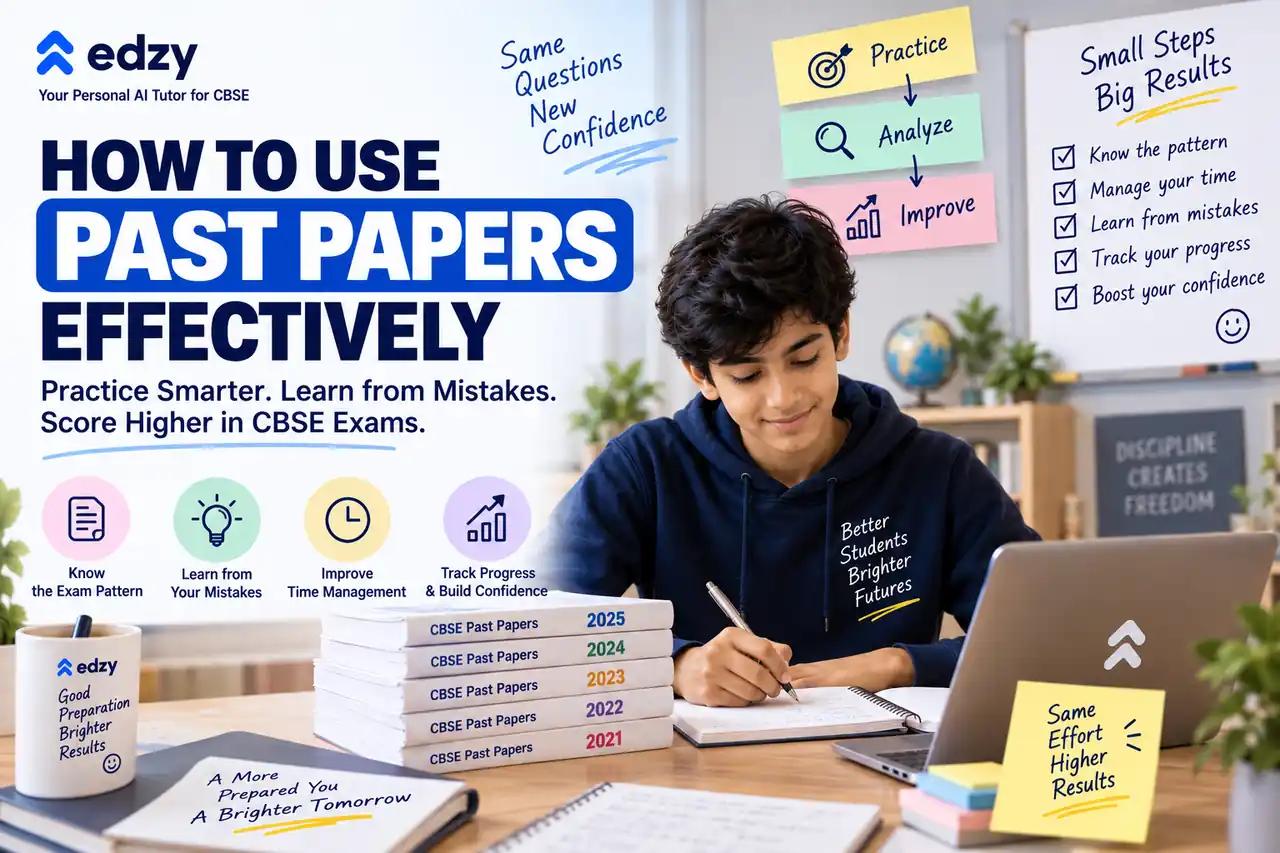
The Past Paper Mastery Framework is a structured approach designed to help students maximize their learning from past papers. It consists of three key components: Practice, Analyze, and Improve. First, students should practice solving past papers under exam conditions. Next, they must analyze their mistakes thoroughly to identify patterns and areas for improvement. Finally, they should implement targeted study strategies to address these weaknesses. By following this framework, students can transform their approach to past papers from passive practice to active learning. For example, a Class 10 student struggling with Social Science can use this framework to focus on specific chapters like Geography and Civics, ensuring a comprehensive understanding of the subject.
Conclusion
Utilizing past year papers effectively is a game-changer for CBSE students. By adopting the Past Paper Mastery Framework, students can enhance their understanding, improve their time management, and build the confidence needed to excel in their exams. Every mark a CBSE student loses to a careless error is a mark they already earned — the only task left is making sure it shows up on the paper.
Suggested blogs

How to Manage Time During a 3-Hour Exam
Mastering time management for a successful exam experience.

How to Check Your Answers Properly in Exams
Mastering the art of answer checking to secure every mark in CBSE exams.

How to Improve Your Speed in Solving Questions Before Exams
Mastering speed in question-solving is crucial for CBSE students aiming for high marks.

Class 10 Maths: How to Practice Case Study Questions for Boards
Mastering case study questions can significantly boost your Class 10 Maths scores.