
How to Revise the Entire Syllabus in 7 Days Before Exams
Master your CBSE syllabus in just one week with effective strategies.
Facing the pressure of last-minute revisions? This blog introduces the 7-Day Revision Framework, a structured approach to cover your entire syllabus efficiently. Learn how to prioritize chapters, utilize active recall, and manage your time effectively to walk into your exams with confidence.

Gaurav Parashar
@gauravparashar
Listen to this article
How to Revise the Entire Syllabus in 7 Days Before Exams
Why Last-Week Revision is Stressful
As exams approach, many CBSE students find themselves in a frenzy, trying to cram an entire syllabus into a limited timeframe. This last-minute rush is often fueled by anxiety and the overwhelming feeling of inadequacy. For instance, a Class 10 student preparing for the Science board exam might feel pressured to review chapters like Light and Electricity without a clear plan, leading to confusion and stress. The reality is that this approach not only hampers retention but also diminishes performance during exams.
The key to overcoming this stress lies in effective planning and execution. By adopting a structured revision strategy, students can transform their panic into productive study sessions. This blog will guide you through a practical 7-day revision plan, helping you cover your syllabus comprehensively while minimizing stress.
Planning a 7-Day Revision Schedule
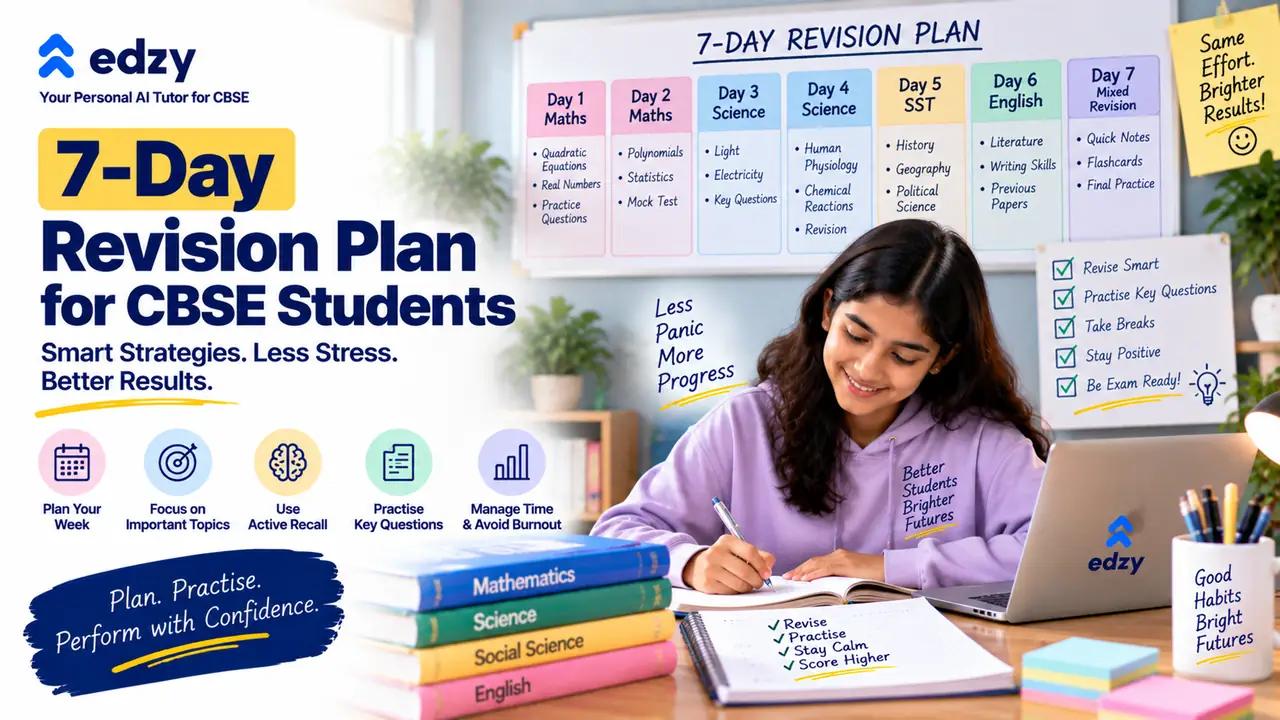
Creating a 7-day revision schedule is crucial for effective learning. Start by listing all the subjects and chapters you need to cover. For example, a Class 12 student might need to revise Photosynthesis in Biology, Federalism in Political Science, and Integrals in Mathematics. Once you have a comprehensive list, allocate specific days to each subject based on your comfort level and the complexity of the chapters.
For instance, you might dedicate the first two days to Mathematics, focusing on chapters like Quadratic Equations and Statistics, which are often challenging. The next two days could be reserved for Science, where you can delve into Human Physiology and Chemical Reactions. Finally, use the last three days for Social Science and English, ensuring you have ample time for revision and practice. This structured approach not only helps in covering the syllabus but also allows for adequate breaks to prevent burnout.
Prioritizing Important Chapters
Not all chapters hold equal weight in your exams. Therefore, it is essential to prioritize based on previous years' question patterns and your own understanding. For example, in Class 10 Mathematics, chapters like Real Numbers and Polynomials frequently appear in board exams. By focusing on these high-yield topics, you can maximize your chances of scoring well.
Additionally, consider your strengths and weaknesses. If you find History challenging, allocate more time to revise key events and dates, while spending less time on chapters you are comfortable with. This tailored approach ensures that you are not only revising but also reinforcing your understanding of critical concepts.
Using Active Recall Techniques
Active recall is a powerful study technique that enhances memory retention. Instead of passively reading through your notes, engage with the material by testing yourself. For instance, after studying the chapter on Laws of Motion in Class 9 Physics, close your book and write down everything you remember. This method forces your brain to retrieve information, solidifying your understanding.
You can also create flashcards for key terms and concepts. For example, make a flashcard for Newton's First Law and write a brief explanation on the back. Regularly reviewing these flashcards throughout the week will reinforce your memory and help you recall information during the exam. To learn more about effective study techniques, check out our article on how to study smarter, not longer.
Practicing Key Questions
One of the best ways to prepare for exams is by practicing key questions from previous years. This not only familiarizes you with the exam format but also helps identify recurring themes. For instance, a Class 12 student preparing for the English board exam should focus on past paper questions related to Shakespeare's Plays or Poetry Analysis. Additionally, consider attempting case-based questions and assertion-reason questions, which are increasingly common in CBSE exams. By practicing these types of questions, you will develop the skills needed to tackle them effectively, boosting your confidence as exam day approaches. For more tips on utilizing past papers, check out our article on how to use past year papers the right way.
Avoiding Burnout
While it is essential to study hard, it is equally important to take care of your mental and physical well-being. Long hours of continuous study can lead to burnout, which negatively impacts your performance. Incorporate short breaks into your revision schedule. For example, after studying for 50 minutes, take a 10-minute break to stretch or grab a snack.
Moreover, engage in relaxing activities such as meditation or light exercise. These practices not only refresh your mind but also enhance focus during study sessions. Remember, a well-rested mind is more productive than one that is fatigued. For more strategies on maintaining focus, refer to our blog on how to stay focused for the entire exam duration.
Managing Time Effectively
Time management is crucial during your revision week. Allocate specific time slots for each subject and stick to them. Use a timer to keep track of your study sessions. For instance, if you plan to study Geography for two hours, set a timer for 50 minutes of focused study followed by a 10-minute break. This technique helps maintain concentration and prevents procrastination.
Additionally, prioritize tasks based on deadlines and importance. If you have a mock test on Federalism in Political Science, ensure that you revise that chapter first before moving on to less urgent topics. This strategic approach ensures that you are always prepared for upcoming assessments.
Walking into Exams Confidently
As the exam day approaches, confidence becomes key. Ensure you have all necessary materials ready the night before, including your admit card, stationery, and any required textbooks. A well-prepared student is a confident student. For instance, a Class 10 student should double-check that they have their Mathematics formula sheet ready and that they understand how to apply the formulas in various contexts.
On the day of the exam, practice deep breathing techniques to calm your nerves. Remind yourself of the hard work you have put in over the past week. Trust in your preparation and approach the exam with a positive mindset. Remember, every mark you earn is a reflection of your effort and understanding. To further enhance your exam readiness, consider reading our guide on how to check your answers properly in exams and our article on how to avoid last-minute cramming before exams.
The 7-Day Revision Framework
The 7-Day Revision Framework is a structured approach designed to maximize your learning in a limited timeframe. This framework emphasizes planning, prioritization, active recall, and effective time management, ensuring that you cover your syllabus comprehensively while minimizing stress. By following this framework, you can transform your last-minute revision into a productive and confidence-building experience.
In summary, effective revision is not just about cramming information but about understanding and retaining knowledge. Implementing the strategies outlined in this blog will empower you to walk into your exams with confidence, ready to tackle any question that comes your way. Remember, every mark a CBSE student loses to a careless error is a mark they already earned — the only task left is making sure it shows up on the paper.
Suggested blogs
How to Improve Speed in Exams Without Making More Mistakes
Mastering the art of speed and accuracy for CBSE exams.
How to Revise One Day Before the Exam (Without Panic)
Mastering last-minute revision for CBSE exams without stress.
Class 12 Physics: How to Revise Entire Syllabus Before Boards
Mastering the Class 12 Physics syllabus for board exams through efficient revision strategies.
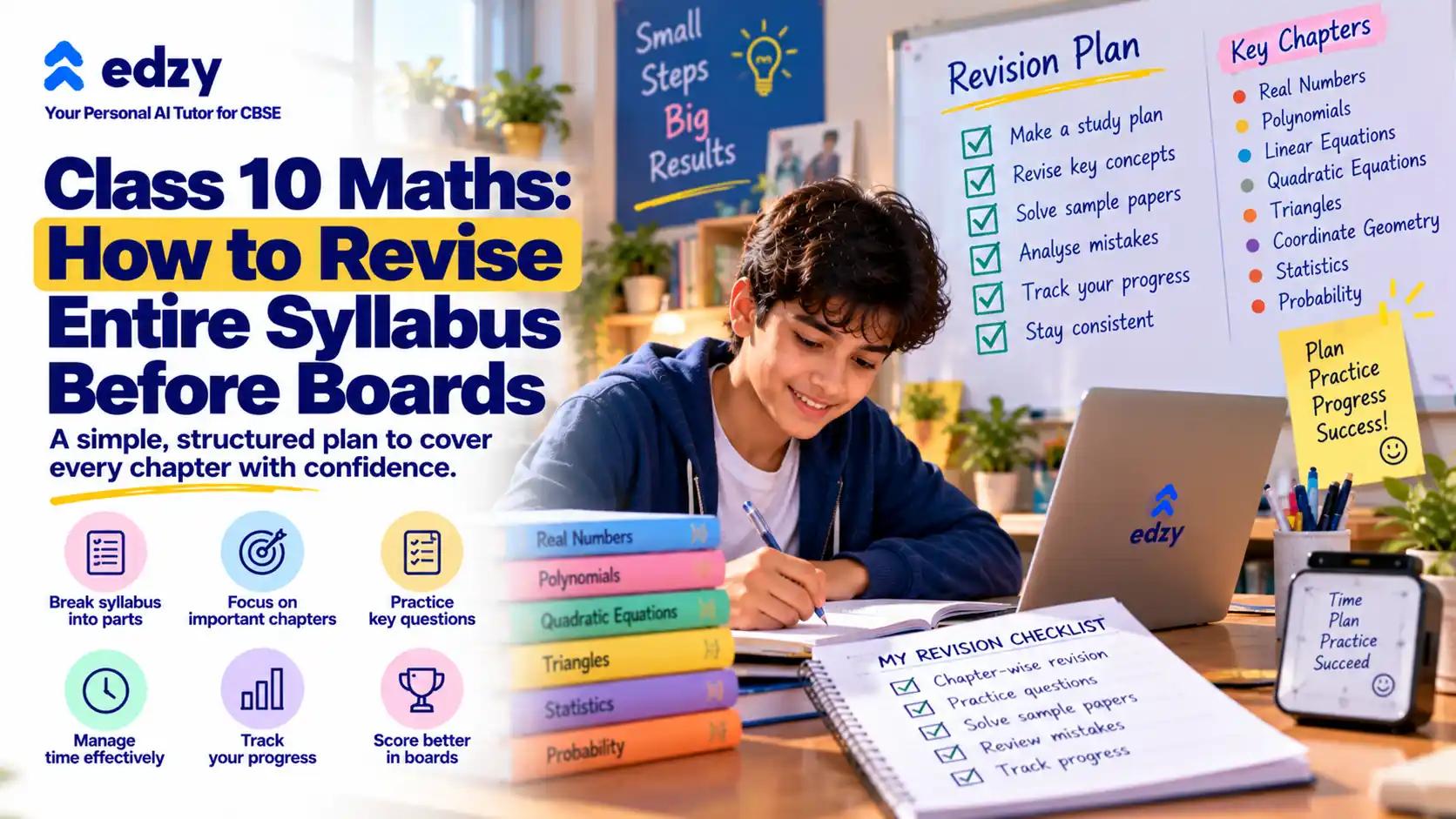
Class 10 Maths: How to Revise Entire Syllabus Before Boards
Mastering the Class 10 Maths syllabus for board exams requires a strategic approach to revision.