Brand Logo
Home
All News

CBSE reiterates strict 75% Att...

CBSE
Aug 06, 2025

CBSE reiterates strict 75% Attendance Rule for 2025 Board Exam Eligibility

Students citing illness must provide valid documentation to support their absence in order to be considered for attending the 75% cutoff necessary to take the Class 10 and Class 12 Board exams.

CBSE enforces 75% attendance for 2025 board exam eligibility. Medical or sports exemptions require documentation submitted in a timely fashion.
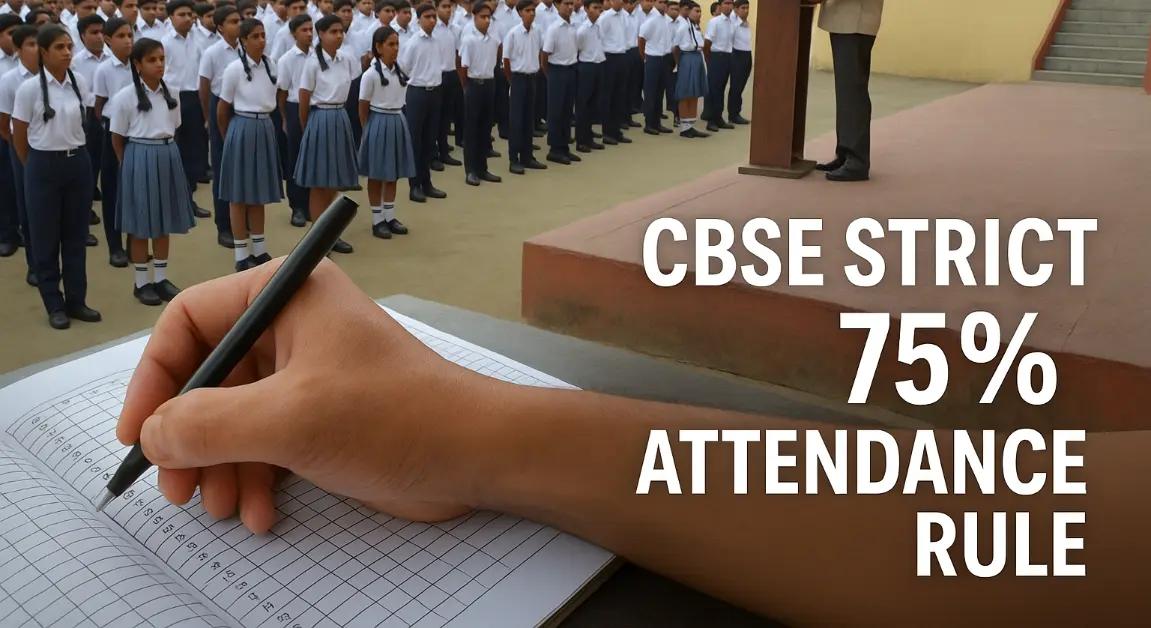
CBSE reiterates strict 75% Attendance Rule for 2025 Board Exam Eligibility

With an announcement, the Central Board of Secondary Education has issued a novel directive enforcing the 75% attendance requirement for class 10 and 12 students for the 2025 to 2026 session board examinations. The circular has made it compulsory for all the affiliated schools to implement the attendance controls as per rules 13 and 14 of the CBSE Examination Bye-Laws.

The board aims to clarify that students will not be permitted to attend the board examinations unless they meet the 75% attendance requirement, except in very limited cases that have been pre-approved and require a transparent process for validation and verification.

Key Requirements and Procedures

  1. Students must adhere to an Attendance Limitation: Students in all classes will be required to maintain a minimum attendance of 75% on or before 1st January of the academic calendar. If this baseline attendance is not achieved, students will not be permitted to sit for board exams.

  2. Valid Exemptions: Attendance below 75% will only be considered for condonation in serious exceptional cases.

    • Overdue illness with medical documentation • Death in the family • Attending events at the national or international level for recognised sports.

    • Other extraordinary circumstances with supporting documentation

  3. Enforcement of Leave Policies: Applications for leave must be submitted and documented at the time leave is taken. Unattended documentation offered during unscheduled checks may result in students being marked as “dummy” candidates and subsequently barred from examination eligibility.

  4. School Responsibilities: Schools must authenticate and update attendance registers in real time, ensuring accurate daily records. In cases of persistent non-attendance, parents must be formally informed through email or speed post, emphasizing the importance of regular attendance. All related correspondence, including leave records and communication with parents, must be carefully preserved and made available for examination or CBSE inspection when required.

  1. Unannounced Inspections by CBSE: CBSE is allowed to visit and check the schools unannounced at any time. Any discrepancies with maintaining/monitoring attendance or following the mandates may lead to the students being disqualified or the school losing its affiliation.

All requests for exemption will be filed through the CBSE prescribed proforma and SOPs and will be submitted to the respective Regional Office by the 7th of January 2026.

Keep In Mind These Important Dates

The attendance cut-off date for board exam eligibility is January 1, 2026. Schools must submit condonation requests for attendance shortages by January 7, 2026. If any deficiencies are found in the submitted cases, they must be rectified by January 21, 2026. The final deadline for CBSE to issue approvals for such cases is February 7, 2026.

“Regular attendance is not only essential for board exam eligibility but also for building responsible and disciplined individuals,” observed Dr Sanyam Bhardwaj, Controller of Examinations, CBSE.

The board has asked all affiliated schools to communicate with students and their parents concerning the updated policies as soon as possible and to observe openness for the entire academic cycle. No cases of late submission or erroneous paperwork will be entertained under any circumstances.

Related News
Important Update on CBSE Board Examinations for Class X and XII in the Middle East
CBSE
Mar 03, 2026

Important Update on CBSE Board Examinations for Class X and XII in the Middle East

Direct Recruitment Quota Examination 2026: Key Updates and Insights
CBSE
Mar 03, 2026

Direct Recruitment Quota Examination 2026: Key Updates and Insights

CBSE Opens SARAS 7.0 Affiliation Window for 2027-28 Academic Session
CBSE
Feb 27, 2026

CBSE Opens SARAS 7.0 Affiliation Window for 2027-28 Academic Session

CBSE's Observations on the 2026 Question Papers: A Comprehensive Overview
CBSE
Feb 17, 2026

CBSE's Observations on the 2026 Question Papers: A Comprehensive Overview

Class 9

Class 9 - English
Moments (9 Chapters)|
Beehive (18 Chapters)|
Words and Expressions - I (9 Chapters)
Class 9 - Health and Physical Education
Health and Physical Education (14 Chapters)
Class 9 - Hindi
Sanchayan (4 Chapters)|
Sparsh (10 Chapters)|
Kshitij (13 Chapters)|
Kritika (4 Chapters)
Class 9 - ICT
Information and Communication Technology (8 Chapters)
Class 9 - Mathematics
Mathematics (12 Chapters)
Class 9 - Sanskrit
Shemushi Prathmo Bhag (10 Chapters)|
Vyakaranavithi (20 Chapters)|
Abhyaswaan Bhav (15 Chapters)
Class 9 - Science
Science (12 Chapters)
Class 9 - Social Science
Contemporary India (6 Chapters)|
Democratic Politics (5 Chapters)|
Economics (4 Chapters)|
India and the Contemporary World - I (5 Chapters)

Class 10

Class 10 - English
First Flight (22 Chapters)|
Foot Prints Without feet (9 Chapters)|
Words and Expressions - II (9 Chapters)
Class 10 - Health and Physical Education
Health and Physical Education (13 Chapters)
Class 10 - Hindi
Kshitij - II (13 Chapters)|
Sparsh (14 Chapters)|
Sanchayan - II (3 Chapters)|
Kritika (3 Chapters)
Class 10 - Mathematics
Mathematics (14 Chapters)
Class 10 - Sanskrit
Vyakaranavithi (14 Chapters)|
Shemushi - II (12 Chapters)|
Abhyaswaan Bhav - II (14 Chapters)
Class 10 - Science
Science (13 Chapters)
Class 10 - Social Science
Contemporary India (7 Chapters)|
Democratic Politics (5 Chapters)|
India and the Contemporary World - II (5 Chapters)|
Understanding Economic Development (5 Chapters)
Class 10 - Urdu
Nawa-e-urdu (25 Chapters)

Class 11

Class 11 - Accountancy
Accountancy - II (2 Chapters)|
Financial Accounting - I (7 Chapters)
Class 11 - Biology
Biology (19 Chapters)
Class 11 - Biotechnology
Biotechnology (12 Chapters)
Class 11 - Business Studies
Business Studies (11 Chapters)
Class 11 - Chemistry
Chemistry Part - I (6 Chapters)|
Chemistry Part - II (3 Chapters)
Class 11 - Computer Science
Computer Science (11 Chapters)
Class 11 - Creative Writing and Translation
Srijan (4 Chapters)
Class 11 - Economics
Statistics for Economics (8 Chapters)|
Indian Economic Development (8 Chapters)
Class 11 - English
Hornbill (11 Chapters)|
Snapshots (5 Chapters)|
Woven Words (27 Chapters)
Class 11 - Fine Art
An Introduction to Indian Art Part - I (8 Chapters)
Class 11 - Geography
Fundamentals of Physical Geography (14 Chapters)|
India Physical Environment (6 Chapters)|
Practical Work in Geography (6 Chapters)
Class 11 - Health and Physical Education
Health and Physical Education (11 Chapters)
Class 11 - History
Themes in World History (13 Chapters)
Class 11 - Home Science
Human Ecology and Family Sciences - I (7 Chapters)|
Human Ecology and Family Sciences - II (4 Chapters)
Class 11 - Informatics Practices
Informatics Practices (8 Chapters)
Class 11 - Knowledge Traditions Practices of India
Knowledge Traditions Practices of India (9 Chapters)
Class 11 - Mathematics
Mathematics (14 Chapters)
Class 11 - Physics
Physics Part - I (7 Chapters)|
Physics Part - II (7 Chapters)
Class 11 - Political Science
Indian Constitution at Work (10 Chapters)|
Political Theory (8 Chapters)
Class 11 - Psychology
Introduction to Psychology (8 Chapters)
Class 11 - Sangeet
Tabla evam Pakhawaj (8 Chapters)|
Hindustani Sangeet Gayan Evam Vadan (10 Chapters)
Class 11 - Sociology
Understanding Society (5 Chapters)|
Introducing Sociology (5 Chapters)

Class 12

Class 12 - Accountancy
Accountancy Part - I (4 Chapters)|
Accountancy Part - II (6 Chapters)
Class 12 - Biology
Biology (13 Chapters)
Class 12 - Biotechnology
Biotechnology (13 Chapters)
Class 12 - Business Studies
Business Studies - II (3 Chapters)|
Business Studies - I (8 Chapters)
Class 12 - Chemistry
Chemistry - II (5 Chapters)|
Chemistry - I (5 Chapters)
Class 12 - Computer Science
Computer Science (13 Chapters)
Class 12 - Economics
Introductory Microeconomics (5 Chapters)|
Introductory Macroeconomics (6 Chapters)
Class 12 - English
Flamingo (14 Chapters)|
Vistas (7 Chapters)|
Kaliedoscope (21 Chapters)
Class 12 - Fine Art
An Introduction to Indian Art Part - II (8 Chapters)
Class 12 - Geography
Practical Work in Geography - Part II (4 Chapters)|
Fundamentals of Human Geography (8 Chapters)|
India - People and Economy (9 Chapters)
Class 12 - Hindi
Aroh (15 Chapters)|
Antra (23 Chapters)|
Antral Bhag - II (3 Chapters)|
Vitan (3 Chapters)
Class 12 - History
Themes in Indian History - III (4 Chapters)|
Themes in Indian History - I (4 Chapters)|
Themes in Indian History - II (4 Chapters)
Class 12 - Home Science
Human Ecology and Family Sciences Part I (7 Chapters)|
Human Ecology and Family Sciences Part II (7 Chapters)
Class 12 - Informatics Practices
Informatics Practices (7 Chapters)
Class 12 - Mathematics
Mathematics Part - I (6 Chapters)|
Mathematics Part - II (7 Chapters)
Class 12 - Physics
Physics Part - I (8 Chapters)|
Physics Part - II (6 Chapters)
Class 12 - Political Science
Politics in India Since Independence (8 Chapters)|
Contemporary World Politics (7 Chapters)
Class 12 - Psychology
Psychology (7 Chapters)
Class 12 - Sangeet
Hindustani Sangeet Gayan Evam Vadan (9 Chapters)|
Tabla evam Pakhawaj (7 Chapters)
Class 12 - Sociology
Social Change and Development in India (8 Chapters)|
Indian Society (7 Chapters)

About Edzy - Gamified Learning Platform

Edzy is India's premier gamified AI tutor platform for CBSE and State Board students in classes 6-12. Our platform transforms traditional studying with AI-powered study plans, interactive practice sessions, and personalized learning pathways. Students using Edzy experience unmatched learning efficiency through our immersive educational environment that combines advanced technology with curriculum-aligned content.

Why Choose Edzy for CBSE and State Board Preparation

Edzy offers an adaptive AI educational experience tailored to each student's learning style and pace. We integrate gamification with proven educational strategies to create an engaging environment that students love. Our micro-content approach breaks down complex CBSE and State Board topics into manageable lessons, building confidence through mastery-based progression and real-time feedback.

CBSE and State Board Focus Areas

Edzy specializes in transforming online education for classes 6-12 with AI-powered tutoring. We provide comprehensive NCERT-aligned content and engaging lessons across Mathematics, Science, English, Social Studies, and IT. Our system helps students master fundamental concepts and excel in board exams through AI-generated study plans, personalized learning timelines, and dynamic practice sessions.

Edzy's Unique Approach to Online Learning

Unlike traditional online coaching platforms, Edzy converts CBSE and State Board syllabus content into interactive learning adventures. Our AI tutor provides timely assistance while adapting to student progress. The platform features instant feedback, gamified practice sessions, and achievement badges to motivate continuous learning and concept mastery.

Brand Logo

Edzy | Largest Online Learning Platform for Classes 6–12

Study smarter with Edzy – India’s leading gamified AI tutor for CBSE and State Boards. Designed for Classes 6–12, Edzy offers interactive lessons, AI-powered study plans, and rewarding practice tools for every subject.

Find us on Social Media

Links

About EdzyFAQsContact UsCBSE CoursesDuelsRumblesEdzy App

Parents & Teachers

Search EdzyParent DashboardCreator PlatformEducation BlogCBSE & NCERT News

Policies

Terms and ConditionsRefund PolicyPrivacy PolicyCookie Policy

© 2026 Edzy | Largest Online Learning Platform for Classes 6–12. All rights reserved.

Edzy is an AI tutor for CBSE and State Board students, offering interactive lessons and personalized learning for Classes 6–12.

SitemapNews SitemapBlog SitemapSchool SitemapAccessibility