
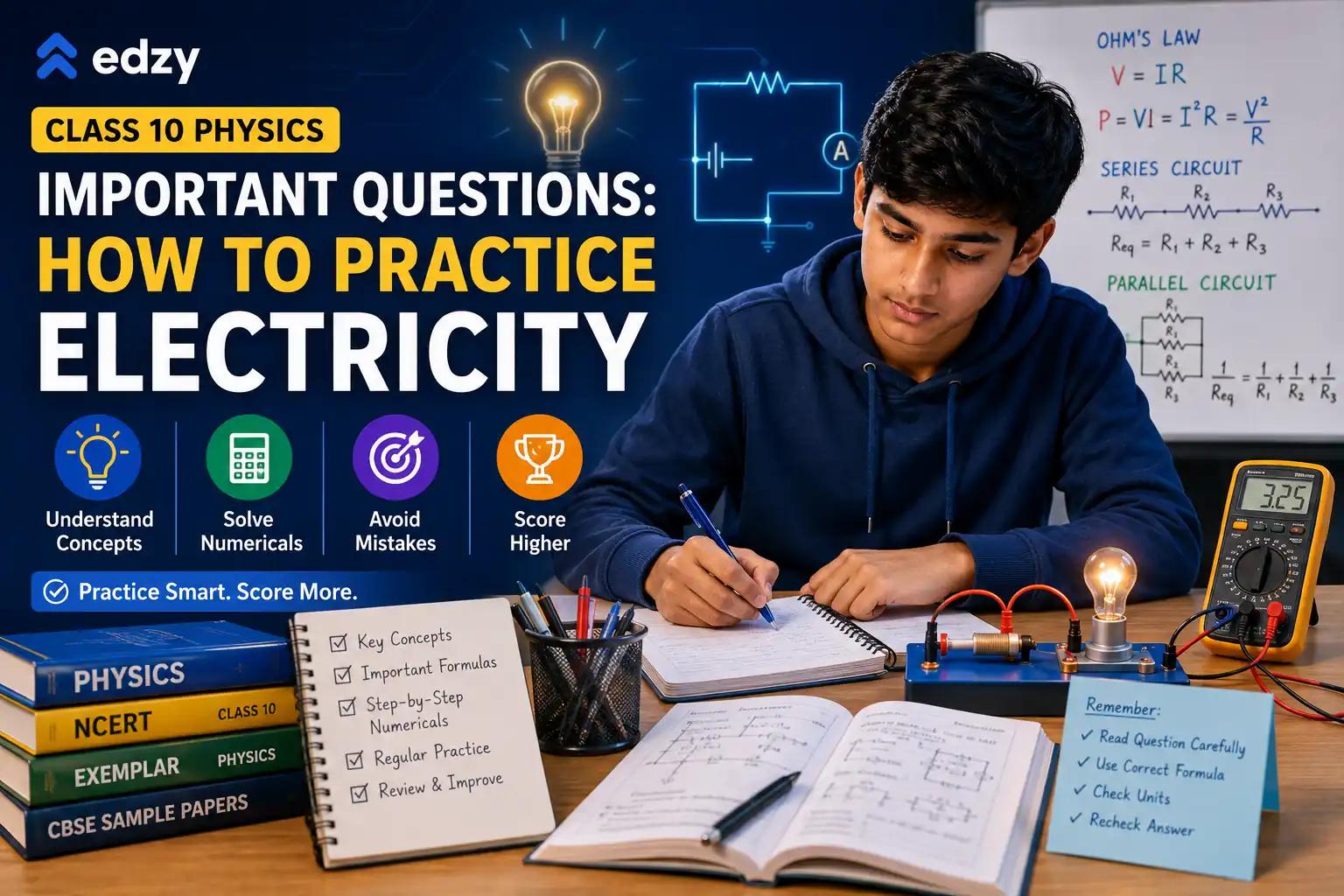
Class 10 Physics Important Questions: How to Practice Electricity
Mastering electricity concepts can significantly boost your Class 10 scores.
Many Class 10 students struggle with electricity concepts, leading to lost marks in board exams. This blog outlines effective strategies for mastering electricity, including understanding formulas and practicing important questions. Readers will learn how to avoid common mistakes and improve their exam performance in this crucial chapter.

Gaurav Parashar
@gauravparashar
Class 10 Physics Important Questions: How to Practice Electricity
Electricity is a pivotal chapter in the Class 10 Physics syllabus under the CBSE curriculum. It encompasses essential concepts that not only appear frequently in board exams but also serve as foundational knowledge for higher studies. Understanding electricity can lead to significant scoring opportunities, making it crucial for students to practice effectively. This blog will guide students and parents through the best practices for mastering electricity questions, ensuring a solid grasp of the subject.
Why Electricity is a Scoring Chapter
Electricity is often considered a scoring chapter in Class 10 Physics due to its clear concepts and direct application in numerical problems. The chapter covers topics such as Ohm's Law, series and parallel circuits, and electrical power, all of which are essential for both theoretical understanding and practical application. For instance, questions related to calculating resistance in series and parallel circuits are common in CBSE board exams. A well-prepared student can easily score full marks by practicing these types of problems.
Moreover, electricity-related questions often appear in various formats, including case-based and assertion-reason questions. Understanding these formats can give students an edge in the examination. For example, a typical case-based question might present a real-life scenario involving electrical appliances and ask students to calculate the total current drawn. By practicing such questions, students can enhance their problem-solving skills and boost their confidence.
Understanding Formulas Conceptually
Mastering the formulas related to electricity is crucial for solving numerical problems effectively. Key formulas include Ohm's Law (V = IR), the formula for electrical power (P = VI), and the formulas for calculating equivalent resistance in series (Req = R1 + R2 + ...) and parallel circuits (1/Req = 1/R1 + 1/R2 + ...). Understanding these formulas conceptually helps students apply them correctly in different contexts.
For instance, a Class 10 student preparing for the board exam should not just memorize the formula for electrical power but also understand how changing voltage or current affects the power consumed by an appliance. This conceptual understanding allows students to tackle complex problems that may not follow a straightforward application of formulas.
Solving Numericals Step by Step
When approaching numerical problems in electricity, a systematic step-by-step method is essential. Start by carefully reading the question to identify what is being asked. For example, if a question asks for the total resistance in a circuit with both series and parallel components, first identify which resistors are in series and which are in parallel. Then, apply the appropriate formulas sequentially.
Let’s consider a practical example: A circuit contains a 10Ω resistor and a 20Ω resistor in series, connected to a 5V battery. To find the total resistance, the student would add the resistances: Req = 10Ω + 20Ω = 30Ω. Next, using Ohm's Law, they can calculate the current: I = V/Req = 5V/30Ω = 0.167A. This method not only helps in arriving at the correct answer but also minimizes the chances of making careless mistakes.
Avoiding Common Mistakes
Many students lose marks due to common mistakes in electricity-related questions. One frequent error is misapplying formulas, particularly in complex circuits. For example, students often confuse the formulas for series and parallel circuits, leading to incorrect calculations of equivalent resistance. To avoid this, it is crucial to practice a variety of problems and understand the underlying principles governing each type of circuit.
Another common mistake is neglecting the units of measurement. Students might calculate the current in amperes but forget to convert voltage from millivolts to volts, resulting in incorrect answers. Always double-check units before finalizing calculations. A good practice is to write down all known values with their respective units before starting the calculations.
Practicing Important Questions
To excel in the electricity chapter, students should focus on practicing important questions from previous years' CBSE board exams. These questions often highlight key concepts and problem-solving techniques that are essential for success. For instance, a common question might involve calculating the total power consumed by multiple appliances connected in parallel.
Additionally, students should refer to NCERT textbooks and sample papers to find a variety of problems. Engaging with different types of questions, such as assertion-reason questions and case-based problems, will prepare students for the diverse formats they may encounter in the exams. For example, a student might come across a case-based question that requires them to analyze the energy consumption of a household based on given data, which is a practical application of the concepts learned.
For further insights on effective study strategies, check out our blog on revising smartly for exams. Additionally, students can enhance their understanding by exploring how to identify weak areas in studies to target their revision more effectively.
Revising Effectively
Effective revision is key to retaining information and performing well in exams. For the electricity chapter, students should create a summary of key formulas and concepts. Flashcards can be particularly useful for memorizing formulas and their applications. For instance, a flashcard for Ohm's Law might include the formula on one side and a practical example on the other, helping students recall its application during exams.
Moreover, group study sessions can enhance understanding as students explain concepts to each other. Teaching a peer is one of the best ways to reinforce one's own understanding. For example, a student who can explain how to calculate equivalent resistance in both series and parallel circuits is likely to have a solid grasp of the concepts.
Improving Accuracy
Improving accuracy in solving electricity problems requires consistent practice and self-assessment. After completing practice problems, students should review their answers and identify any mistakes. This reflection helps in recognizing patterns in errors, such as consistently miscalculating resistance or forgetting to convert units.
Additionally, timed practice sessions can simulate exam conditions, helping students manage their time effectively during the actual test. For example, a student might set a timer for 30 minutes and attempt to solve a set of 10 electricity-related problems. This practice not only enhances speed but also builds confidence in tackling questions under pressure.
For more tips on improving accuracy, read our article on improving writing answers in CBSE exams. Furthermore, students can benefit from our guide on studying smarter, not longer to maximize their efficiency.
Scoring Higher in Exams
Ultimately, the goal of mastering the electricity chapter is to score higher in exams. By understanding the concepts, practicing important questions, and avoiding common mistakes, students can significantly improve their performance. Regular self-assessment and effective revision strategies will ensure that students are well-prepared for their board exams.
In summary, electricity is a chapter that offers ample scoring opportunities for Class 10 students. By focusing on conceptual understanding, practicing numericals, and refining exam techniques, students can turn their efforts into high scores. The key lies in consistent practice and a proactive approach to learning.
For additional strategies on managing study time effectively, refer to our blog on finishing your syllabus on time.
By adopting the Electricity Mastery Framework, which emphasizes understanding concepts, practicing regularly, and self-assessment, students can navigate the complexities of electricity with confidence. This framework not only aids in mastering the current chapter but also lays a strong foundation for future studies in physics.
Every mark a CBSE student loses to a careless error is a mark they already earned — the only task left is making sure it shows up on the paper.
Suggested blogs

How to Manage Time During a 3-Hour Exam
Mastering time management for a successful exam experience.

How to Check Your Answers Properly in Exams
Mastering the art of answer checking to secure every mark in CBSE exams.

How to Improve Your Speed in Solving Questions Before Exams
Mastering speed in question-solving is crucial for CBSE students aiming for high marks.

How to Use Past Year Papers the Right Way
Mastering past papers transforms passive practice into effective learning for CBSE students.