
Class 10 Science Important Questions: How to Practice Them for Boards
Mastering important questions in Class 10 Science is key to achieving high board exam scores.
Many Class 10 students struggle with board exam preparation, particularly with important questions in Science. This blog introduces the 'Focused Question Practice Framework,' a structured approach to mastering these crucial questions. Readers will learn how to select the right questions, practice effectively, and avoid common pitfalls to enhance their exam performance.

Gaurav Parashar
@gauravparashar
Listen to this article
Class 10 Science Important Questions: How to Practice Them for Boards
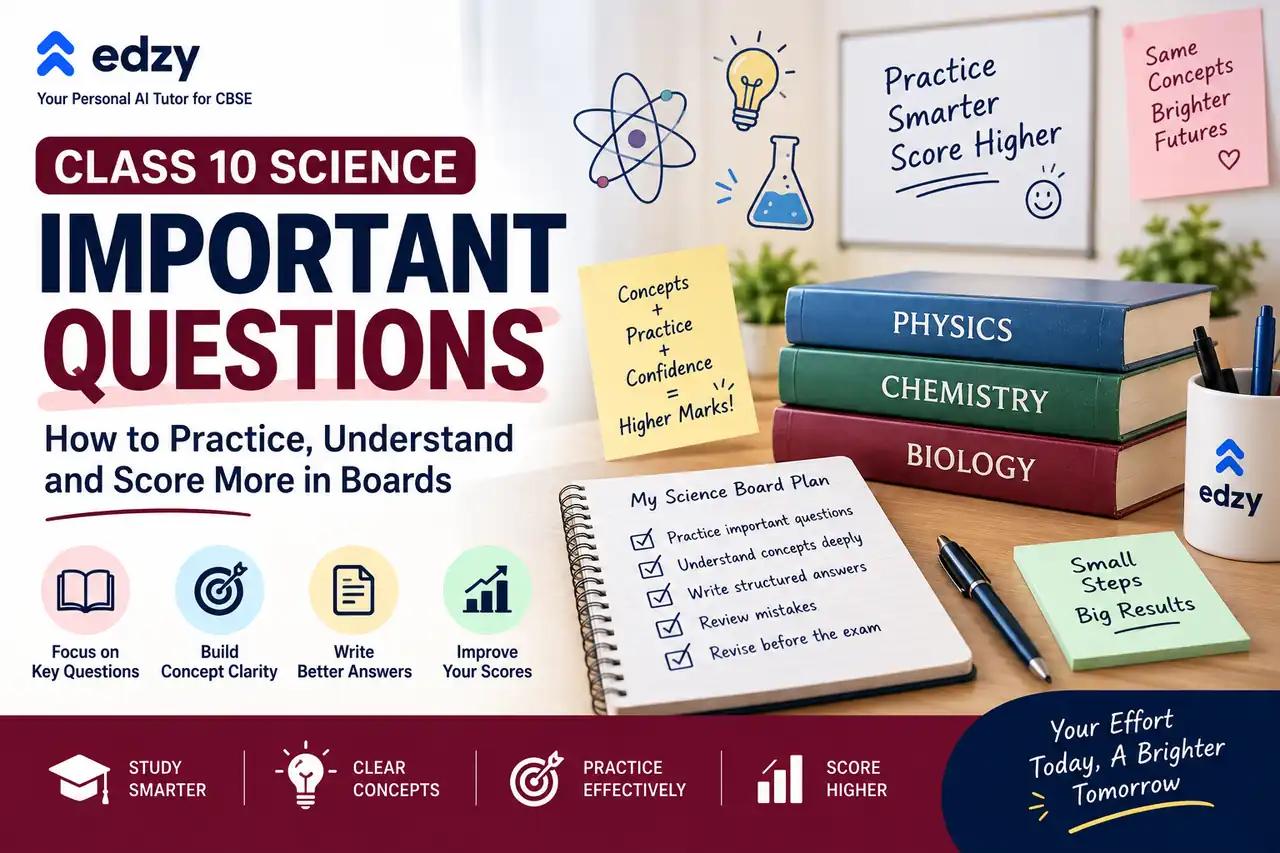
As Class 10 students gear up for their board exams, the pressure to perform well can be overwhelming. One of the most effective strategies to ensure success is focusing on important questions in Science. These questions not only help in understanding the core concepts but also align closely with the CBSE exam pattern. In this blog, we will explore a structured approach to practicing these important questions, ensuring that students can tackle their exams with confidence.
Why Important Questions Matter for Boards
Understanding the significance of important questions in Science is crucial for any Class 10 student. The CBSE board exams often emphasize specific concepts that are frequently tested. For instance, chapters like Light and Acids, Bases and Salts have historically featured questions that require a deep understanding of the underlying principles. By concentrating on these important questions, students can maximize their chances of scoring well. To further enhance your preparation, consider checking out our guide on important questions in Physics.
Moreover, practicing these questions helps students identify their strengths and weaknesses. For example, a student who struggles with Human Eye and Colorful World can focus on the important questions from that chapter to improve their understanding. This targeted approach not only enhances knowledge but also boosts confidence. Students can also benefit from our article on identifying weak areas in studies.
How to Select the Right Questions
Selecting the right questions to practice is a skill in itself. Students should begin by reviewing the previous years' board exam papers to identify recurring questions. For instance, questions related to Photosynthesis and Magnetic Effects of Current often appear in various formats, including case-based and assertion-reason questions. By compiling a list of these important questions, students can create a focused study plan. Additionally, our resource on smart study techniques can provide valuable insights.
Additionally, consulting NCERT textbooks and supplementary materials can provide insights into which topics are emphasized. For example, the chapter on Periodic Classification of Elements is not only fundamental but also frequently tested, making it essential for students to practice related questions thoroughly.
Practicing with Full Understanding
Merely attempting to solve important questions is not enough; students must strive for a comprehensive understanding of the concepts behind them. When practicing questions from the chapter on Electricity, for instance, students should not only focus on solving numerical problems but also grasp the underlying principles such as Ohm's Law and the concept of resistance. This depth of understanding will enable them to tackle variations of questions that may appear in the exam.
To reinforce this understanding, students can use visual aids like diagrams and flowcharts. For example, while studying Control and Coordination, creating a flowchart that outlines the nervous system's functioning can aid in better retention of information. This method aligns with the 'Focused Question Practice Framework,' which emphasizes understanding over rote memorization.
Writing Answers with Proper Structure
The way students present their answers can significantly impact their scores. A well-structured answer not only conveys knowledge but also demonstrates clarity of thought. For instance, when answering a question on Chemical Reactions, students should begin with a clear definition, followed by relevant examples and equations. This structure not only helps in organizing thoughts but also makes it easier for examiners to follow the student's reasoning.
Additionally, practicing answer writing under timed conditions can prepare students for the actual exam scenario. This practice can be particularly beneficial for subjects like Science, where time management is crucial. Students should aim to complete their answers within a set time limit, ensuring they can articulate their thoughts clearly and concisely.
Common Mistakes Students Make
Despite their best efforts, students often fall into common traps that can hinder their performance. One frequent mistake is neglecting to read the questions carefully. For example, a student might misinterpret a question on Work and Energy and provide an answer that does not address the specific requirement. This oversight can lead to unnecessary loss of marks.
Another common error is failing to include units in numerical answers. In Science, precision is key, and omitting units can result in marks being deducted. Students should practice writing answers that include all necessary details, such as units and significant figures, to avoid these pitfalls.
Reviewing Mistakes Effectively
Reviewing mistakes is an essential part of the learning process. After practicing important questions, students should take the time to analyze their errors. For instance, if a student struggles with a question on Refraction of Light, they should revisit the concept and understand where their reasoning went wrong. This reflective practice not only helps in correcting mistakes but also reinforces learning.
Using a journal to track mistakes can be beneficial. Students can note down the questions they found challenging, the reasons for their mistakes, and the correct solutions. This method aligns with the 'Focused Question Practice Framework,' allowing students to systematically address their weaknesses.
Using Questions for Final Revision
As the exam date approaches, students should utilize important questions for their final revision. Creating a revision schedule that incorporates these questions can help reinforce knowledge. For example, dedicating a day to revise the chapter on Life Processes by solving important questions can solidify understanding and boost confidence.
Additionally, group study sessions can be effective for revision. Students can quiz each other on important questions, fostering a collaborative learning environment. This approach not only aids in retention but also allows students to gain different perspectives on challenging concepts. To further enhance your group study, consider our tips on finishing your syllabus on time.
Improving Scores with Smart Practice
Smart practice is the key to improving scores in board exams. Students should focus on quality over quantity when it comes to practicing important questions. Instead of attempting numerous questions superficially, they should aim to master a select few. For instance, a Class 10 student preparing for the chapter on Magnetism should focus on understanding the key principles and solving a few representative questions thoroughly.
Incorporating technology can also enhance practice sessions. Utilizing platforms like Edzy, which offers gamified learning experiences, can make studying more engaging and effective. These platforms often provide tailored questions based on the CBSE syllabus, ensuring that students are practicing relevant material. You can explore more about this in our article on building a daily study habit.
Why Do CBSE Students Struggle with Important Questions?
Why do CBSE students struggle with important questions? Many CBSE students face challenges with important questions due to a lack of targeted practice and understanding of the concepts. Often, they focus on rote memorization rather than grasping the underlying principles. This approach leads to confusion during exams when questions are framed differently. By adopting a structured framework for practice, students can enhance their comprehension and performance.
In conclusion, mastering important questions in Class 10 Science is not just about answering questions correctly; it's about developing a deep understanding of the subject. By following the 'Focused Question Practice Framework,' students can systematically approach their studies, avoid common pitfalls, and ultimately improve their board exam scores. Every mark a CBSE student loses to a careless error is a mark they already earned — the only task left is making sure it shows up on the paper.
Suggested blogs

How to Manage Time During a 3-Hour Exam
Mastering time management for a successful exam experience.

How to Check Your Answers Properly in Exams
Mastering the art of answer checking to secure every mark in CBSE exams.

How to Improve Your Speed in Solving Questions Before Exams
Mastering speed in question-solving is crucial for CBSE students aiming for high marks.

How to Use Past Year Papers the Right Way
Mastering past papers transforms passive practice into effective learning for CBSE students.