
How to Avoid Panic When You Don’t Know an Answer in the Exam
Mastering calmness to tackle exam challenges effectively.
Facing uncertainty in exams can lead to panic, affecting performance. This blog introduces the Reset and Engage Framework to help students maintain composure. Readers will learn practical strategies to stay calm, break down questions, and maximize their scores even when unsure.

Gaurav Parashar
@gauravparashar
Listen to this article
How to Avoid Panic When You Don’t Know an Answer in the Exam
Understanding Why Students Panic When Stuck
Panic during exams is a common experience for many CBSE students. When faced with a question that seems insurmountable, the mind often races, leading to a complete mental block. This reaction is not just psychological; it can stem from a fear of failure, the pressure of expectations, or a lack of preparation. For instance, a Class 10 student encountering a case-based question in Science on the topic of Photosynthesis may feel overwhelmed if they cannot recall specific details. This panic can hinder their ability to think clearly and recall information they do know. To better prepare for such scenarios, students can explore effective study techniques that help reinforce their knowledge.
Moreover, the high stakes of board exams amplify this anxiety. Students often believe that their entire future hinges on their performance, which can create a paralyzing fear of making mistakes. Understanding these triggers is the first step towards managing panic effectively.
Pausing and Resetting Your Mind
When panic strikes, the first and most crucial step is to pause. Taking a moment to breathe deeply can significantly help in resetting your mind. For example, a Class 12 student faced with a challenging question in Mathematics about Quadratic Equations should take a few deep breaths to calm their nerves. This simple act can help clear the mental fog and allow for better focus. Students may also benefit from learning time management strategies that can alleviate stress during exams.
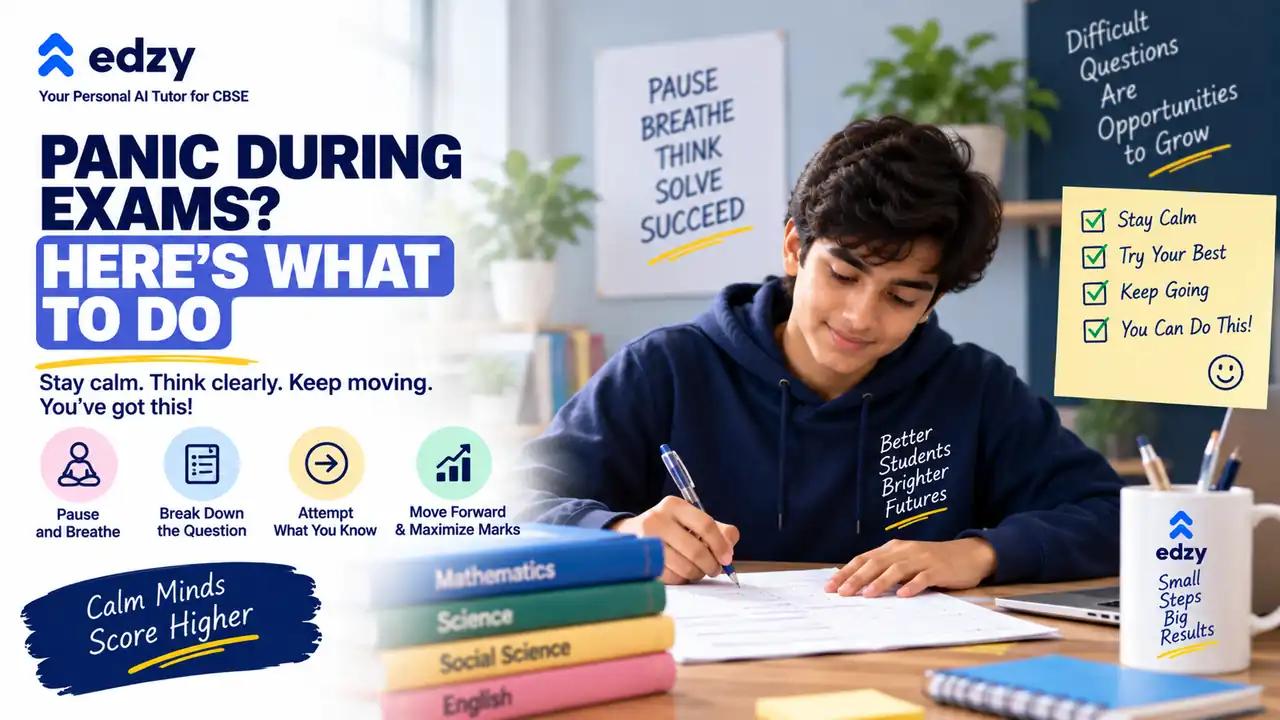
Implementing the Reset and Engage Framework can be beneficial here. This framework encourages students to first reset their mental state through breathing exercises and then engage with the exam material more effectively. By consciously deciding to take a moment to collect their thoughts, students can reduce anxiety and prepare to tackle the question at hand.
Breaking Down the Question
Once the mind is calm, the next step is to break down the question into manageable parts. Many students overlook this strategy, which can lead to feelings of being overwhelmed. For instance, if a Class 9 student encounters a source-based question in Social Science regarding Federalism, they should first identify the key components of the question. What is it asking? Are there specific terms or concepts that can guide their response? Utilizing checklists for answering can help clarify their approach.
By dissecting the question, students can often find clues that lead them to relevant information they already know. This approach not only clarifies the task but also builds confidence as they realize they can answer parts of the question even if they are unsure about the entire topic.
Attempting What You Know
After breaking down the question, students should attempt to answer what they know. This strategy is particularly effective in subjects like English, where students can often draw on their understanding of themes or character analysis even if they cannot recall specific quotes. For instance, a Class 10 student writing an essay on a literary piece can start by outlining their thoughts on the main themes, even if they struggle to remember specific details.
This approach not only helps in filling the answer sheet but also boosts the student’s confidence. By focusing on what they can articulate, they create a foundation upon which they can build further responses. Additionally, this method can help students avoid leaving blank answers, which can be detrimental to their overall score.
Moving to the Next Question
If a student finds themselves stuck even after attempting what they know, it is essential to move on to the next question. This tactic prevents the exam from becoming a source of stress and allows the student to maintain momentum. For example, a Class 11 student facing a complex problem in Physics related to Laws of Motion should not dwell on it. Instead, they can skip to another question that they feel more confident about.
By doing so, they can return to the challenging question later with a fresh perspective. This strategy is part of the Reset and Engage Framework, emphasizing the importance of pacing oneself during exams and not getting bogged down by difficult questions.
Coming Back Later Calmly
Returning to a question after attempting others can often yield better results. When students revisit a question with a clearer mind, they may recall information that eluded them initially. For instance, a Class 12 student who initially struggled with a case-based question in Biology about Photosynthesis might find that after answering other questions, they can remember key processes like the light-dependent reactions.
This technique reinforces the idea that sometimes stepping away from a problem can provide the mental clarity needed to solve it. It also aligns with the Reset and Engage Framework, where students are encouraged to engage with the material in a more relaxed state of mind.
Avoiding Blank Answers
One of the most detrimental actions a student can take during an exam is leaving answers blank. This not only results in lost marks but can also contribute to feelings of failure. Instead, students should strive to write something, even if it’s a rough outline of their thoughts. For example, a Class 10 student faced with a question on Geography regarding the impacts of climate change should jot down any relevant points they can recall, such as effects on agriculture or weather patterns.
By attempting to answer, even partially, students can earn partial credit and demonstrate their understanding of the topic. This proactive approach is crucial in maximizing their overall score and can be a game-changer in their final results. Additionally, students can enhance their preparation by reading strategies to study effectively before the exam.
Maximizing Marks Even When Unsure
Finally, students should focus on maximizing their marks even when they feel unsure. This involves strategically answering questions based on what they do know and how they can relate it to the question asked. For instance, if a Class 12 student is unsure about a specific Mathematics formula but remembers the concept behind it, they should explain that concept in their answer. This can often lead to receiving marks for demonstrating understanding, even if the final answer is incorrect.
Additionally, students should familiarize themselves with the exam format, such as case-based questions and assertion-reason questions, which often allow for partial credit based on the reasoning provided. Understanding how marks are allocated can empower students to approach their answers with confidence, knowing that every effort counts. They can also benefit from effective revision techniques that help consolidate their knowledge.
Conclusion
Panic during exams is a common hurdle for CBSE students, but with the right strategies, it can be managed effectively. By implementing the Reset and Engage Framework, students can maintain composure, break down questions, and maximize their scores. Remember, every mark a CBSE student loses to a careless error is a mark they already earned — the only task left is making sure it shows up on the paper.
Suggested blogs

How to Manage Time During a 3-Hour Exam
Mastering time management for a successful exam experience.

How to Check Your Answers Properly in Exams
Mastering the art of answer checking to secure every mark in CBSE exams.

How to Improve Your Speed in Solving Questions Before Exams
Mastering speed in question-solving is crucial for CBSE students aiming for high marks.
How to Use Past Year Papers the Right Way
Mastering past papers transforms passive practice into effective learning for CBSE students.