
Class 10 SST: How to Write Better Answers in Geography
Mastering the art of writing high-scoring answers in Class 10 Geography.
Struggling to score well in Geography? This blog reveals why students lose marks and introduces the 'Geography Answer Framework' to enhance answer quality. Learn how to structure your responses, incorporate maps, and use keywords effectively to boost your scores.

Gaurav Parashar
@gauravparashar
Listen to this article
Class 10 SST: How to Write Better Answers in Geography
Why Geography Answers Lose Marks
Many Class 10 students find themselves losing marks in Geography, often due to common pitfalls that can be easily avoided. A significant reason for this is the lack of clarity in understanding the question. For instance, when a question asks for the impacts of urbanization, students might list general facts instead of focusing on specific examples like the effects of urbanization in Delhi or Mumbai. This oversight can lead to a loss of valuable marks, especially in a subject where detail and specificity are crucial. To avoid this, students can refer to effective writing strategies that emphasize clarity and detail.
Additionally, many students fail to structure their answers properly. A well-structured answer not only presents information logically but also makes it easier for examiners to follow the student's thought process. For example, when answering a question on 'Federalism in India', students should ideally start with a definition, followed by examples, and conclude with its significance. This methodical approach can significantly enhance the clarity and quality of their responses. Students can learn more about structuring answers by checking out revision techniques that help in organizing thoughts.
Understanding What the Question Asks
Understanding the question is paramount in Geography exams. Questions can vary from descriptive to analytical, and recognizing the type is essential for crafting a suitable response. For example, a question like 'Discuss the causes of deforestation' requires a detailed explanation of various factors, while a question such as 'Evaluate the impact of deforestation on biodiversity' demands a more analytical approach, discussing both causes and effects. Students should practice identifying keywords in questions. Terms like 'discuss', 'analyze', and 'evaluate' dictate the structure and depth of the answer. For instance, if a student encounters a question asking them to 'analyze the effects of climate change on agriculture', they should focus on specific impacts, such as changes in crop yields and the introduction of new farming practices, rather than just listing general effects. To further enhance their understanding, students can explore ways to learn from past mistakes.
Structuring Answers Properly
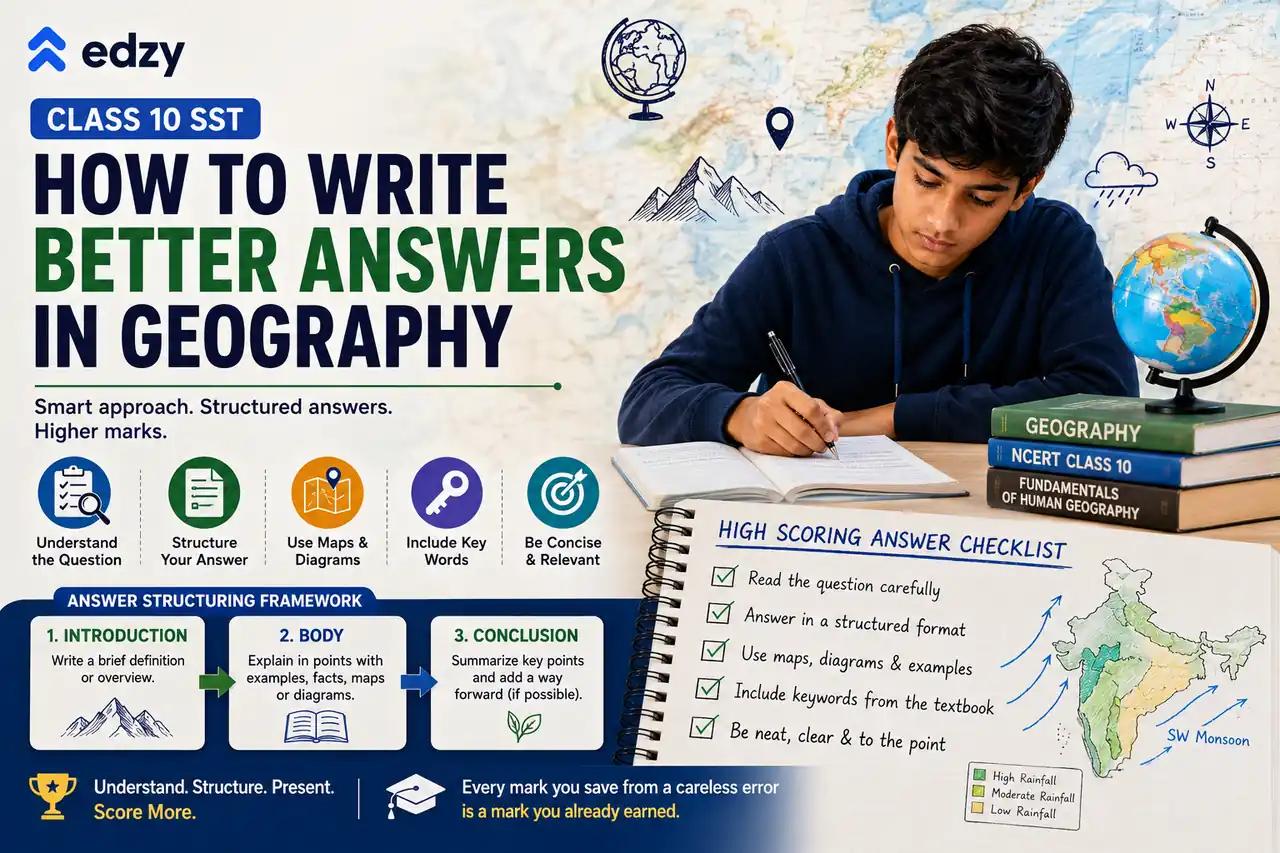
A well-structured answer is crucial for scoring high marks in Geography. The 'Geography Answer Framework' is a method that encourages students to organize their responses into clear sections: introduction, main body, and conclusion. For instance, if a student is asked to explain 'The Water Cycle', they should start with a brief introduction that defines the water cycle, followed by detailed explanations of each stage—evaporation, condensation, precipitation, and collection—before concluding with its importance in the ecosystem. Students can find more about this method in our article on smart study techniques.
Using headings and bullet points can also help in structuring answers, especially for longer responses. For example, when discussing 'Urbanization', students can break down their answers into sections like 'Definition', 'Causes', 'Effects', and 'Case Studies', making it easier for the examiner to follow their argument and ensuring that no critical points are missed.
Using Maps and Diagrams
In Geography, visual aids like maps and diagrams can significantly enhance the quality of answers. For instance, when answering a question about 'The Distribution of Natural Resources in India', students should include a map highlighting key resources such as coal, iron, and petroleum. This not only demonstrates their understanding of the topic but also provides a visual representation that can impress examiners.
Diagrams can also be beneficial in explaining processes. For example, a labeled diagram of the 'Water Cycle' can clarify the stages involved and show the interconnections between them. Students should practice drawing and labeling diagrams neatly, as this can often be the difference between a good answer and an excellent one.
Including Keywords Effectively
Using keywords effectively is essential in Geography answers. Keywords are terms that are central to the topic and can help in demonstrating a student's knowledge. For example, when discussing 'Climate Change', students should incorporate terms like 'greenhouse gases', 'global warming', and 'sustainable practices' throughout their answers. This not only shows familiarity with the subject but also aligns with the examiners' expectations for depth and specificity.
Moreover, students should ensure that they use these keywords in context. For instance, instead of merely stating that 'deforestation leads to climate change', they should explain how specific activities, such as logging and agriculture, contribute to increased carbon emissions. This level of detail can significantly enhance the quality of their answers.
Avoiding Unnecessary Writing
One common mistake students make is including unnecessary information that does not directly answer the question. This not only wastes time but can also confuse the examiner. For example, if a student is asked about 'The Impact of Urbanization on Rural Areas', they should focus on relevant points such as migration patterns and changes in land use, rather than providing a lengthy history of urbanization.
To avoid this, students should practice writing concise answers. A good strategy is to outline their answers before writing them out fully. This helps in identifying the key points that need to be addressed and ensures that the response remains focused. For instance, when preparing for questions on 'Globalization', students should outline the economic, cultural, and environmental impacts before expanding on each point in their answers. They can also refer to time management strategies to help streamline their study sessions.
Practicing Answer Writing
Regular practice is vital for improving answer writing skills in Geography. Students should set aside time each week to practice writing answers to previous years' board exam questions. For instance, a Class 10 student preparing for the Geography board exam should attempt to answer questions from the last five years, focusing on different chapters such as 'Agriculture' and 'Mineral Resources'.
Additionally, peer review can be an effective way to improve. Students can exchange answers with classmates and provide feedback on each other's work. This not only helps in identifying areas for improvement but also exposes students to different writing styles and perspectives. Engaging in discussions about the answers can further deepen understanding of the subject matter.
Improving Exam Performance
To enhance overall exam performance, students should focus on time management during the exam. Practicing under timed conditions can help students get accustomed to the pressure of the exam environment. For instance, when practicing answers, students should time themselves to ensure they can complete their responses within the allocated time for each question.
Moreover, students should familiarize themselves with the exam format, including case-based questions and assertion-reason questions, which are common in CBSE Geography exams. Understanding how to approach these question types can significantly boost confidence and performance. For example, when faced with an assertion-reason question about 'The Role of Forests in Climate Regulation', students should be prepared to analyze both statements critically and provide a reasoned conclusion.
Why Do CBSE Students Struggle with Writing Geography Answers?
Why do CBSE students struggle with writing Geography answers? Many students find it challenging to write effective Geography answers due to a lack of understanding of the question requirements, poor structuring of responses, and insufficient practice. This often results in vague answers that do not meet the examiner's expectations. By adopting a structured approach and practicing regularly, students can significantly improve their answer quality and exam performance.
Conclusion: The Geography Answer Framework
In summary, mastering the art of writing better answers in Geography requires a structured approach, understanding of the question, and effective use of visual aids. The 'Geography Answer Framework' can guide students in organizing their responses logically and clearly. By practicing regularly and focusing on key concepts, students can transform their Geography answers from average to exceptional, ensuring they score the marks they deserve.
Suggested blogs

How to Avoid Panic When You Don’t Know an Answer in the Exam
Mastering calmness to tackle exam challenges effectively.

How to Manage Time During a 3-Hour Exam
Mastering time management for a successful exam experience.

How to Check Your Answers Properly in Exams
Mastering the art of answer checking to secure every mark in CBSE exams.

How to Improve Your Speed in Solving Questions Before Exams
Mastering speed in question-solving is crucial for CBSE students aiming for high marks.